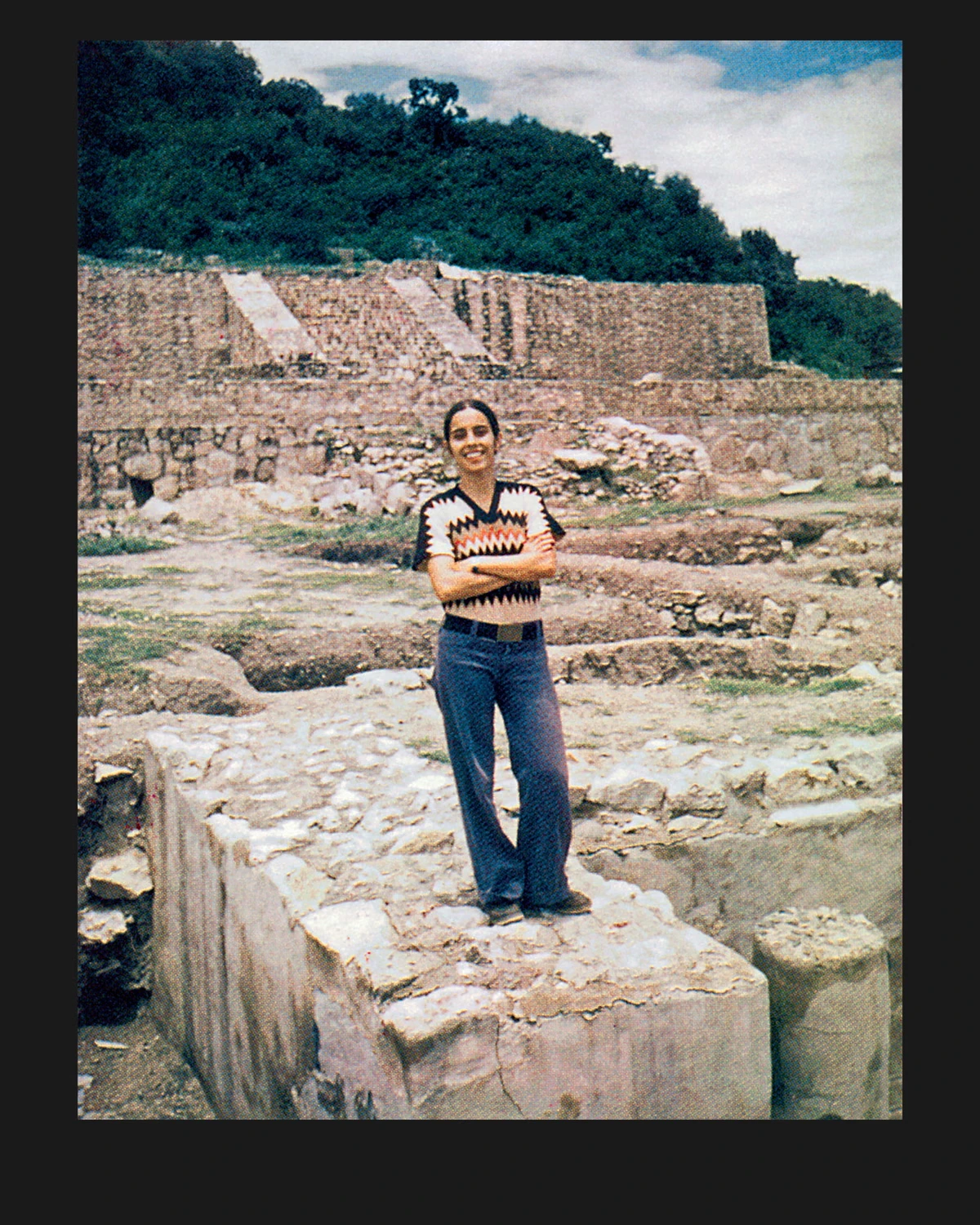
In the summer of 1985, Ana Mendieta was playing with gunpowder and a chainsaw. Just 5ft tall, the Cuban American artist worked outside her studio in Rome, trying to figure out the scale of a new commission for MacArthur Park, Los Angeles. Her idea was to cut up trees and burn the gunpowder directly into them, creating a totem “grove” inspired by her recent trips to neolithic sites. It was a breakthrough of sorts – permanent, monumental work that built on her performance art – and in a photograph of her standing next to a test piece, Mendieta looks proud, excited.
She had arrived in Italy two years earlier, after winning the prestigious Prix de Rome and a residency at its American Academy. She alienated half the staff, but fell in love with the city, driving like a local (right hand on the wheel, left middle finger out the window). Mendieta admired Roman women, mailing her friend, the film critic B Ruby Rich, a newspaper clipping of a pro-choice demonstration. “She said, ‘Look, they’re not like American women,’” remembers Rich. “‘They’re showing women butchered and dead from botched abortions. Look how much fiercer they are.’”
The sculptor Marsha Pels became Mendieta’s friend in Rome, though it wasn’t easy. “She wanted me to take her side in everything,” she tells me. Pels had befriended the academy’s gatekeeper, letting him use her studio as a hair salon. “Ana didn’t like him because he didn’t treat her like a royal highness one day. We fought, and I’d say, ‘If he’s cutting hair, then just don’t come in.’” But she could also be very generous. “When Ana was working with the trees, there was one I really liked, like a woman crossing her legs. I said, ‘Can I have that?’ and she said yes.”
In the evenings, Mendieta would mix a cocktail, or they’d walk down the hill to Trastevere. Earlier that year she had married the minimalist artist Carl Andre. He was 49 to her 36 and world famous – and when he visited from New York he would join them. Not Pels so much, who disliked him, but sometimes Mendieta’s friend Ida Panicelli, the curator of Italy’s National Gallery of Modern Art, or fellow academician Christian Haub.
Panicelli recalls “fantastic” rows about art. “They were always drinking a lot of wine. I used to think of Ana as a volcano – very energetic and fun, but with [Andre] often arguing.” With Haub, Mendieta loved to gossip. “There was lots of complaining about the neo-expressionists in New York,” he says.
When Rome emptied out in August, Pels and Mendieta visited the island of Ponza – a last hurrah before Pels returned to America and Mendieta moved to another flat in Rome. Before that, she would fly to New York and clear her apartment, so that Pels could stay there. On Ponza, climbing a donkey track with a sheer drop to the Mediterranean, Mendieta had a panic attack. “I turned to see Ana shaking and crying, ‘I’m an acrophobiac! I can’t!’” Acrophobia is an extreme fear of heights. “It took an hour to calm her down.”
Pels thought of it often over the coming weeks, and especially after waiting two hours with a removal van outside Mendieta’s Sixth Avenue apartment in New York on 9 September. When Mendieta failed to turn up, Pels left a note: “Where the hell are you?” The answer was on page three of the New York Times the next day: Sculptor Accused of Pushing Wife Out Window To Death. Mendieta had fallen 33 storeys from Andre’s apartment on Mercer Street.
In less than 20 years of making art, Mendieta worked extraordinarily fast. She moved from painting to performance to earth works and sculpture, burning through the possibilities of each while asking the same questions. What is our relationship with nature? Which archetypes resonate across time? Where does energy come from and where does it go? She was interested in the body, decay, Cuba and exile, having been airlifted from Havana to Miami aged 12 as part of Operation Peter Pan, a joint CIA-Catholic church initiative.
As a graduate at the University of Iowa, she filmed performance pieces that still feel startlingly contemporary. In Sweating Blood (1973), Body Tracks and Blood Writing (both 1974), Mendieta worked with buckets of cow’s blood, letting it drip over her eyes, or painting with her hands or forearms on to a wall: the outline of a tree; the words SHE GOT LOVE.
From 1973, Mendieta developed her Silueta series, often on field trips to Mexico, travelling with a plywood outline of her body strapped to her VW Beetle. To start with, she put herself into this work, covering her skin with flowers or feathers or mud. Later she burnt her silhouette into the ground or the sky, using gunpowder and fireworks. Her friend Joy Silverman, a gallery director, tells me she remembers Mendieta taking a roll of turf from her pickup truck after a picnic in a Washington DC cemetery. “She piled up the dirt and put the grass on it, so it would grow into a silueta.” These works decayed but many were recorded on Super 8 film.
There was more political art, such as Moffitt Building Piece and Rape Scene (both 1973). For Moffitt, Mendieta poured butcher’s waste under her front door and across the pavement, photographing the non-reactions of passersby. For Rape Scene, inspired by the murder of a fellow student, she left her door open and let people find her bloody and bound, half naked. Then they’d talk about it. It wasn’t a subject she returned to: when galleries requested the stills in the 1980s, she’d say she wasn’t doing that kind of work any more, though she stood by it.
By the time she moved to New York in 1978, Mendieta was getting noticed. Her friend Natalia Delgado, a lawyer, heard from a college professor about “this very interesting Cuban woman in Iowa” long before they met. By 1985 Mendieta was a rising star, which was what she and Andre argued about the night she died. In his 911 call he said, “My wife is an artist, and I’m an artist, and we had a quarrel about the fact that I was more, uh, exposed to the public than she was. And she went to the bedroom, and I went after her, and she went out the window.”
Andre, who died aged 88 in 2024, changed his account of what happened at least twice. He was in the room, then he wasn’t. They had both been drinking before she fell at 5.29am. But you won’t hear anything about that in Tate Modern’s upcoming exhibition, or from Mendieta’s estate, which is managed by her niece Raquel Cecilia Mendieta. After 40 years of having her art seen in the context of her death, they are firmly anti-biography. They find the books (Robert Katz’s 1990 pulpy but forensic Naked By the Window), the true-crime podcasts (Helen Molesworth’s 2022 Death of an Artist), even the protests against Andre’s exhibitions unhelpful, reducing Mendieta to a victim. A forthcoming Amazon TV dramatisation of Katz’s book, starring America Ferrara, is a new problem.
I spoke to 10 people close to Mendieta and they, too, were frustrated: none of them liked Molesworth’s podcast. But 41 years on, there was still outrage and anger towards Andre, his supporters and a trial they felt was a travesty. The window in Andre’s apartment was high – chest height for Mendieta – with no footprints on the sill. Evidence that she was planning to divorce him was ruled inadmissible in court. People who were friends with both wouldn’t talk to the police, or sided with Andre. The artist Frank Stella paid Andre’s $250,000 bail and the defence later portrayed Mendieta as a hot-headed Latina, whose art was evidence of suicidal tendencies. “It was explicitly racist,” Rich says. “Ana was a crazy Cuban drunk who flew out the window. It was completely nuts.”
But for Mendieta’s family, this just gets in the way. “Having to speak for Ana all the time,” says Raquel Cecilia, “it shocks me how much I have to say, ‘Why are you sensationalising her? Would you do that with Rothko [who died by suicide]?’ Ana took up space: [She’d say] ‘I’m not a ‘woman artist’, I’m an artist.’ She didn’t want these labels. But is it because she’s a woman?”
Everyone agrees on one thing: the late 70s and early 80s were an exhilarating time to be an artist in New York. Marsha Pels was a welder by day, a sculptor by night and a pal of Louise Bourgeois, taking the French artist dumpster-diving and to S&M shops (for materials, of course). Rent was cheap and grants were plentiful. B Ruby Rich wrote for the Village Voice and managed a $4m film fund for New York State. “There was lots of mixing,” says Haub. “Painters, sculptors, composers, dancers, poets, writers, critics, historians and musicians. In the 70s, collectors had not achieved their disproportionate influence. Everyone saw everything, in person.”
The abstract expressionists and minimalists, artists such as Stella, Donald Judd, Richard Serra, were making way for more conceptual, performance-based and feminist art. There was new interest in work from Latin America. One of the first people Mendieta looked up was the Argentine artist Liliana Porter, who recalls: “There were people coming to New York from different countries, and you felt there were so many artists better than yourself – you had to think and rethink the work. That was exciting.” Mendieta stayed in her Tribeca loft, borrowing a fur-lined raincoat.
Another person Mendieta called was the painter Dotty Attie, who suggested she apply to the all-female AIR gallery after meeting her in Iowa. “We had a dinner for a lot of people there, she showed me her work and I really liked it,” says Attie. Mendieta was accepted in 1978 and set to work, manning reception, painting ceilings, proposing shows. “We all did everything,” says Attie. “That was important.”
The artist Juan Sánchez met Mendieta at the opening of her first AIR show in November 1979: “The place was crowded and they all wanted to talk to Ana. But that evening [the painter] Leon Golub threw a party at his loft and I chatted with her on the couch.” They met again at a group show. “She looked at my paintings and said, ‘Oh, you’re working with Taino petroglyphs [prehistoric Caribbean carvings]? Me too.’ We hit it off.”
Sanchez’s parents were Puerto Rican and the two artists spoke fluent Spanglish. They would meet at Mendieta’s place: “It was a one-room apartment, half studio, half living space. She’d be playing Cuban music and show me what she was working on. At one point, it was her leaf drawings and figuring out what type of leaf was more resistant. She sealed some in acetate and my argument was, ‘It’s natural. If you preserve it, it’s like frozen food.’ But many of them still exist.” Mendieta’s friend Joy Silverman saved one when her house burned down in last year’s LA fires.
Sanchez was due to have lunch with Mendieta the day she died. “She never showed up … We went back to our friends’ apartment to see if she’d called.” Panicelli recalls that “the news was like an earthquake”. The trial would not take place for another two years, but in 1985 what her friends knew was this: on 7 September, Mendieta and Andre had dinner with another couple, then stayed up watching TV. Mendieta had recently learned that Andre had been unfaithful and was collecting evidence (phone bills, letters) for a divorce: she discussed this on a call with Natalia Delgado the same evening, and planned to confront him. When the police arrived, the bedroom was a mess. The window was high on the wall and there were no footprints on the sill. A doorman had heard a woman shouting, “No, no, no!” followed by a sound “like an explosion”.
The art world split. Stella paid Andre’s bail and the sculptor Claes Oldenberg loaned him a flat. Delgado was shocked by how many people looked the other way. “There were friends who didn’t want to get involved, because they perceived Carl as the more important artist. That was terrible.” Pels says Mendieta’s death made her a feminist: “I didn’t want to identify with feminism until I saw the art world stand up with this murderer.” After the police recorded scratches on Andre’s face, the artists who’d had dinner with him earlier said there had been none. The following day, they retracted.
Rich was at the Toronto film festival. “I came back to the news on my answer machine: ‘Can you believe it? Carl Andre threw his wife out the window.’” Was that Rich’s first thought too? “It’s not my thought, it’s my absolute conviction. There’s a lot of proof, but the art world boys gave him a lot of money, and they hired detectives on both sides of the Atlantic and suppressed a lot of evidence.” She had never liked Andre. “He was such a macho guy in his very quiet, ‘who, me?’ way. He slept with almost every quote unquote feminist in the art world, so a ton of them were on his side somehow.” A friend at MoMA told her the gallery got calls from Andre collectors soon after his arrest. “They called to ask, ‘Buy or sell?’ It’s all about the Benjamins, as the song goes.”
While Mendieta’s friends pushed for a trial, they found ways of keeping her work in the conversation. Panicelli recommended it for every exhibition panel she sat on. She and Raquel, Mendieta’s sister, packed up the studio in Rome. “Everything was ready for her move,” says Panicelli. “The only thing outside the boxes was my little watercolour.” She had painted it for the couple as a wedding present, Andre floating Buddha-like in the sky while his new wife threw stones.
A memorial gathering on Park Avenue was well attended and chaotic, testament to Mendieta’s gift for connecting with disparate groups – the Latinas, the feminists, the bigwigs, the students. “It was a pretty interesting crowd,” says Sanchez. “I knew who she didn’t like. Carl Andre was there and her family were very upset, but they decided to go ahead.” The artist Liliana Porter wasn’t able to go but also noted the new hangers-on: “Suddenly a lot of people who didn’t like Ana were her friends.”
Rich, the artist Nancy Spero and Raquel were the driving forces behind a powerful New Museum retrospective in November 1987, which closed a week before the trial. Rich published a furious essay in the Village Voice, calling out the venality of the art world. “Is this the first postfeminist murder case?” she wrote. “For many of the women who came of age with the minimalists, brotherhood is outweighing sisterhood.” Marsha Pels wrote to thank her, and when she later testified against Andre found that the threat of the minimalist brotherhood was real. “My dealer got a call to say, ‘Marsha is never going to show in New York again.’ And I didn’t, for 15 years.”
As a child, Mendieta led a privileged life in Cuba. Her great-uncle Carlos had been president and her father was a well-connected lawyer. The family lived between a townhouse in Havana and her grandmother’s beach house at Varadero, with a bell on the porch to call the children in from the sea. Her cousins remember Mendieta burying them in the sand, giving them big breasts to make them laugh, a kid’s version of her later work. Some of her best siluetas deliberately recalled this – imprints carved into a Florida beach in 1981, angled to let the tide from Cuba wash in and out.
After Castro’s revolution in 1959, the girls’ Catholic schools closed and Mendieta’s father was jailed for collaboration with the CIA. Ana and Raquel, then 12 and 15, were flown with thousands of other children to start a new life without their parents. Or, as Pels puts it, “They were somewhat wealthy and important, and then they were shipped off to Mudfuck, Iowa, and put in a nunnery.”
The girls moved between orphanages, reform school and foster homes. It was their first experience of racism. “Ana was dark,” says Porter. “Imagine Iowa, where everybody was blond. She always said, ‘I decided I was going to become an artist or a criminal.’” Mendieta’s niece, Raquel Cecilia, says: “They didn’t speak English. You’re going to have to learn quickly to be like the other girls, and she did. She was able to have boyfriends and go to dances, have all those teenage experiences.”
Delgado’s family had left Cuba around the same time, and the two women bonded over their split identities. “Our mothers tried to set us up with the children of people they knew in Cuba, and that never worked. My mother sent me a pink turtleneck and Ana said, ‘Your mother has not figured out that you’re an adult.’” On nights out, Mendieta clashed with cab drivers and waitresses who did not meet her standards. (Rich says she once called an art critic friend to yell after a lukewarm review.)
After the travel ban lifted in 1977, Mendieta became a founding member of the Circulo de Cultura Cubana, organising exchanges for artists and taking an American group in 1981. “She said that had been a mistake, because she got fed up with how they behaved,” says Rich. “Their entitlement – the hotel wasn’t nice enough, the food wasn’t good enough.”
Mendieta was full of plans for Cuba, starting with her carvings in the limestone Jaruco caves outside Havana – the Esculturas Rupestres (1980-85), inspired by petroglyphs. In footage of her 1981 trip, she is presented with an orchid by schoolchildren and looks ready to faint with joy. At 32, she also looks like one of them. “I think it’s why children loved her,” says Raquel Cecilia, who was taught art by her at Henry Sabin elementary school, Iowa City. “She was playful and small. She taught me to take care of my work: ‘Put that in a drawer, it’s important.’ And she loved children but she didn’t want to be a mother. She said that her children were my mother’s children.”
Mendieta worked best alone, which made Delgado’s trip to Rome in spring 1985 “a little stressful. Ana had got going on the tree trunks and was really into it. She said, ‘Figure out what you’re going to do during the day. I’m not going to entertain you.’” Mendieta handed her a book of Roman walks, a sandwich and packed her off. “One day she got mad because I wanted a dessert with fresh cream, and she said, ‘I wouldn’t, it’s not in the refrigerator.’ Well, I got so sick. She had to call around for a doctor and she was very unsympathetic. At the time I was pissed but in retrospect, it made me laugh. I was wasting her precious time.”
On the first day of his trial for second-degree murder, 29 January 1988, Andre asked for the jury to be dismissed. In New York state, it is the defendant’s right to be tried without a jury, and the joke went that he had gone minimalist even in this. He asked his friends to stay away, too, but Mendieta’s supporters packed the prosecution side of the supreme court room – among them her mother, sister, Rich, Sanchez, Panicelli, Pels and Delgado.
There was much that could not be used in court, chiefly Mendieta’s plan to divorce him, which was ruled hearsay. The defence found that the doorman who heard a scream had once suffered from auditory hallucinations, and milked it.
Panicelli had moved to New York only three months earlier to edit Artforum magazine, and on a snowy day testified to Mendieta’s significance as an artist. Andre’s lawyer “tried to make me a lousy witness, because my English wasn’t perfect. He would move to the back of the room, so I was forced to say, ‘Excuse me, can you repeat?’” Andre sat blank-faced, wearing overalls and scanning his newspapers – the Times Literary Supplement, the New York Times. “He carried his newspapers all the time,” says Panicelli, “even to their wedding.”
What shocked Mendieta’s friends was the ruthless way Andre’s lawyer, Jack Hoffinger, interpreted her art as the expression of a death wish. “He painted her as a woman doing voodoo things, who was a suicidal character,” says Panicelli. “I felt even if [Andre] didn’t kill her, he killed her during the trial.” Hoffinger argued that a woman who blew things up and buried herself was dangerous and out of control. “This was a woman who didn’t believe the traffic lights when it was her turn to cross,” says Sanchez. “Even if it was one direction, she looked both sides. She was very disciplined, a vegetarian who ran every morning.”
As well as the lack of people prepared to say that the relationship was combustible, sometimes physically, Rich thinks the clinching evidence was a neighbour who testified that he had heard nothing. “He was a surprise witness,” Rich says, added by the defence. When the prosecution went to counter-examine him, “he had mysteriously flown back to Hong Kong.”
The judge gave his verdict on 11 February 1988: “The evidence has not satisfied me beyond a reasonable doubt that the defendant is guilty.” Panicelli was in a meeting when she got a call from the district attorney, Elizabeth Lederer. “She said, ‘I don’t want you to know from the papers tomorrow. I want to tell you that we lost.’ She was almost in tears, and she said, ‘I wish I had known Ana. She must have been a fantastic person.’”
The lawyer in Delgado thinks the case could have been better prosecuted but understands why Hoffinger was cynical in his defence. “That she had suicidal tendencies, and her art was about smashing into the earth. That’s bullshit. But you want to get your client off, so you throw a lot of things at the wall and hope that something will stick.” What else did Andre have? “All I wanted was revenge,” Delgado says, “but he paid a heavy price. He was really tarred by it, and appropriately so.” Andre continued to exhibit but became a more isolated figure.
The important thing was that the family inherited Mendieta’s work, which might legally have gone to her husband. “A lawyer friend talked to [Andre] and convinced him that it would look good – and be consistent with his approach that Ana committed suicide – if he gave the art as condolence,” says Delgado. “The reason that was so important is I knew the argument that night was about who was a better artist. She kept saying, ‘Look, I have a trajectory and I’m significantly younger.’ He was furious with her for various things. But one of the things he wanted to accomplish is … he wanted to cut off her opportunity to be known as an artist.”
In 1992, Mendieta’s friend Joy Silverman staged a protest at Guggenheim Soho, a new gallery showing Andre’s work. She made T-shirts with Mendieta’s face on them and led a funeral march with the Women’s Action Coalition. “One of the artists made a banner: ‘Carl Andre is at the Guggenheim, Donde esta Ana Mendieta?’ Then I threw on a nice jacket and Raquel [Mendieta] walked in with me. We tossed Ana’s photo all over his artwork, and the guards thought it was a performance.” In 2017 Silverman protested again at an Andre retrospective in LA (“I wanted Ana to have a presence”), and others have led dozens of actions: “cry-ins” at a Berlin gallery, blood spills in New York, a 2016 march on Tate Modern (“Oi, Tate, we’ve got a vendetta / Where the fuck is Ana Mendieta?” went the chant).
It’s a moot point whether her work, or that of her generation, ever faded from view. For Marsha Pels, there was a definite late-1980s backlash. “Feminism was just another ism that had to be stepped on. It’s the stupid way that art trends work: ‘They got their due, let’s forget about them for a while.’” She remembers doing an event with an influential critic in the 00s, and when she came into the room they said, “Marsha Pels! You look good, I thought you were dead.” Later the critic got ill and Pels was tempted to say, “Hey! You look bad, I thought you were dead … I didn’t, but Ana would have,” she says.
If there was a moment for Mendieta protests, her niece Raquel Cecilia thinks it has passed. “How is she overlooked if she’s in all these art history books and museum shows? She never was forgotten. People love to do that, right? To take an icon to become their voice.” Mendieta only cared about the art, she says. “She said feminism was a white women’s movement, she rejected the idea of borders, of the ‘white cube’ gallery. She wanted her work to be received in an open way.” That said, she would have been thrilled at sharing Tate Modern with a Frida Kahlo exhibition this summer. “She’d have been bragging. Kahlo was one of the few artists she really admired, and she went to her house [in Mexico City] whenever she could.”
At an AIR gallery party in 1979 (“Dress as your favourite artist”), Mendieta came as Kahlo, complete with monobrow. Louise Bourgeois came as herself. Pels was meant to be there, but Bourgeois had given her invitation to someone else. What is striking about Mendieta’s contemporaries, now in their 70s and 80s, is how many are still hard at work. Sitting in her Brooklyn loft, Pels shows me her hands, which after six operations resemble the claws of Bourgeois’ later years: “Louise had these bumps.”
What would Mendieta, who would have been 77 this summer, be doing now? “The early work is so brilliant,” says Pels, “but it laid the groundwork, pun intended, for everything else. She’d be making monumental art, applying for [commissions in] cities.” She was just getting started, say Rich and Haub, and people underestimated her ambition. She planned to revisit early pieces, Raquel Cecilia says. “She wanted to make all the images lifesize, much bigger.”
In 2014, Raquel Cecilia started to digitally restore Mendieta’s Super 8 films. Her aunt leapt from the screen – in colour, in black and white – the technology revealing new layers of detail, the beauty and solitary effort of the work. A new print of one of them, Bird Run (1974), will be shown for the first time at Tate Modern. Mendieta appears at the end of a beach in Mexico, her body covered in white feathers, and begins to sprint towards the camera, a dot becoming a bird becoming a blur.