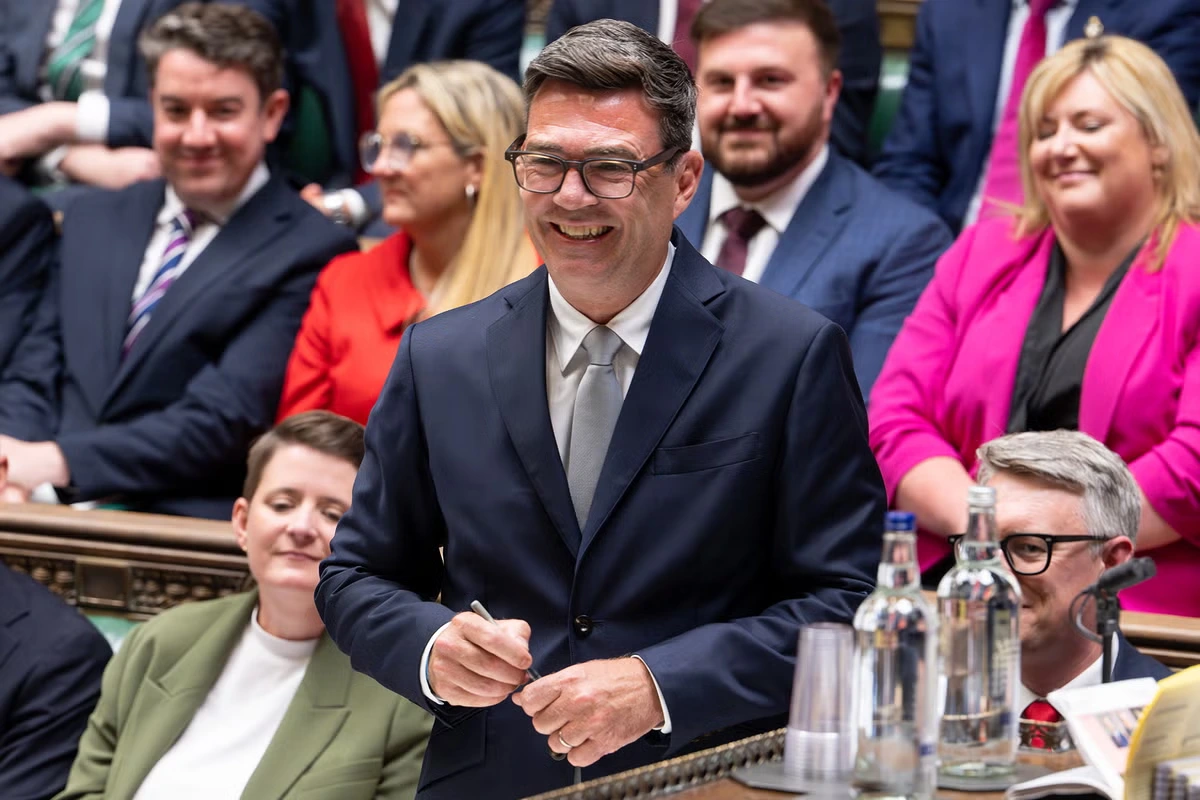
Andy Burnham, a figure often considered a future prime ministerial candidate, was sworn in on a Bible as the new Labour MP for Makerfield, making his first appearance in the House of Commons since his by-election win last week.
This follows his previous description of himself as "not particularly religious", though he has also asserted that "Catholic social teaching underpins my politics".
The religious affiliations of British prime ministers have historically been predominantly Anglican.
While Boris Johnson was baptised a Catholic, he was confirmed as an Anglican as a teenager, and Sir Tony Blair’s conversion to Catholicism did not occur until after he had left Number 10.
Rishi Sunak became the first British Asian prime minister, describing himself as a devout Hindu, while Benjamin Disraeli – who held office in the 1800s – was the first and so far only Jewish premier.
Taking the oath on Monday, he said: “I swear by almighty God that I will be faithful and bear true allegiance to His Majesty King Charles, his heirs and successors, according to law. So help me God.”
In an interview just over a decade ago, he described himself as “Catholic by upbringing, but I’m not particularly religious now”.
He told the Huffington Post in 2015 that his children went to a Catholic school and that he believed “in the values and the grounding it gives you, I’m a very big believer in that”.
He said: “Catholic social teaching underpins my politics, we did have to read the catechism at school, but it is powerful and strong and right.”
In that same interview, he said while the Church he grew up in was “quite forgiving really, quite humane, humorous, irreverent”, it had in later years seemed to “click into a more judgmental mode and became much more obsessed with sexuality and issues related to sexual behaviour”.
It was then under the late Pope Benedict that Mr Burnham said he “drifted more and more away”.
He referred to the then-pontiff’s talk of wanting “a ‘smaller, purer’ church, which I found quite terrifying actually”.
Mr Burnham spoke in the same interview of his “high hopes” for Benedict’s successor Pope Francis, who he subsequently met while Greater Manchester mayor in 2023.
He visited the Vatican with a delegation from Greater Manchester to discuss the mission of tackling climate change, presented Francis with a Manchester United jersey and later branded the experience “profoundly moving”.
After Pope Francis’ death last year, Mr Burnham said it had “hit me harder than I expected”, describing him as “the most relevant and relatable Pope of my life”.
The Catholic Church has been staunch in its opposition to assisted dying, but it is something Mr Burnham has suggested he would vote for in principle.
In 2024, just before the first Commons vote on the Terminally Ill Adults (End of Life) Bill, Mr Burnham told BBC Manchester he would “probably vote in favour of it”.
When he was previously an MP he abstained from a 2015 vote on another Bill to legalise assisted dying because of concerns over safeguards and people feeling under pressure.
But he said he had “family experience in the nine years since that has changed my view”.
He said: “I think we do allow people to suffer and families to suffer too much.”
He caveated his support as being for the principle of assisted dying and insisted he would want a requirement before any new law was implemented that hospices would be “properly funded and sorted out”.
Archbishop John Sherrington, lead bishop for life issues for the Catholic Bishops’ Conference of England and Wales, said last week he was “deeply disappointed” by the return of assisted dying in the form of a “flawed Bill”.
He said: “Reintroducing this legislation, once again, places the most vulnerable at risk. I ask MPs to reject this Bill.”
The Bill, sponsored by Labour MP Lauren Edwards – who has taken the baton from her party colleague Kim Leadbeater – is back for debate in the Commons on September 11.