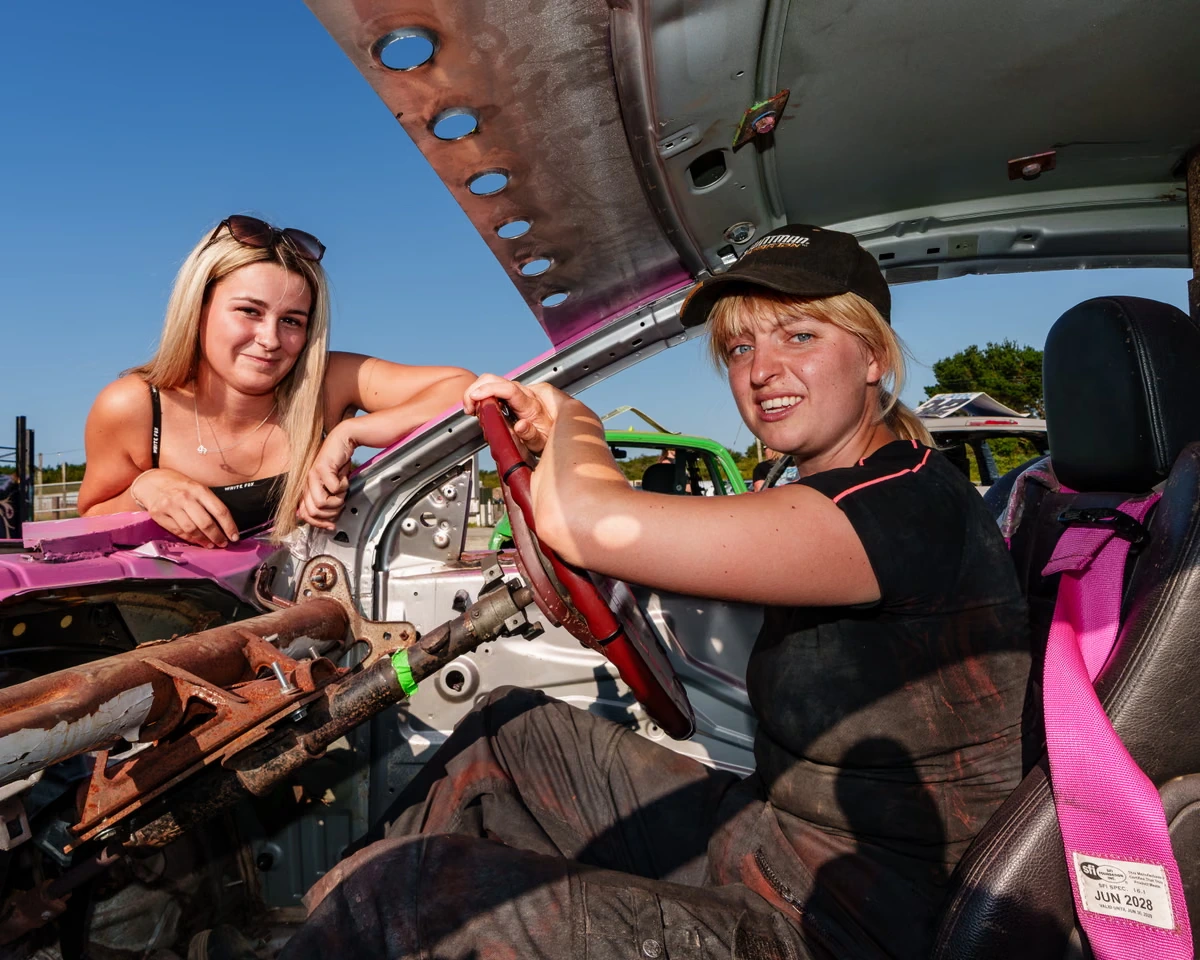
Lexi Crosbie was five days old when she went to her first ever banger race. “I grew up around the track,” the 14-year-old says. At nine, her racer dad gave her a chance at the Micro F2s, the junior league, and Crosbie has been racing ever since. “You’re so filled with adrenaline,” she says of the motorsport. “It’s the best feeling ever.”
This month, Crosbie went to her local Cornish track, United Downs Raceway (also known as St Day), for a different kind of event. The Kneebone Cadillac, Carl Grose’s raucous play about a banger racer and her family, is set and performed on the track. For Crosbie, it was her first ever theatre show. “I really enjoyed it,” she says. “My whole family did.” Director Kyla Goodey has loved seeing how many racers have come along, when theatre isn’t part of their regular lives. “It’s been a bridging of worlds,” she says. “That’s exactly what we wanted.”
Banger racing is about speed and damage. Regular cars are gutted, stripped and fitted with safety equipment for “nudge and spin” races, where contact is limited but still impressive. In a collision, the car crumples but the driver is safe. “The crowd are there for the crashes,” acknowledges Leeta Rawling-Aldridge, 27, a local care-home worker. She has raced for the last five years with her brother at St Day, where their dad has driven for three decades. “I’ve never been nervous,” she says. In recent months she has fractured her shoulder and sprained her ankle, but “I’m just focused on getting back out there”.
Built on an old tin mine and having survived threats of redevelopment, St Day is the centre of the lives of banger racers across Cornwall, particularly since so many other tracks have shut down. “You turn up to a meeting and it’s like you’ve got a whole family there,” says Crosbie. Grose, who grew up savouring St Day’s screaming tires on bank holidays, wanted to capture this community. Beginning life as a radio play in 2011, The Kneebone Cadillac was commissioned for Plymouth Theatre Royal, where it was staged in 2018.
Grose’s high-octane comedy follows determined young racer Maddy Kneebone on a bumpy journey involving her scrapyard-owning dad’s death, the inheritance of a precious Cadillac and a secret stash of gold. “You just do not stop laughing,” says one of the race track’s co-promotors, Crispen Rosevear. In 2024, he cleared its schedule so Wildworks, Goodey’s company, could put on the show. Two years on, The Kneebone Cadillac is back.
This isn’t a moneymaker for the track. “I do it out of my love for the play,” Rosevear says. He lovingly describes United Downs as “the rough end of racing” because “that means it’s accessible to all”. The world of racing seems to work on this ethos of generosity: “If anything goes wrong,” says Crosbie, “you’ve always got someone there to help you fix it.”
While the racers are getting a glimpse into theatre, the theatre-makers are falling for the sport. “It blows your mind,” says Goodey. “Everything’s a risk assessment in theatre, and here I watched a 10-car pile up, and a young woman walked right out of the middle of it.”
Though racing is still heavily male-dominated, the picture is changing. “When I started,” says Crosbie, “most of the girls were very doubted, like they were out there to get in the way. But we’re all trying to prove them wrong.” Caitlin Emery, whose parents and grandparents also raced, has been doing it for five years and has won several championships. “I still get nervous,” says the 19-year-old, “from the unknown of what’s going to go down. But it’s the buzz. When you’re in the car, you forget about everything.” Racing against both men and women, she has dipped her toe into national banger races, a more extreme category in which aggressive contact is allowed. “It’s a lot scarier,” she says. “A lot harder hitting.”
All the drivers agree about the addictive nature of racing. “If banger racing grabs you, you’re hooked,” Rosevear says. “It becomes a way of life.” Kerry Birch is in her second year of racing, after meeting her partner, a racer of 23 years whose father’s ashes are scattered at the St Day track. “He got me in a car and that was that,” she says. “It just looked fun, as crazy as it is. Once I’m on that track, I’m in my own little world.” She is a mum to four girls, including a seven-year-old who worries Birch will get injured but is also eager to have a go in the Micro F2s. “We’re just trying to get the funds so she can get out there,” Birch says.
Like theatre, racing is an expensive sport. Even at the top of the game, drivers will spend far more than they can win. “It’s the rush,” Rosevear reasons. “You can’t buy excitement like that.” Goodey was firm that the show shouldn’t exclude those it speaks about and to. With tickets starting at £1, the radical pricing echoes the generous principle that surrounds the track: if you’ve got a spare part, you give it; if someone needs help, you step up. With puppets and songs and the setting of the sun behind the track, The Kneebone Cadillac works to reflect back some of this magic of the track. “I hope the show captures the spirit of going to the Raceway,” Grose says. “Chaotic and thrilling and a little bit dangerous.”
-
The Kneebone Cadillac is at United Downs Raceway, St Day, Cornwall, until 29 July.