Last time you travelled on the London Underground, here’s guessing you didn’t stop to think about how you were sitting on art history. Yet tube fabrics have a fascinating place in the development of British design. And now the woman at the centre of their story is the subject of an exhibition that aims to weave her back into the narrative, after a long period when her contribution was overlooked.
Enid Marx’s designs for what was then the London Passenger Transport Board were discontinued in the 1960s, but the groundbreaking work she did in the 1930s would change the ambience of tube train interiors for ever. Until she was commissioned to create a series of new patterns, the mood board for tube carriages could be summed up in one word: dreary. They were created in-house by the factories that produced the fabric – moquette, a durable form of carpet-like velvet used to this day – and were made in a colour palette of browns and greys to blend in with the muck and sweat left behind by London commuters.
Marx, who was taken on in 1937 alongside Paul Nash and Marion Dorn to create proper designs for the first time, ran with a different idea. Why not, she wondered, make the seats bright, exciting and cheerful so that instead of blending in with the dirt, they disguised it? That idea has been the guiding principle of London Transport ever since, and visitors to The Pattern of Life: Enid Marx and Modern British Design at Compton Verney in Warwickshire, opening on Saturday, will see samples of Marx’s very first designs in that vein, including the bright red and green geometric pattern – eye-shaped ovals that interconnect, interspersed with elongated diamonds of red and green – that would become her best-known tube fabric.
She named the pattern Shield, since it was inspired by African designs Marx had seen at the British Museum. She spent hours there, and also at the V&A, where she was especially interested in Indian woodblocks and their history. “She was influenced by cubism and purism – but more than anything, her work was shaped by the ethnographic displays she saw in the London museums,” says Az Crawford, the show’s curator. “And though it’s sometimes said she appropriated these designs, she came from a time when empire and nationalism influenced everything else. Her designs show how pattern is political and cultural.”
Marx’s work also denotes a watershed, says Crawford, between the Arts and Crafts and modern British eras. “She often referred to ‘washed-out William Morris stuff’, and she was determined to update the tenor and style of British design. There’s so much richness to her patterns. She was dismissed as decorative but in fact she is taking abstraction very seriously, and embedding messages about African art, colonial influences, and the way one art form takes from another.”
One intriguing element of Marx’s work, agrees Crawford, is the contradiction between the rigidity of the work she created – she often took factories to task for failing to work to her exacting standards in reproducing her designs – and the non-conformity that underpinned her lived experience. Marx’s life partner was the historian Margaret Lambert, and the two were part of what Crawford calls “a sapphic community”, many of whom, like Marx, were designers and makers. Marx went by the name Marco, and she sported her own-design bow ties – the Compton Verney show will include examples, including some of her lively, brightly coloured Spreyton spot ties, named after the Devon village where Lambert grew up.
“They were a couple, at a time when male homosexuality was still criminalised,” Crawford says. “They lived against the grain – but they were both from privileged backgrounds, and their same sex partnership could be seen as a modish style of social privilege than a radical statement.” Marx’s whole persona, Crawford adds, was shot through with paradox: she resisted being categorised throughout her life. “She didn’t see herself as a feminist. In some ways she was breaking the mould, but in her views she was often conservative with a small ‘c’.” She’s often said to have been a distant cousin of Karl but “it’s a loose connection - Enid may have wanted to disconnect herself from his history”. For Crawford, Marx’s relationship to pattern links to the constraints she had to live with. “There’s a visceral quality to her conservatism. She was able to live freely, but there was always a sense of restraint that I think comes from her gender, and from class expectations for women.”
Born in London in 1902, the youngest of three children in a middle-class Jewish family, Enid Crystal Dorothy Marx was educated at the prestigious Roedean school in Sussex before studying at the Royal College of Art, where Nash was her tutor, and her contemporaries included Barbara Hepworth and Eric Ravilious.
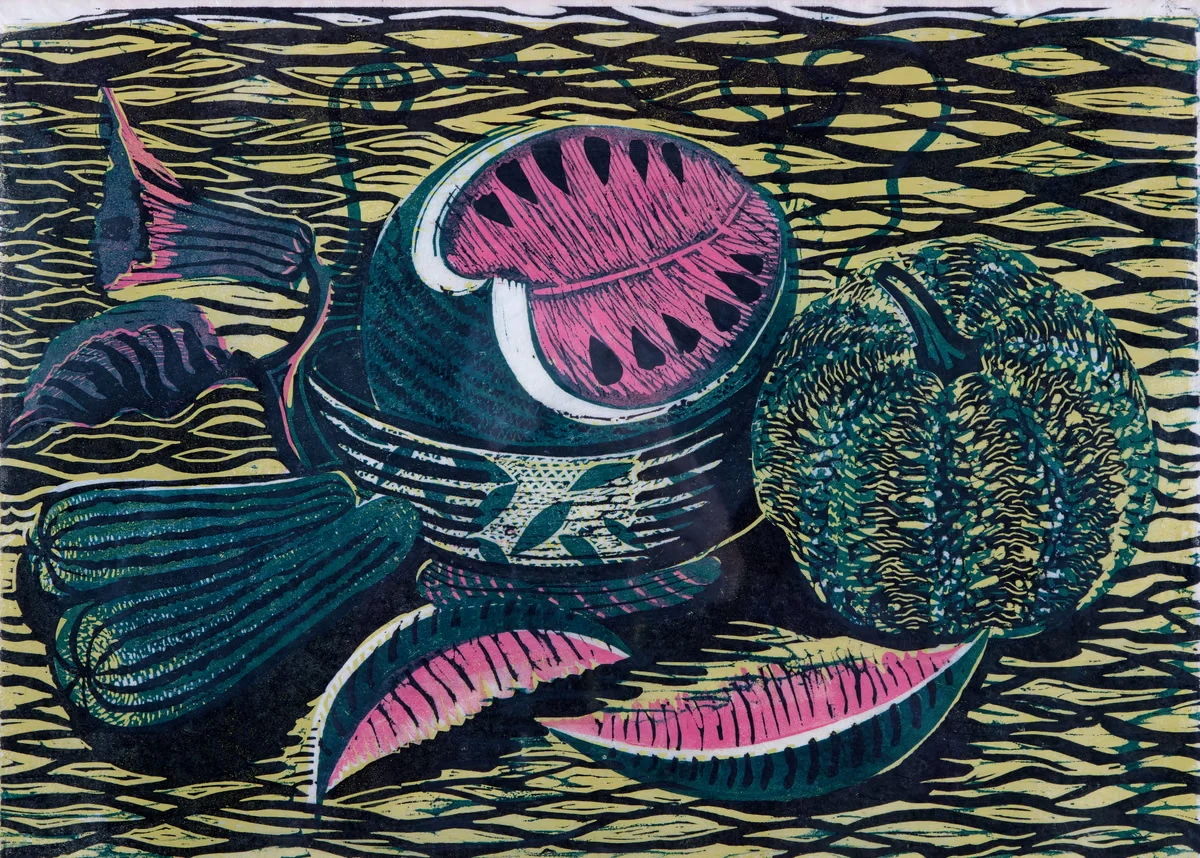
Her father was an entrepreneur who specialised in paper making, and this inspired her lifelong interest in what she called “popular art”. But this was deemed vulgar at the RCA, where she failed her final assessment. Popular art, though, would be the backbone of her life’s work: after training in the workshop of influential textile artists Phyllis Barron and Dorothy Larcher, she went on to design her own block-printed textiles – examples of which will be in the Compton Verney show – but then pivoted to industrial design when she was commissioned for the London Transport patterns.
During the second world war she became one of the designers for the utility scheme, aimed at producing good-quality, low-cost materials for furnishing the homes of bombed-out families. The key was small repeats, which cuts down on waste when making curtains and covering furniture: one of her utility fabrics, Chevron – a zigzag pattern in brown and blue – is among the exhibits at Compton Verney.
In 1944, in recognition of her outstanding contribution to design, Marx became only the third women to be awarded Royal Designer for Industry; but the war years would turn out to be her high point. Disappointments followed: only one of her designs was included in the 1951 Festival of Britain, and while she was commissioned to work on the postage stamps for the new queen in 1952, and though her framing of Elizabeth’s photo was deemed a success, many later stamp designs were rejected – including one nixed by the sovereign herself who didn’t like Marx’s positioning of the regal head in an oak tree, feeling it might evoke unfortunate memories of her ancestor Charles II who hid in the Royal oak.
Her later work included designing book covers for publishers, and creating the wood-block picture book published in 1985 as An ABC of Birds and Beasts, later republished in 2000 as Marco’s Animal Alphabet. By then Marx had been dead for two years, having survived Lambert for three.
But Marx’s love of popular art was not restricted to her own creations: she and Lambert, whose partnership lasted more than 60 years, were avid collectors of mass-produced artwork, which they bequeathed to Compton Verney. The show there will be peppered with the pair’s corn dollies; ceramics including Wedgwood pieces, dogs, and a figure of St George; a plaster model of a gingerbread cat (they always had a pair of Siameses) and other myriad curiosities.
“It’s an eclectic mix of pieces,” says Oli McCall, senior curator at Compton Verney. “But it was a lifelong passion for Marx, and you clearly see how the collection influenced her work. She believed there was a space for popular art that was mass produced, that it wasn’t only one-off pieces that constituted ‘art’.” Among the 165 or so works in the show are pieces borrowed from the V&A, to which Marx left her archive – some of them, says McCall, haven’t been seen as they’ve been in storage. “She’s been overlooked – forgotten – and this show seeks to explore her life and work with an in-depth examination of the influences on her,” he says.