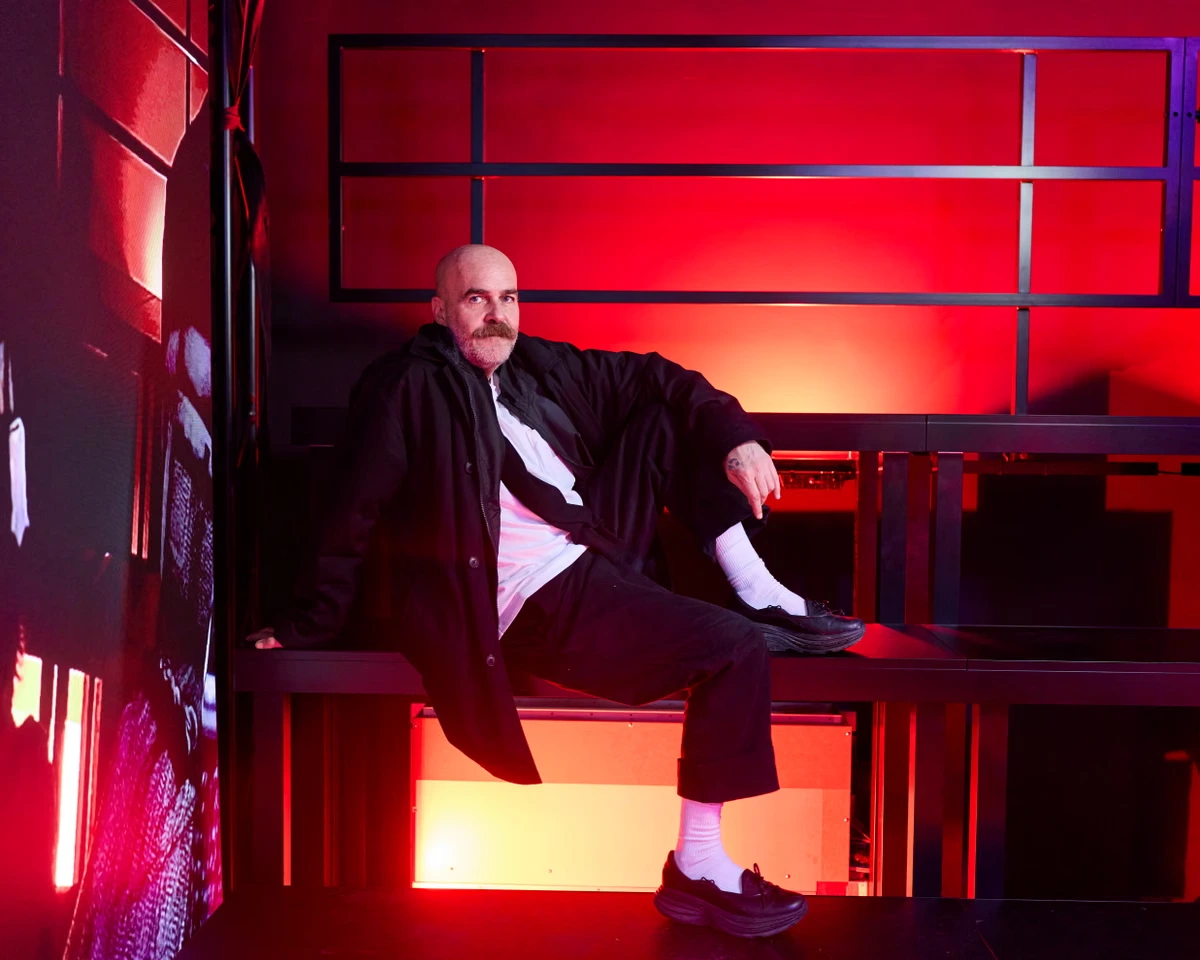
‘Do you mind if I’m smoking while we’re talking?” enquires Andreas Angelidakis as we both recline on a bean bag in the form of a fallen classical column. “Do you mind if it’s narcotics? If it’s cannabis?” He extracts an elegantly constructed spliff wrapped in pink cigarette paper from his black Nike windcheater and lights it up. “It’s my medicine for anxiety,” he says, before reconsidering. “No, I’m just addicted.”
The artist likes to see the world in a slightly altered state – which you can tell as soon as you set foot in the Escape Room, the name of his installation in the Greek pavilion at this year’s Venice Biennale. The pavilion, which was designed by M Papandreou and inaugurated in 1934, the year that Hitler met Mussolini here, has been furnished with a light-up dancefloor, Frankie Goes to Hollywood’s Relax is pumping from the sound system and wilted classical columns hang from the ceiling or are arranged as seating on the floor.
The columns at once refer to Guernica, Picasso’s protest against the 1937 bombing of the Spanish city by the Nazis and Italian fascists; the migration crisis, which Angelidakis says is a contemporary Guernica; and the artist’s sexuality – since, he says, they nod to the soft furnishings once known as pouffes. His penchant for getting stoned gets in there, too: his pavilion was officially opened at 4.20pm – a mischievous reference perhaps lost on the dignitaries who conducted the ceremony. Straight afterwards, there was an afternoon rave, or “tea dance”, with the Greek DJs from Power Dance Club, currently Berlin’s hottest queer night.
By the pavilion’s dancefloor there’s an LED screen broadcasting hall of mirrors-style images of its visitors, which Angelidakis says is a nod to Plato’s cave, the philosopher’s fable of people who thought images created by an external mechanism were reality; a souvenir shop with giant books and T-shirts, including some commemorating the LGBTQ+ activist Zak Kostopoulos, who was beaten to death by civilians and police in Athens in 2018; riot shields protecting two neon eggs representing “the fascism that hatched in 1934”; and inflatables hanging from the walls, emblazoned with deconstructed versions of the Maga slogan. One says Make Erika Eat Again, a reference to Charlie Kirk’s widow Erika. “She’s a wild phenomenon,” Angelidakis says. “They tell her to be sad and she comes on dressed like Janet Jackson doing Rhythm Nation, with a black cap, almost doing the Elon Musk salute.”
The artist’s “endless and complicated” references are taken from all over the place: from TikTok trends to ancient history, all somehow shedding light on our current predicament as the far right attempt to seize global control. At the curator George Bekirakis’s instigation, there’s also a space dedicated to Vaso Katraki, an artist who was the only Greek person ever awarded anything for visual art at Venice, for her etchings in 1966, and was flung in prison for being a communist the following year.
The idea is to give the pavilion itself a voice: “If it could talk, this is what it would say,” Angelidakis says. The building’s history is a loaded one, he adds. It was opened at a time when Greece and Austria were seeking to join the axis of fascist power with Italy and Germany, while its Byzantine-style facade also speaks to the then Greek government’s architectural preferences.
“You know, let’s make Istanbul Constantinople again,” Angelidakis says – in other words, turn the clock back to a time before the Ottoman empire took over. “That has been the slogan for centuries – even though Byzantium was the Roman empire and we were made captive by it. I’m addressing some of those aspects of Greek delusion, in a way.” He takes a drag on his reefer and confides: “You know, I’m against national pavilions. That’s why I’m turning it into an escape room.”
Angelidakis tells me the history of escape rooms, an immersive game in which one is locked in a chamber and has to work out how to get out. “They happened first as internet games online in 2003 or 2004. But then in 2007 the Japanese decided to build one in Tokyo. Which is a bit like the January 6 moment, where the internet spills out into reality. That, for me, is the interest of the escape room. I would never go to one because there’s too much reality in my mind – I don’t need extra.”
And it might be a bit scary doing it stoned as well? “I don’t mind scary,” says the artist. “My tattoo here is very clear about the way I approach things.” He shows me two dice tattooed on his hand, along with a bottle of pills. “Just throw the dice and see what happens. Or tap and twist the cap for the pills.”
Angelidakis is 58, but likes to say that he is 60 because “it sounds more cunt. Like, bitch, I’m 60. I don’t care!” He was born in 1968 in Athens to a Greek father and a Norwegian mother, and says that he “grew up on Smash Hits”, the British pop magazine – hence his admiration for 80s UK bands. “I was on vacation one summer and this Welsh girl who was teaching English to my cousins introduced me to Soft Cell,” he says. “Before that I was listening to Raffaella Carrà and Donna Summer and the shift was incredible. And Relax was a super big hit on the Greek islands. [British people] came to Greece to drink a lot of alcohol and dance to Relax, but it’s a song about sex in the Aids moment.”
His mother dreamed that he would become a civil engineer like his father, so he started studying architecture at the Greek polytechnic school before dropping out: by then he was absorbed by the writings of Zaha Hadid and Rem Koolhaas, whereas his tutors “were teaching us how to design buildings but not why”. Motivated partly by “a crush on a guy in California”, he went to the Southern California Institute of Architecture (SCI-Arc) in 1989, and immediately found himself in the midst of the Los Angeles art scene. “The first event I saw was Mike Kelly performing a puppet show of a gallerist arguing with a collector, super contrary. And then I met Cathy Opie, Lari Pittman, Dennis Cooper. It was a great, great moment.”
He graduated top of the class, but his mum insisted that he should get a master’s, so he went to New York to study at Columbia University. “It was the first university to introduce computers in architecture in 1994, the first paperless studio. And then I happened to be in the first ever digital studio of Keller Easterling”, the architect and professor “who has since written Extrastatecraft and all these books about urbanism that are super fascinating”.
After he graduated, the eminent Swiss curator Adelina von Fürstenberg commissioned his first building – called Pavilion – in 1996. Another formative influence was fellow Greek artist Miltos Manetas. Together, the pair started to explore the digital realm.
“I got my first email in 94, and by the end of my degree I was doing computer animation and uploading things,” Angelidakis says. “Architecture education gives you more tools than you would need for any other profession – you need to know everything from the psychology of space to the construction of wooden beams. SCI-Arc was really an art school. And then with computers added to that, suddenly I had a lot of power. Miltos introduced me to online communities and he had gotten his first Mac. We became roommates.”
“I was approaching computers not as a thing to do things with, but a tool that made me think differently about the world,” Angelidakis continues. “So when I would see my fellow students playing online games marathons, I was like, ‘Oh my God, computers in different rooms talking to each other!’ So I made buildings in different sites talking to each other. I like when technology becomes popular – it has actual meaning. So I’m always looking for those technologies that go viral.”
He straddled the worlds of art and architecture – when I ask if he ever built anything he says “my house” – but in 2010, a combination of major life events forced him to change course. First, his father died of cancer; his business had gone bankrupt in 1999, and the rest of the family had bought his house, meaning that Angelikadis had to move his mother out of it after his death. Then Angelidakis was diagnosed with HIV. “Death, bankruptcy and HIV all in three months was too much,” he says. “I really collapsed, and I think that’s what forced me to become an artist and stop feeling obliged to call myself an architect. And then two years later, my mum committed suicide, but that was due to her mental illness. So I’ve had to do a reset quite late in life, let’s say. Plus divorce after 22 years,” he adds.
He was married to the artist Angelo Plessas, but they split in 2021. “We’re still friends, we share a house and our dogs love each other,” he says. He has had exhibitions and participated in biennales around the world, the Greek pavilion being a career high. Although it’s a different kind of high that Angelidakis seems more preoccupied with as a succession of well-wishers come to shake his hand.
“What was I saying?” he asks me, fishing out another spliff. “Do you remember? You want one?”
No, I’m good, thank you.
“Why not?” Angelidakis asks. “Try it.”
He lights up again, and talks about the protests against the participation of Russia and Israel at the biennale. “I think national pavilions continue the original purpose of the biennale, which was foreign policy in the late 1800s,” he says. “And I’m afraid that when we protest political things in the biennale, we’re not addressing the system that generates the problem. So that’s why I’m changing the function of the pavilion. It’s no longer national, it’s an escape room. But of course, it’s a game, all of this. Science fiction and technology are my passions.”
And RuPaul’s Drag Race, I ask, thinking about how ballroom lingo permeates his work. Yes, the artist replies, “for the way it’s changing contemporary culture. RuPaul is like Malcolm X for gay kids. Because a child growing up today can see drag queens talking about their boyfriends and the problems of being masculine and feminine. That did not exist for my generation.”
Angelidakis says that even his biggest and most elaborate projects are very personal. “I’ve made projects that appear funny to people, but they were about my mother’s suicide,” he says, citing a 2013 video he made called Troll, which imagines an Athens housing block falling into ruin, becoming overrun by plants and then deciding to leave the city to become a mountain. “Troll is a Norweigian object, and it’s a building that goes and kills itself. So my work is in fact, very dark. It has to have a bit of Frankie Goes to Hollywood to get people dancing. Otherwise, you’d just get depressed.”
The Venice Biennale is open until 22 November