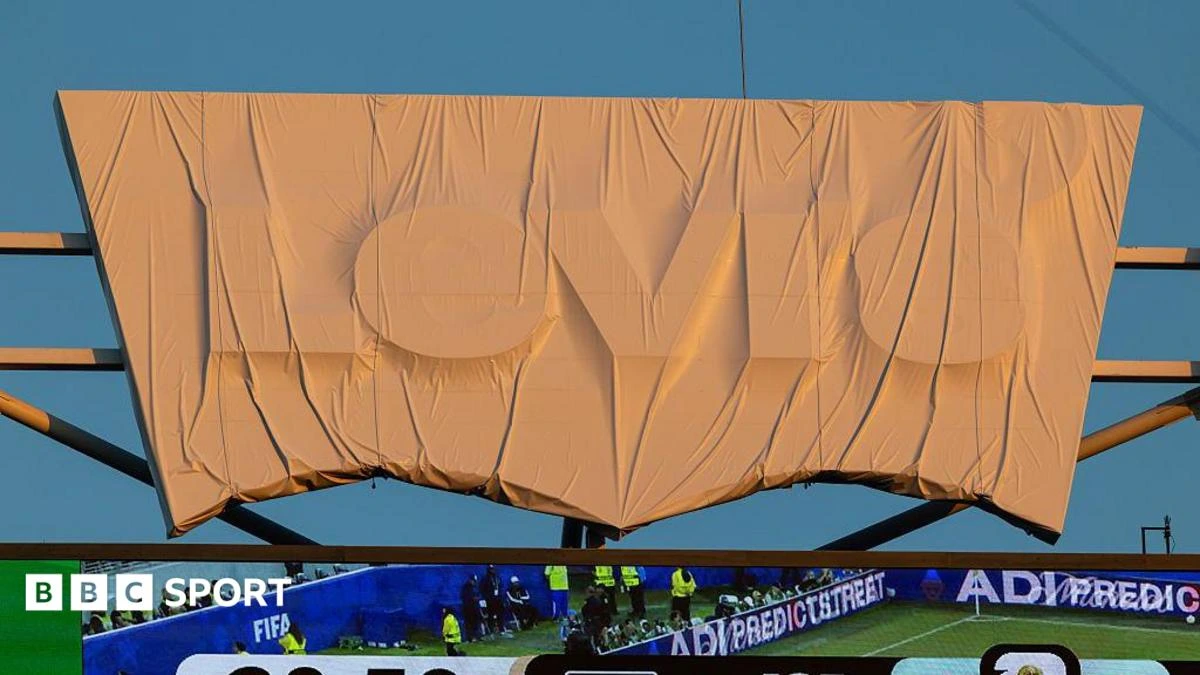
Levi's was not supposed to be one of the biggest brands at this World Cup. Neither were Heinz or Beats.
In fact, Fifa has spent much of this tournament trying to make sure fans see less of them. Which is precisely why everyone seems to be talking about them.
Outside the Levi's Stadium in San Francisco, the iconic Levi's logo has been covered up with a white tarpaulin. Inside the press box, Heinz logos on ketchup bottles have been taped over.
Even players have not escaped - Germany's Jamal Musiala was photographed pre-match with masking tape covering the Beats logo on his headphones.
None of these brands are official Fifa sponsors, yet all three have found themselves at the centre of one of the World Cup's most unexpected stories - arguably generating more conversation than brands that paid millions to be there officially.
It's called the Streisand Effect - a phenomenon named after singer and actress Barbra Streisand, whose attempts to remove photographs of her home from the internet only increased the number of people who saw them.
When we try to suppress something, we often make it more visible, and Fifa appears to be living it in real time.
Protection, not pettiness
Football's world governing body is not doing this out of pettiness. It is protection.
Official sponsors pay huge sums for the right to associate themselves with the World Cup. Some partnerships are worth tens of millions of pounds.
Part of that deal is to protect official sponsors from other brands that seek association without paying for the privilege.
The logic is straightforward. If every brand could get the same exposure for free, why would anyone pay for exclusivity?
So Fifa built a system to control visibility. It can rename stadiums, control what players or fans can wear into the ground, protect language and even the tournament typeface.
But fan attention is slippery, and brands will always try to find a side door into the conversation.
It is known as ambush marketing - and Fifa has been battling it since 1994.
Fifa's brand battle
Back in 2006, Netherlands fans were told to remove their trousers before entering a World Cup stadium.
It was not because of anything offensive - simply because they bore the logo of Bavaria, not Budweiser - the official World Cup sponsor.
Word quickly spread that a fan watched the match in his underwear, and the story went worldwide. Bavaria did not pay Fifa a single penny for that publicity.
By 2010, South African airline Kulula had been forced to withdraw a campaign referring to itself as the unofficial carrier of the 'you-know-what'. The withdrawal generated more publicity than the advert itself.
In 2014, Sony was an official Fifa sponsor and Beats by Dre were banned from every World Cup stadium and media event. Sony sent every athlete a free pair of headphones but star players wore Beats on the team bus, in training, through the tunnel... everywhere Fifa could not control.
Beats bolstered awareness by releasing a five-minute advert and while Sony paid for exclusivity, Beats had everyone listening.
Enforcement - not the sponsors Fifa sought to protect, or the brands it aimed to exclude - became the story.
Ambush marketing
The most interesting part of these stories is not the restriction. It is what happens next.
Heinz turned a taped-up bottle into a limited-edition product release. Beats posted Musiala's photo with the logo taped over, captioned: 'Spoiler alert: it's a b.'
It turned out to be a teaser for an unreleased headphone model nobody knew existed. Fifa had effectively handed Beats a product launch.
Levi's didn't run a stunt. It just let Fifa cover its logo and pointed everyone towards it. A single social post generated hundreds of thousands of interactions. One TikTok of the covered logo amassed nine million views.
Levi's has since rolled out the tarp logo across stores in London, Paris, Milan, Berlin, Hong Kong, Brazil and Mexico. The cover-up became the campaign.
Fifa's enforcement is not just generating publicity. It is generating content brands can amplify.
Official v unofficial
It would be easy to conclude ambush marketing is simply more effective than sponsorship. But that misses an important distinction.
Levi's, Beats and Heinz won attention. Official sponsors are playing a different game. They receive rights, access, activations, hospitality opportunities and official association with one of the world's biggest sporting events.
Those benefits are difficult to replicate.
So sponsorship and ambush marketing are not really competing for the same thing.
One is trying to own the event. The other is trying to join the conversation.
Ambush marketing can win during the tournament; sponsorship can win the memory after it.
Right now, it's clear who's captured the world's attention.
Who retains it is a question that won't be answered until long after the trophy has been lifted and the tarp comes down.
Adam is on TikTok at AdamTheCCO, external
Related topics
Nike v Adidas - the World Cup brand battle
Play BBC Sport's new World Cup predictor game
World Cup fixtures and group standings
How to watch the World Cup on the BBC