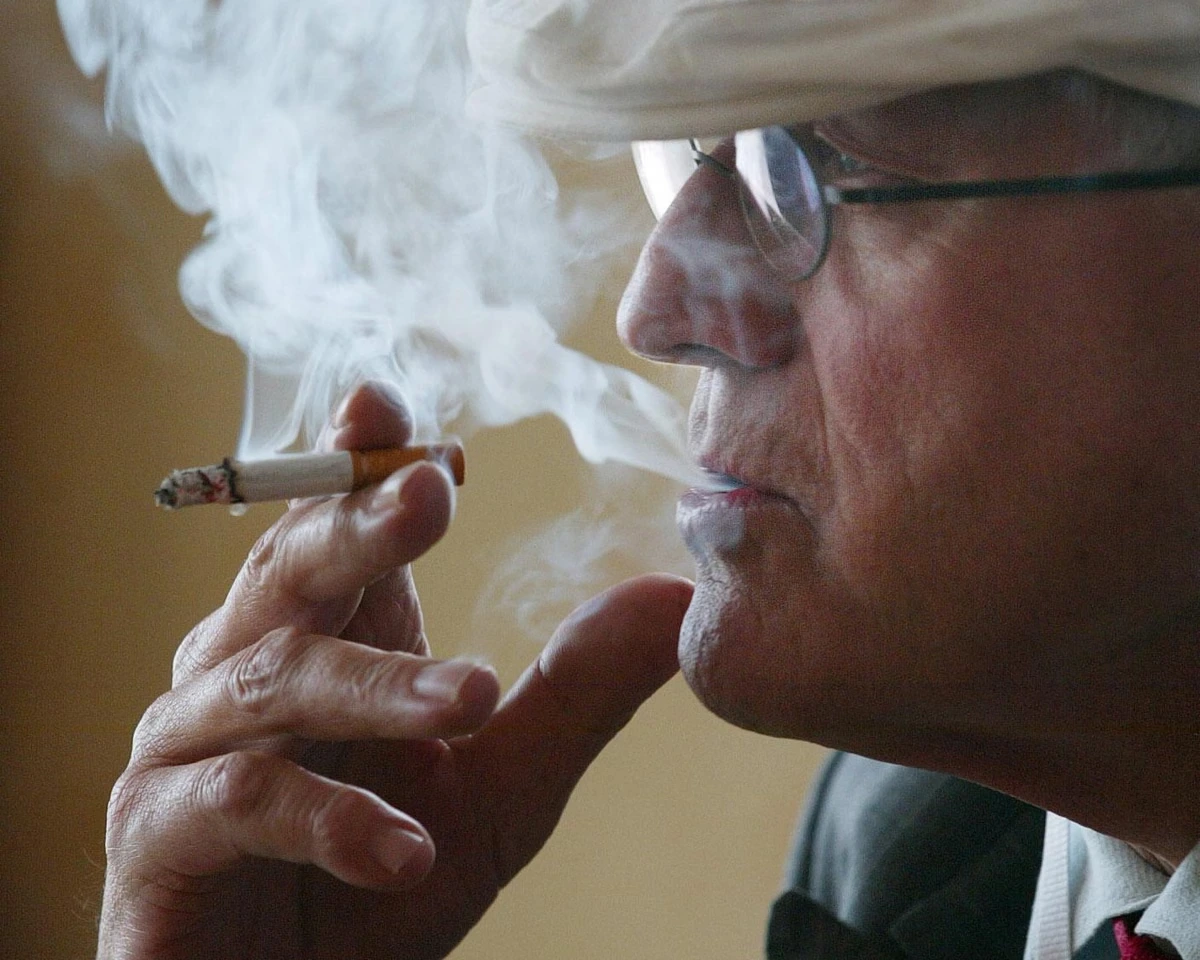
David Hockney’s last self-portrait that went on show while he lived, in 2025’s Paris retrospective, has a Droste effect: the figure holds a picture in which the figure holds a picture. Between the fingers of one hand, a paintbrush; of the other, a cigarette. He could have been smoking and smoking and smoking into infinity. That’s the elemental truth of the work, and even while that turned out not to be literally true – he died this week, aged 88 – he gave it his best shot.
The painting is titled Play within a Play within a Play and Me with a Cigarette, and it got him into a scrap with the authorities of the Paris Metro, who said a photo of it couldn’t be used to advertise the show, since it contravened regulations – it is a pretty common rule that you’re not allowed to glamorise smoking lest you influence the young. “The bossiness of those in charge of our lives knows no limits,” he said at the time. “Art has always been a path to free expression and this is a dismal [decision].”
Bossiness was his bête noir – he often wore a badge that said: “End bossiness soon.” Whether or not the work really did glamorise the habit is an open question since, although nattily dressed in houndstooth, Hockney didn’t exactly look in rude health.
There is a wonderful photo of him at the Royal College of Art in 1962, thick set, dressed in a shirt and tie like a kid just arrived at grammar school, covered in paint, deep in concentration, smoking. He didn’t have a great time at the RCA, where peers mocked his Bradford accent. “I’d look at their artworks,” he said later, “and I’d think, well, if I drew like that, I’d keep my mouth shut.”
Arguably, if you looked at smoking as a social crutch, you could trace his lifelong addiction to this early alienation. Freud might say it was a reaction against Hockney’s father, who loathed the habit years before medical science supported him. Hockney Snr died of a heart attack and, although the two were terribly close, David Hockney often mentioned the chocolate biscuits that apparently killed him.
The smoking could have been an act of artistic self-fashioning, to join the ranks of other celebrated smokers – Picasso, Monet – to whom Hockney paid homage as fag forebears. But if you saw it as he did, you wouldn’t be looking for reasons. He smoked because he really loved smoking, and he did it all the time.
For most of his smoking life, his only foes were doctors, telling him to stop: he loved to outlive them (he saw off four). He came out in the 1950s, after seeing an exhibition by the Russian ballet impresario Diaghilev, of which he said later, “he was homosexual and absolutely accepted it, and I thought, that’s what I will do, just accept it.” He reflected later on our increasingly tolerant attitudes towards diverse sexualities, but mainly to contrast them with the oppression of smokers. “I’ve always known I was gay, but I know it’s a minority. Most men want to fuck women, it’s all they think about. So if it’s a minority, you’ve got to be tolerant. You shouldn’t go on about smoking because it’s a bit intolerant. To tolerate something, it means you may not like it.” He famously kept 2,000 snouts at home “for emergencies”.
It wasn’t until the early 2000s, when the campaign started to ban smoking in pubs, that Hockney really started putting his shoulder behind it as an inalienable right. He staged a protest at the Labour conference circa 2005, flanked by posters saying “Death comes to us all” (this was at the high point of clashes over the Iraq war, so Tony Blair arrived with more or less the same message, albeit from a different direction).
Hockney wrote to the Guardian constantly, always with the same message. In 2004, he was querying the medical certainty around this very certain thing: “Could the medical profession give an explanation for Mrs Thatcher’s life? Her husband puffed away on Senior Service, and she must have had some of it second-hand. He dies at 86, and she is still going. Please explain.” In 2007, by which time the ban had come into force, he lamented the “mean and unpleasant land” England was becoming, comparing it unfavourably if a bit randomly to “the Festspeilhaus in Baden Baden, during the intervals of Tristan and Isolde, [where] I found a smoking lounge”.
The following year, he complained about the BBC and it’s “smoke-free agenda”, Polly Toynbee, who had critiqued the Beeb but failed to mention this signal persecution, and Dawn Primarolo, then health minister, regrettably “as naive as the Women’s Christian Temperance Union.” It was ironic and perhaps typical of the single-issue campaigner that he wound up finding enemies where there were none, as Toynbee herself had until the 90s been a champion smoker.
It scarcely needs pointing out that smoking is not big or clever, and Hockney’s long life would definitely have been easier towards the end had he not had a mini-stroke in 2012. Yet his last run of paintings featured one of his carer, Thomas Mupfupi, a portrait of such warmth and dignity that it’s impossible to imagine David Hockney unhappy with his choices. It was his lifelong joy and, he’d have argued, there would have been no fire without smoke.