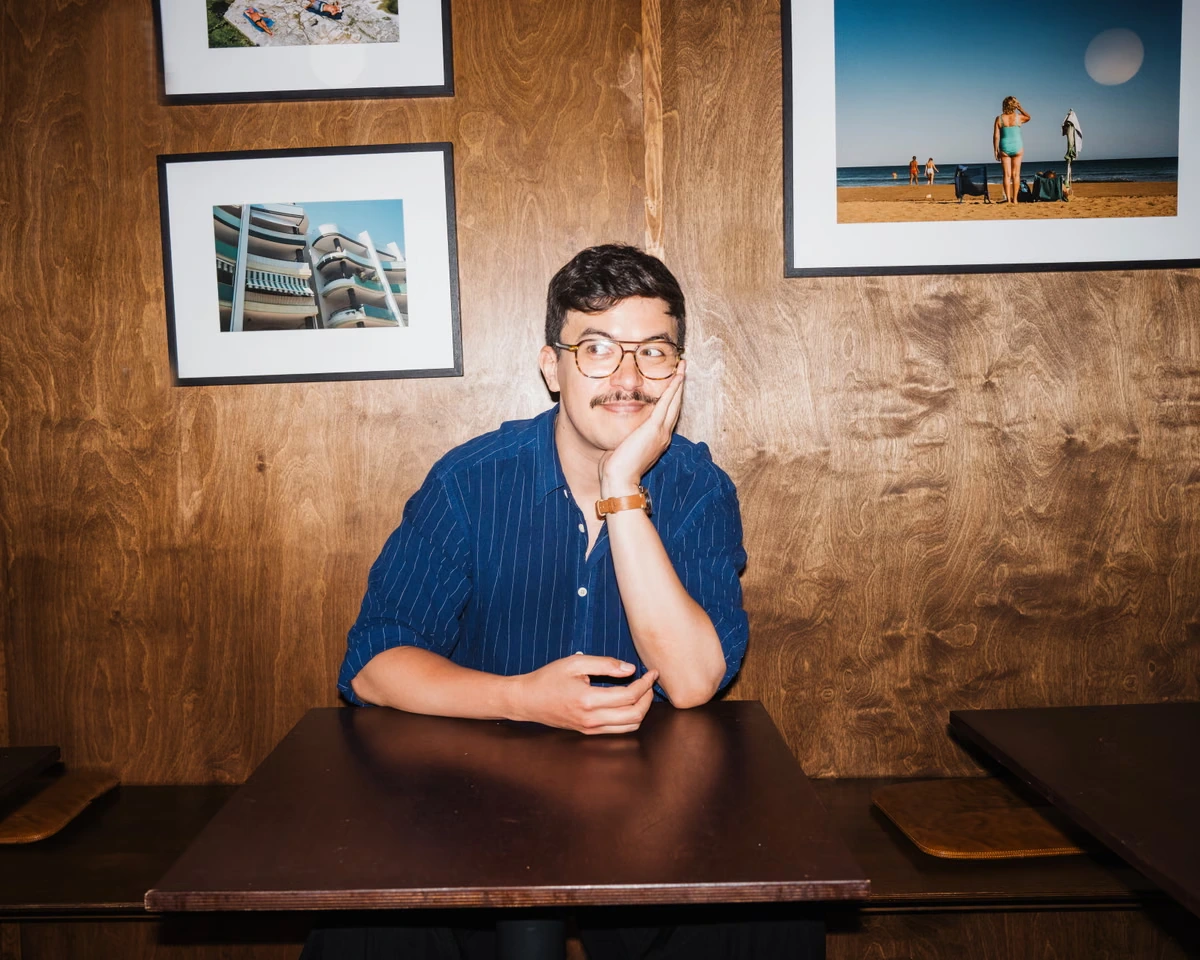
Born in Stoke-on-Trent to a British mother and Chinese-Malaysian father then raised in Borneo and educated in Brunei, Bath and Cambridge, Phil Wang – or “Old Wang”, as he refers to himself mock-imperiously on stage – has certainly been around. Today, the 36-year-old standup with the pleasantly befuddled air is in a cafe near his home in London, wearing high-waisted baggy black trousers, a blue shirt, salmon-coloured New Balances and a baseball cap bearing the word “Chump”. Most significantly, he is sporting a moustache.
Wang went public with his face furniture two years ago but the upcoming tour of his new show, Uh Oh, will mark the first time he has taken it out on the road. Is the tache here for good? “Well, I’ve got five minutes of standup on it now,” he says over coffee. “Until I come up with a better five minutes, it’s staying.”
It also announces one of the themes of Uh Oh. “The show is partly about ageing, so the moustache is a visible marker of trying to do that with grace.” Age-related anxieties have always figured in his routines. “People often think I’m older,” he said on stage a decade ago, “because although I am 26, I look … terrible.” At 31, he joked: “I’m getting to that age when most of my friends are having … podcasts.” Nor was there any solace to be found in fortysomethings reassuring him that he was youthful: “Forgive me if I take no comfort from the jealous face of death itself!”
But Uh Oh addresses a cultural change specific to the mid-2020s. “I find the ageing of millennials fascinating,” he tells me. “The show is about the recent end of the woke – or highly progressive – age and how it has coincided with millennials ceding cultural control.” How is he experiencing that? “Finding things online more incomprehensible. Finding that people behave more irrationally. Sometimes I’m like, ‘Oh, I’m maturing.’ When it feels bad, it’s more like, ‘Oh no, I’m becoming an old cunt.’”
If the moustache draws a hairy line under Wang’s previous shows, then the title – distinct from his Netflix specials Philly Philly Wang Wang and Wang In There, Baby! – marks an additional point of departure. “Point of departure,” he repeats. “That would have been a good title. A ‘take me seriously’ title.” He visualises the poster: “I’m in a departures lounge …” But the point stands. “I thought about calling it The Vibe Shift Is Real. The culture moves so fast, though, and this tour could last two years. That term already feels old hat.”
The shift to which he alludes is the current dramatic lurch to the right. “It’s there in young, gen Z men in response to the progressive age they grew up in, and in older people who think the country around them has changed too quickly. The re-election of Donald Trump felt like the final nail in the coffin of identity politics. The woke age was primarily invented by millennials on social media; Twitter was the main engine of cancel culture, and when Twitter died the engine lost its power and everything split. Now gen Z are much more divided than millennials.”
Wang may be exactly the standup we need to lower the temperature of our incendiary age. As an equable and even placatory comic, his innate approach is to reassure and reason with his audience rather than hectoring them. “Politically, I always give them the benefit of the doubt. That felt especially worthwhile when progressive people were being very ungenerous with all these supposed transgressions.” It is a subject he touched on in his 2021 book Sidesplitter: How to Be from Two Worlds at Once, in which he queried, for instance, the distinction between the accepted term “person of colour” and the verboten one “coloured person”, writing that “it almost seems like a trap intentionally designed to catch people out”.
“The underlying problem for the left,” he says now, “is they were so starved of real victories that they became addicted to small ones. Changes of language were attainable, while the political victories they wanted remained out of reach. So that became their only source of satisfaction, even though it amounted to a minor moving of the deckchairs.” Wang has joked rather charmingly that he now identifies as POC: “Phil, of course.”
I wonder how it feels to be heading out on tour in a country where the subjects of race and identity have become dangerously inflamed. After all, union jacks and St George’s flags will be fluttering from lamp-posts in many of the towns and cities he visits. “In divided times, extremists and populists take advantage of people’s concerns and anxieties,” he says. “They give people ways to express their frustrations and that can take the form of a flag. But on an individual basis, people tend to be more reasonable. Sometimes, a St George’s cross is just a blunt instrument to say: ‘I’m not happy.’ I always think people are more complex than the symbols they use.”
Recent live experiences have alerted him to a craving for positivity in the UK. “It used to be that you’d play somewhere and say, ‘This town’s a bit crap’, and people would laugh. Now they get pissed off. They still love to hear that the town down the road is shit but they’ve become protective of their own community. They’re eager to hear something positive about themselves. I love this country, too, and that makes me feel prouder to be out on the road as a semi-immigrant.”
His ambition remains the same today as it ever was. “You want to do the best comedy you can to as many people as you can. I was never trying to be alternative. I’ve always been mainstream.” How does he define the difference? “Mainstream comics think of the audience first; alternative comics think of themselves first. I’m not saying one is better than the other. But getting big laughs in a big room is something I always pursued.”
Wang has seen fellow comics seduced by the romance of being alternative when that isn’t their natural metier. He came close himself in 2015. “My show that year was trying to be what I thought of as an Edinburgh show.” Which is? “Something with a sad bit. Mine was about finding meditation and the difficulties of a long-distance relationship.” Was it a bid for integrity? “It was a bid for the Edinburgh comedy award. I coined this term ‘Fringe Derangement Syndrome’ for when comics get so focused on that one month, that one panel of judges, that they pander to it. The odds are against you and the emotional toll is so high.”
Uh Oh will be stopping at the fringe, but he has no shortage of other irons in the fire, including a burgeoning film career. His two minutes of screen time in Wonka, where he and Timothée Chalamet danced on adjacent cafe tables, drew lots of attention online; more recently he played the grumpy manager of a student union bar in the romcom Finding Emily. In his downtime, he has been reading PG Wodehouse’s Jeeves and Wooster stories. “They’re amazing. It’s like Frasier!” I ask whether he has started work on a novel of his own, and he eyes me warily: “What makes you say that?” I point out that it’s a well-trodden path for comic performers (Bob Mortimer, Julian Clary, Graham Norton) and he unclenches. “I’d definitely like to give it a try.”
Who knows what it will be about? Wang has mined his background comprehensively throughout his standup career, as well as for Sidesplitter and the award-winning Radio 4 special Wangsplaining. But it isn’t a case of exhausting his biographical material, he says, so much as developing the skills to transform unexplored parts of it.
“Sometimes you have a memory that you’re not good enough to make a routine out of until much later. I think of memories as like in an RPG [role-playing game] where you pick up a level-30 sword early on but you’re only a level five and you have to wait until you can use it.” Ah, I say, cottoning on late: he is referring to computer games. “Video games, yeah,” he says, correcting me sotto voce. It’s a small but invaluable chance for the millennial to give this gen Xer a vocabulary lesson and to prove that Old Wang’s not so old after all.