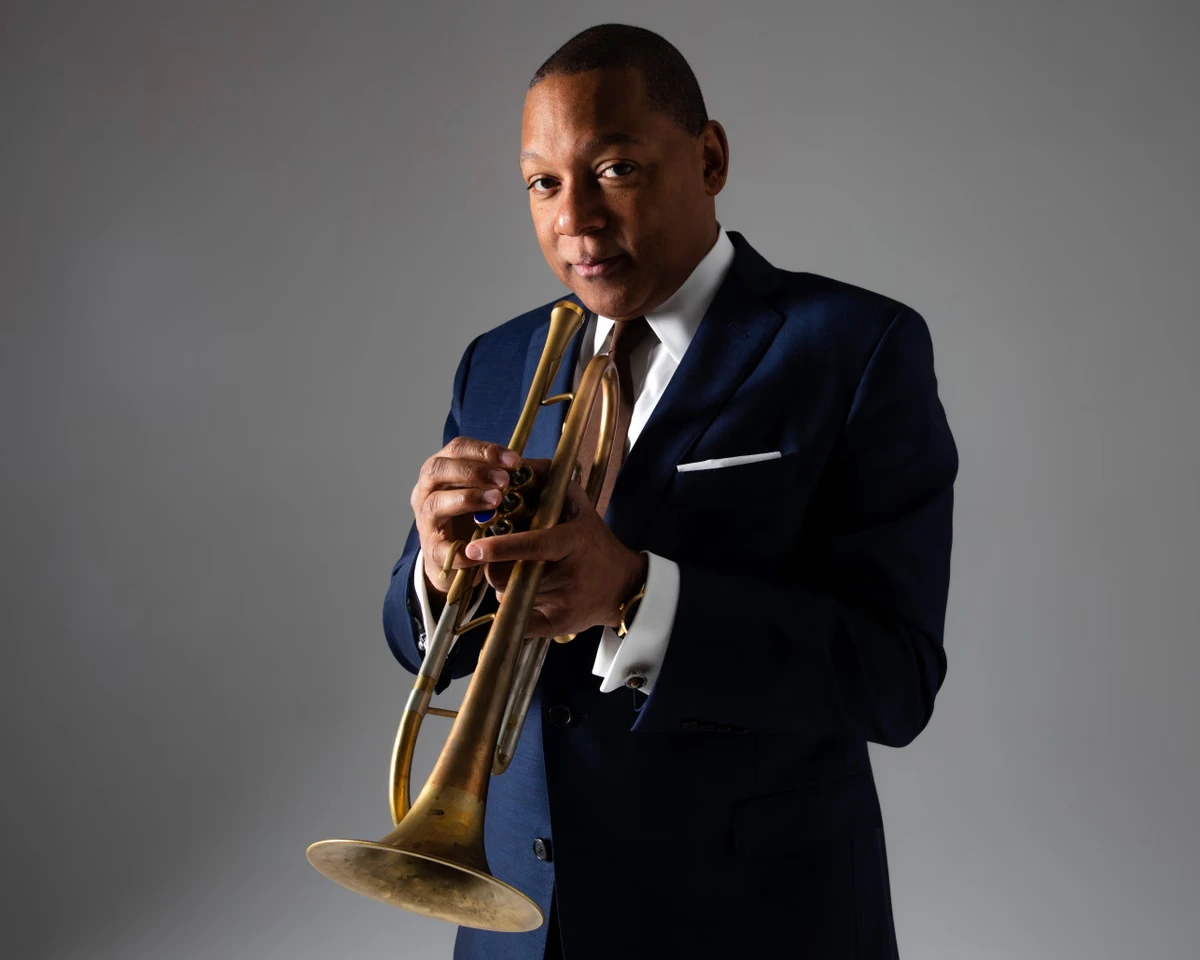
At Heinz Hall in Pittsburgh, Wynton Marsalis is hard to spot. When he first played this venue, in 1984, he was the prodigious 22-year-old soloist out front, blowing Haydn’s trumpet concerto under the baton of Lorin Maazel. Tonight he is embedded in the machinery: half-hidden behind ranks of strings and woodwind, a black-suited figure in the heart of his own symphony.
It’s a strange way for a composer to behave – especially one whose public persona has long been associated with certainty, polemic and the upright authority of a man who can make any argument sound like a moral law. Yet Marsalis seems almost pleased by his disappearance. “It’s my piece,” he says, as we talk in his hotel room the next morning, “but it’s not my show.”
The piece is All Rise, Marsalis’s first symphony, written in 1999 – a mammoth hybrid for a 15-piece jazz band, a 50-piece orchestra and a 100-piece choir, premiered at the turn of the millennium by the New York Philharmonic with Kurt Masur. Across 12 movements, Marsalis paints a sprawling civic canvas whose building blocks are American – marches, blues, dance rhythms – and whose aspiration is almost embarrassingly large: to sound like pluralism.
This year’s Edinburgh international festival has built its artistic theme around the piece: on the opening night at Usher Hall, Marsalis and his Jazz at Lincoln Center Orchestra will join the Royal Scottish National Orchestra and massed choirs. That’s more than 200 performers in total. Edinburgh has had no shortage of big opening statements over the decades, but this is a particularly pointed choice: a work first conceived as a celebration of integration, now revived in a moment when the very idea of common culture has begun to look quaint.
In the past, Marsalis could be confrontational: a man with a rulebook and a relish for battle. Today he’s mellower: quick to credit others, reject ego and talk more about collaboration than correction. He’s keen to puncture the myth that a symphonic work is the solitary utterance of genius. “All Rise was a collaborative exercise. James Oliverio, a soundtrack writer, was teaching me how to orchestrate while I was doing it. I had Milan Turković, the great Austrian bassoonist, helping me with the woodwind. But the main man was the late conductor Kurt Masur. He was always goading me to write something for him. ‘Are you afraid to write for the New York Philharmonic?’ he’d say. Kurt saw a segregated New York, and wanted a piece that brought people together.”
Masur – East German, Beethovenian, exacting – was conscripted into the German army as a teen in the final months of the second world war. “I remember he told me then, ‘You think that nazism is unique to Germany? It can happen here.’ Kurt said nazism didn’t happen because people were poor: it happened because lots of Germans wanted to behave like that. And, coming from the south, I could relate to that.”
For some, All Rise is exhilarating: a large-scale attempt to make American music sound like an argument worth having. For others, it feels like an impossible negotiation: two institutions – orchestra and big band – asked to behave like one. Marsalis has always been furiously outspoken about what he sees as the malign role of “fusion” in jazz, and is equally wary of the limits of fusing jazz and symphonic music. “I wanted to draw from American mythology and find intersections. Because with some music, there is no common ground.”
For instance? “You’re not going to hear a jazz version of a Beethoven symphony. It’s too many chord changes.” Marsalis’s first symphony is instead built on the dance music shared by Americans. “It’s about the relationship between tango and choro; between ragtime and Anglo-Celtic fiddle music; between New Orleans marches and European band counterpoint. But you have to be aware of certain things. In classical music, the basses don’t play all the time. In our music, it plays all the time. And in classical music, the percussion is accent, but in jazz and Latin music, it’s everything.
“So you have to find the common ground that you intersect with. Because if you’re not on that ground, there’s no intersection. John Coltrane said he was looking for a universal coefficient. It’s like the word mama. You say mama, it has a universal sound and feeling to it.”
He talks a lot about seeking links with other musics – about what he’s learned from the Iraqi oud virtuoso Naseer Shamma, Ghanaian percussionist Yacub Addy, Irish-American violinist Mark O’Connor, and about his enduring friendships with Willie Nelson and Paul Simon. “I meet up with Paul as much as I can – we talk a lot about the relationships between African-American and Anglo-Celtic music, how that is the foundation of pretty much everything we all do.”
Unlike some of Marsalis’s other large-scale pieces, All Rise is not a polemic. “If you want to know how I think jazz can help democracy, listen to [2020 album] The Ever Fonky Lowdown. If you want to hear what I say about government corruption – and how our government has always been corrupt – listen to my song Super Capitalism, on [the 2007 album] From the Plantation to the Penitentiary. But All Rise is different, it’s about bringing people together.”
Drawing from spirituals, gospel music and European devotional sources, All Rise is also full of God. Has his faith changed since writing it? “No. I always had a very strong spiritual faith that was not denominational, even as a kid. I came from very spiritual people. I spent a lot of time with my great uncle, who was born in 1883. He was a stonecutter for the cemetery. If you are around death that much, you become religious.
“But I never believed in the dogma. I always noticed the contradictions in Christianity: the saviour was poor, the church is rich. The saviour took a vow of poverty and said, ‘Love people.’ But a lot of religious people don’t love people who aren’t into their religion. So my libretto constantly counterstates that. I draw from the Muslim call to prayer as much as the Bible.”
Marsalis, now 64, is fascinated by such ecumenical statements: he remembers his father telling him to read Autobiography of a Yogi when he left high school. “That book was hard work. My dad told me to carry a notebook and write down the name of each swami. When you want to make connections, you have to really work at it.”
One connection he’s worked at is his marriage. Marsalis recently married Scottish violinist Nicola Benedetti, who also happens to be director of the Edinburgh international festival. They have a daughter, Elise, born in May 2024. Their relationship is largely long-distance at the moment – lengthy FaceTime chats and phone conversations. Would he ever move to the UK? “I’m going to have to plead the fifth on that one, I’m afraid,” he says with a chuckle, but also dismisses the prospect of Benedetti joining him in New York. “She’s not going to do that,” he says with a resigned smile.
Benedetti, 26 years Marsalis’s junior, has been a frequent collaborator. “What really made me fall in love with Nicola was when I wrote a violin concerto for her,” says Marsalis. “After the first run-through, she sent me a list of about 40 notes. First I laughed. Then I read them. And each of them were tiny things she thought I should change. Her detail was quite incredible. ‘If you put the violas on beat one of the 58th bar, that will save us 20 minutes of rehearsal time. Maybe put the bassoon’s entry at the end of bar 112, on the four of the bar rather than the two. Maybe stress the first beat of that passage in 5/8 time.’ And so on.
“I was amazed that she was able to notice all of this while playing the piece. I have so much respect for her, the time she spends practising, her dedication to the humility of study, the desire to learn, to get better. And she is completely collegiate in the way she deals with ensembles.” Has he learned humility from her? “Maybe. Trumpeters, we think we’re the kings of the orchestra, there to blow down the walls of Jericho. We think the piece only starts when we start playing. We know the strings are doing something but we can’t figure out what the hell they’re up to. Maybe I’m less like that now …”
I suggest that people will already expect young Elise, with such parentage, to grow up as a virtuoso musician. “She’s a hell of a singer,” he says. “But you can’t determine what your children do. I’ve got three sons – only one is a musician. He’s mainly a visual artist, but he makes music as part of his practice. One teaches track and soccer. Another teaches literature. I never put them in any direction – I just wanted to make sure they have integrity.”
How is he coping with late fatherhood? “You know, I always used to hang out with older people. All my mentors were older men – not just my father, but Clark Terry, Dizzy Gillespie, Sweets Edison, Elvin Jones, August Wilson, Romare Bearden, Ralph Ellison. And, when you’re hanging out with old people, you stay 19 for ever. But I’ve always enjoyed hanging with young people too. It’s a privilege when people come up after gigs, teenage kids with their parents, asking for advice. It takes a village to raise a child. We’re all raising the same kid.”
When Marsalis began running the jazz orchestra and jazz programme at Lincoln Center – New York’s pre-eminent arts complex – he was just 26. “I was one of the youngest in the orchestra, alongside legends who had worked with Ellington and Basie. Now I’m probably the oldest.” He recently announced that he will be stepping back from his executive leadership role after nearly four decades, while remaining involved artistically for a transition period.
It’s easy to imagine Marsalis as an Alex Ferguson-type spectral presence, presiding warily over anyone who takes up the reins. “No, I’m not going to be like that. There are so many talented people in the band now who could carry on what I’m doing. The bassist Carlos Henriquez, the alto saxophonist Sherman Irby, tenor saxophonist and clarinetist Dan Block – all amazing professionals. But it’s not my choice: there’s a whole executive board at the Lincoln Center who will be making that decision.”
Maybe stepping away from the Lincoln Center has altered his angle of vision. For decades it was his pulpit for declarations; now he sounds more interested in how musicians learn one another’s language – happy to defer, amused by his own ego. “I think about Copernicus and Galileo, about how they both observed that the Earth was not the centre of the solar system. They realised that, every time you discovered a new body, the equation became more complicated, until you stopped clinging to the old ways of looking at the universe. Maybe we all need to do that.”