Donald Trump has said that he is strongly considering leaving Nato over the lack of support shown for his attack on Iran in another extraordinary attack on Washington’s allies.
The US president told The Telegraph that the military alliance was a “paper tiger” and that taking the US out of the bloc was now “beyond reconsideration”.
“I was never swayed by Nato. I always knew they were a paper tiger, and Putin knows that too, by the way,” he told the newspaper.
His comments came just hours before he claimed that Tehran’s “new regime president”, whom he did not name, had requested a ceasefire. He also pledged to “bomb Iran back to the Stone Ages” if a deal was not struck to open the Strait of Hormuz and alleviate chaos in the energy markets.
Tehran’s foreign ministry spokesperson rejected claims that a ceasefire had been requested, calling them false and baseless, Iranian state TV reported on Wednesday.
US vice president JD Vance is reportedly in discussions with intermediaries about a potential ceasefire, with Axios reporting that talks between the US and Iran are focused on a pause to hostilities in exchange for a reopening of the Strait.
Mr Trump said that the vital shipping route – through which one-fifth of the world’s oil and gas passes – must be reopened, adding: “Until then, we are blasting Iran into oblivion or, as they say, back to the Stone Ages!”
He had earlier told reporters that “Iran doesn’t have to make a deal” to end the conflict, adding that “we’ll be leaving very soon”. He said the US could withdraw from the conflict as “within two weeks, maybe two weeks, maybe three” but later refused to give a timeline.
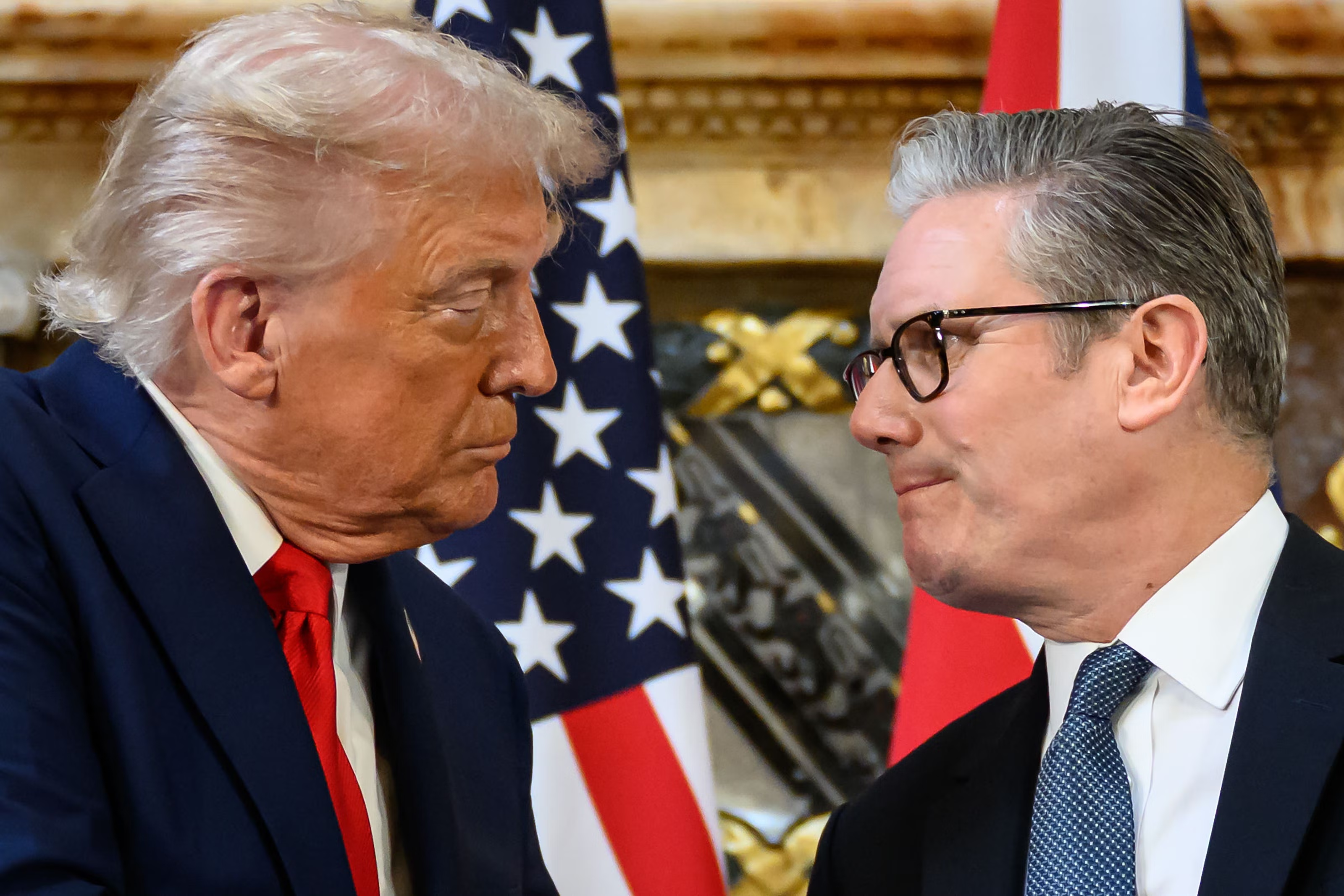
The president also took aim at the UK, saying the country “doesn’t even have a navy”, after prime minister Sir Keir Starmer reaffirmed that Britain would not get “dragged in” to a conflict that was “not our war”.
Sir Keir hit back, saying he would not respond to “noise” and “pressure” to enter the war.
Asked about Mr Trump’s comments at a press conference in Westminster, he hailed Nato as “the single most effective military alliance the world has ever seen”.
He added: “Whatever the pressure on me and others, whatever the noise, I’m going to act in the British national interest in all the decisions that I make. And that’s why I’ve been absolutely clear that this is not our war and we’re not going to get dragged into it.”
Meanwhile, in the strongest display of emotion from the government since the outbreak of the conflict, chancellor Rachel Reeves said she was “angry” that the US president chose to go to war, but promised to stand beside people to keep costs down amid the threat of spiralling prices.
She told BBC Radio 2: “I’m angry that Donald Trump has chosen to go to war in the Middle East – a war that there’s not a clear plan of how to get out of it. It’s why we didn’t want to enter this.”
The chancellor added: “We are preparing – as you would expect me to be – for every single eventuality to make sure there alongside people, standing beside them, keeping costs down for everyone.”
Meanwhile, foreign secretary Yvette Cooper will host an international meeting on Thursday to “assess all viable diplomatic and political measures” to reopen the blockaded Strait of Hormuz, after 35 countries signed up to a statement expressing willingness to contribute to efforts to ensure safe passage for shipping.
It came after Mr Trump on Tuesday singled out Britain and France over their reluctance to get involved in the war.
He wrote on social media that the US “won’t be there to help you any more, just like you weren’t there for us” and told allies they would have to “get your own oil”, following a report that he told aides he would be willing to end the war without the reopening of the Strait of Hormuz.
The closure of the vital waterway is putting enormous pressure on Mr Trump’s allies in Europe, who have come under fire from the Trump administration for not joining the US-Israel strikes on Iran.
The president told The Telegraph that he thought an allied response should be “automatic”. He said Washington had been there “automatically” in trying to mediate a ceasefire between Ukraine and Russia.
“Ukraine wasn’t our problem. It was a test, and we were there for them, and we would always have been there for them. They weren’t there for us,” he said.
Germany has doubled down on its commitment to Nato after Mr Trump’s comments on the US considering withdrawing support from the alliance.
“This isn’t the first time he’s done this, and since it’s a recurring phenomenon, you can probably judge the consequences for yourself,” a government spokesperson told reporters on Wednesday.
“It’s not my place here to comment on the American president’s words. I simply want to state on behalf of the German government that we are, of course, committed to Nato.”
US secretary of state Marco Rubio echoed Mr Trump’s comments in an interview with Fox News late on Tuesday, saying the administration would “have to reexamine the value of Nato and that alliance for our country”.
Sir Keir ruled out putting boots on the ground on Monday, after relaxing rules allowing the US to operate out of bases on British soil.
“Of course, we will defend British lives and British interests in the region, will stand by our allies in the Gulf region, but we’re not going to get dragged in,” he told an audience at Labour’s local election campaign launch in Wolverhampton.
YouGov polling shows 59 per cent of the British public oppose the conflict, while around 25 per cent support it. Just over half (52 per cent) believe Sir Keir is handling the relationship with Mr Trump badly, however.
Only 8 per cent of voters agree that the UK should join the US and Israel in “launching attacks on a wide range of targets in Iran”, according to a poll recorded on 4-5 March. Most (46 per cent) agree that the UK military should only be tasked with shooting down drones and defending civilian areas and UK military facilities.
Mr Trump’s comments come just weeks after he threatened to annex Greenland, a territory of Nato ally Denmark. The president has repeatedly criticised Nato members over historically low defence spending. Nato spending rose 20 per cent year on year in 2025, according to the latest report.