Alexei Navalny, the Russian opposition leader, was killed by dart frog poison administered by the Russian state two years ago, a multi-intelligence agency inquiry has found, according to a statement released by five countries, the UK, France, Germany, Sweden and the Netherlands.
The US was not one of the intelligence agencies making the claim.
Navalny died in a remote Arctic penal colony where he was serving a 19-year sentence. Samples from his body were secured before his burial and sent to the laboratories of two countries.
The UK, describing the poisoning as barbaric, said it would be reporting Russia to the Organisation for the prohibition of Chemical Weapons, as a flagrant violation by Russia of the Chemical Weapons Convention (CWC).
The intelligence agencies claimed laboratory testing found that the deadly toxin in the skin of Ecuador dart frogs (epibatidine) was found in samples from Navalny’s body and highly likely resulted in his death.
The statement adds: “Only the Russian state had the means, motive and opportunity to deploy this lethal toxin to target Navalny during his imprisonment in a Russian penal colony in Siberia, and we hold it responsible for his death.”
“Epibatidine can be found naturally in dart frogs in the wild in South America. Dart frogs in captivity do not produce this toxin and it is not found naturally in Russia. There is no innocent explanation for its presence in Navalny’s body.”
Although it had been widely assumed that Navalny had been poisoned by the Russian state, the evidence of the specific poison in his body is a new development. His wife, Yulia Navalny, posted in September that there was evidence of poison in his body at the time an autopsy was conducted.
Yulia wrote in a post on X that the named poison “causes paralysis, respiratory arrest, and a painful death. I was certain from the first day that my husband had been poisoned, but now there is proof: Putin killed Alexei with [a] chemical weapon. I am grateful to the European states for the meticulous work they carried out over two years and for uncovering the truth. Vladimir Putin is a murderer. He must be held accountable for all his crimes.”
The Kremlin has a long history of using poison as a weapon against its enemies. The death of Alexander Litvinenko in London from radioactive polonium in 2006, the nerve agent attack on the former spy Sergei Skripal in Salisbury in 2018, and a previous poisoning attempt on Navalny have cemented Russia’s reputation for resorting to toxins to silence critics and defectors.
The Foreign Office, which oversees the intelligence agencies, said it has pursued the truth of Navalny’s death with partners from Sweden, France, the Netherlands and Germany. The UK added: “We know the Russian state now used this lethal toxin to target Navalny in fear of his opposition.”
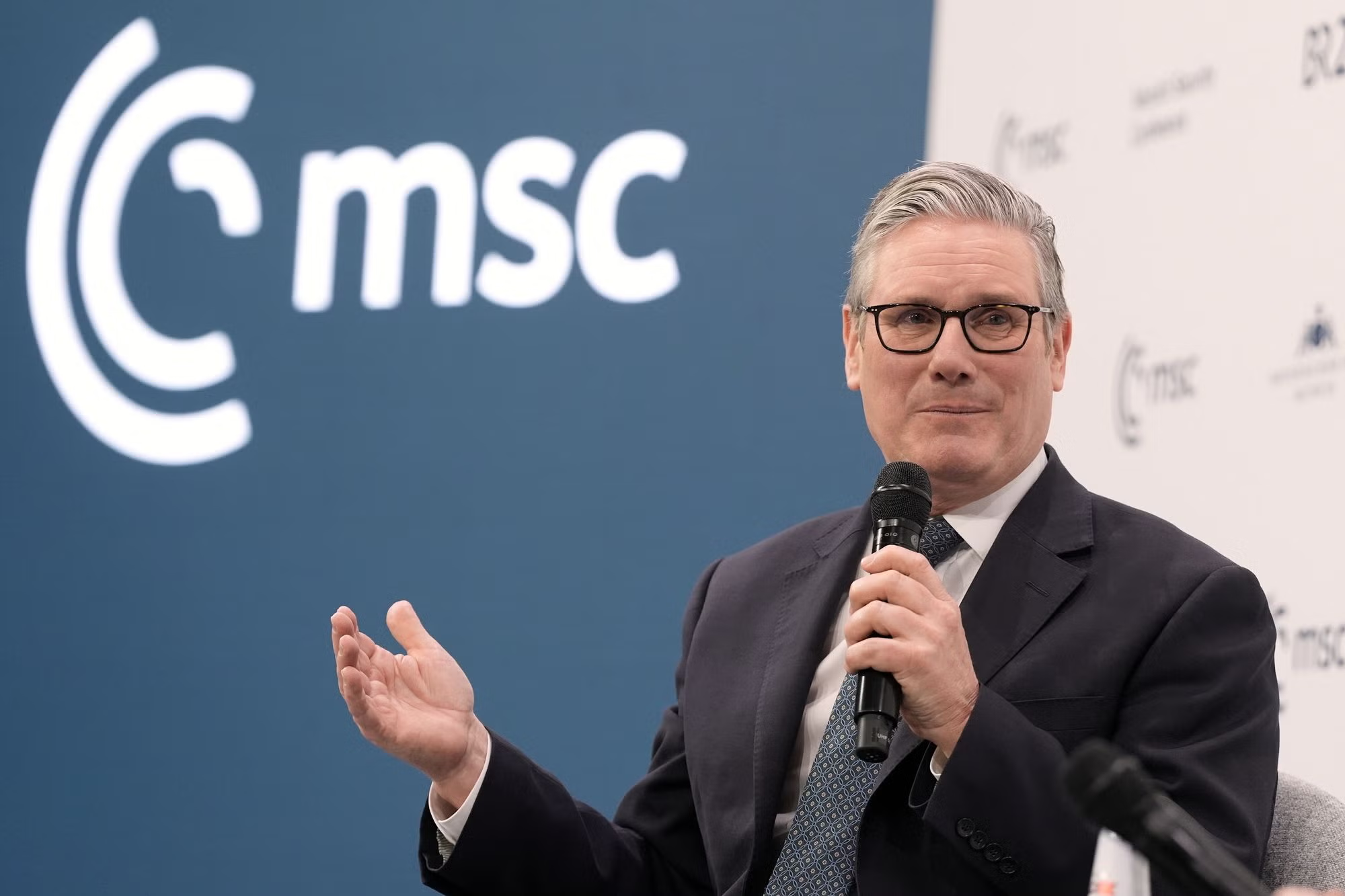
The release of the information during the Munich Security Conference was designed to remind everyone that Russia announced the news of Navalny’s death just as the conference convened two years ago.
His wife, after some hesitation, made a short address to the conference in 2024 saying: “I would like Putin and all his staff, everybody around him, his government, his friends, I want them to know that they will be punished for what they have done with our country. With my family and with my husband, they will be brought to justice. And this day will come soon.”
The UK foreign secretary, Yvette Cooper, said: “Only the Russian government had the means, motive and opportunity to deploy this lethal toxin against Alexei Navalny during his imprisonment in Russia.
“Today, beside his widow, the UK is shining a light on the Kremlin’s barbaric plot to silence his voice.
“Russia saw Navalny as a threat. By using this form of poison the Russian state demonstrated the despicable tools it has at its disposal and the overwhelming fear it has of political opposition.”
The UK has led the way in trying to expose what it regards as nefarious Russian suppression of the regime’s opponents using poison, including the attempted killing of the UK agent Sergei Skripal with novichok on the streets of Salisbury in 2018. The UK has also led claims about Russian troops’ frequent use of chemical weapons on the battlefield in Ukraine.
In it statement the UK said it was clear Russia did not destroy all its chemical weapons as claimed in 2017, and that it has not renounced biological weapons, as it is obliged to under the Biological and Toxin Weapons Convention.