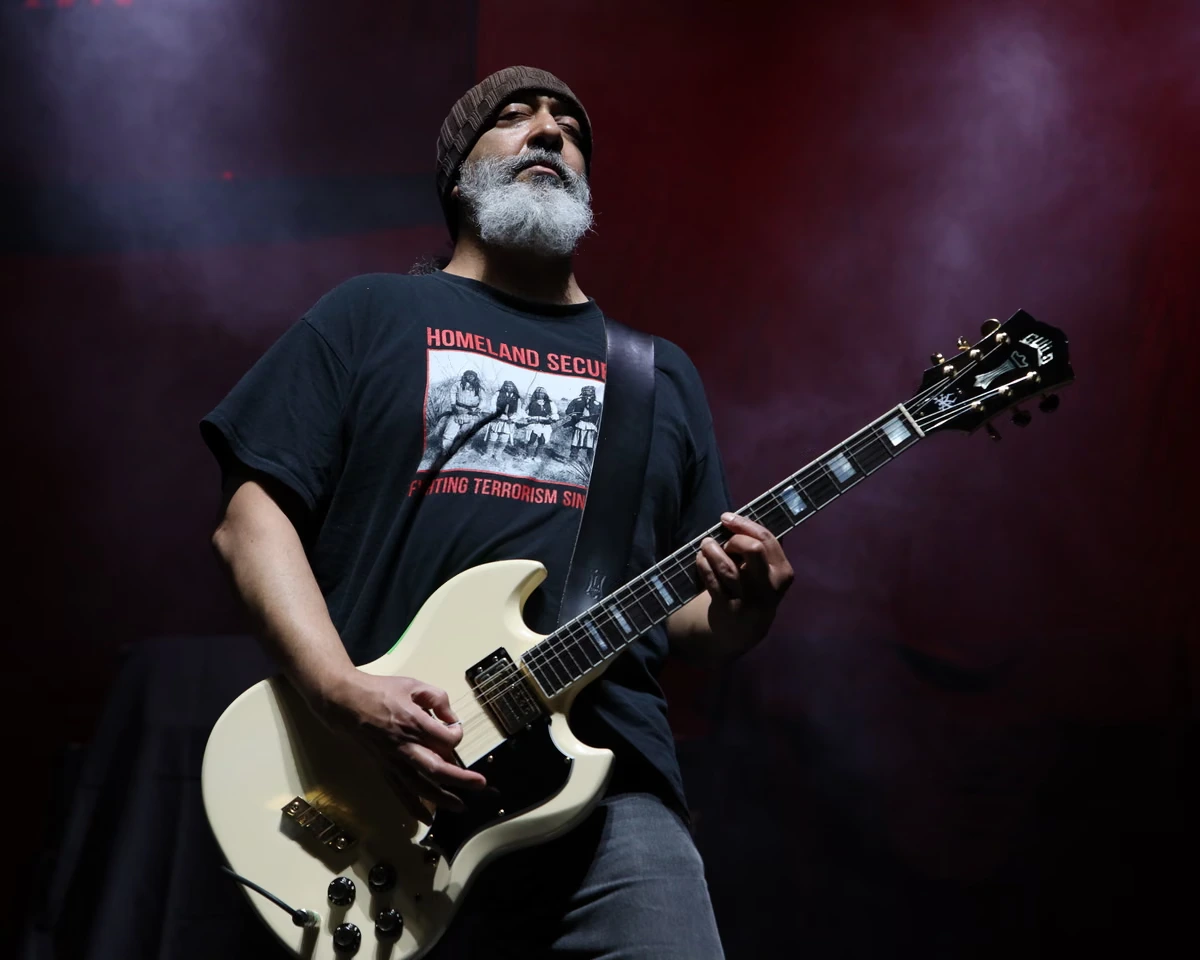
Kim Thayil has always felt like an outsider. For example: the Soundgarden guitarist has lived in Seattle, a city infamously addicted to coffee, for more than four decades, but only started drinking the stuff himself during lockdown. “I was pretty against-the-grain to my Seattle friends, who always wanted to meet up at coffee shops,” he grins, cradling a freshly brewed cup of java in his kitchen. “My girlfriend in the 80s and 90s even worked at the original branch of Starbucks and made coffee with a French press every morning. But I drank tea, because my parents are Indian.”
Thayil’s Indian heritage also set him apart from his peers. In his new memoir, A Screaming Life, he writes that when he and bassist Hiro Yamamoto formed Soundgarden in 1984, the group was “two-thirds Asian”, and that “as liberal and accepting as the punk scene was, it was still largely white, and I was ever aware of that”. Nevertheless, Soundgarden went on to become pioneers of Seattle’s grunge movement, a multiplatinum-selling, critically acclaimed, Grammy-winning group whose breakthrough hit, Black Hole Sun, transcended their gnarly milieu to become an enduring anthem.
Thayil and Yamamoto hailed from Park Forest, a suburb of Chicago. “We grew up as immigrants and outsiders,” Thayil says. “I was raised on American culture: the Monkees and the Brady Bunch and Superman comics. But there was this distance – I wasn’t necessarily a member of this club.” This distance wasn’t entirely a bad thing, especially when he got into weird, heavy music. “I had no obligations to these subcultures I was not a member of. I could explore, without expectation, with no canon I had to adhere to.”
Thayil’s gateway to heavy rock was Kiss, but the hair metal that dominated the 80s was, he says, “the Partridge Family, but with a fuzzbox: hopelessly suburban, white and milquetoast. I was a skinny, long-haired brown guy, and the idea of all that spandex and hairspray and makeup …” He tugs at his grey beard and grins. “This was not a fitting palette for that kind of display.”
So Soundgarden embraced the might of heavy rock while rejecting the genre’s retrograde sexism – a generation X approach that later defined grunge – and hair metal’s machismo and misogyny was repudiated with the satirical Big Dumb Sex. Audiences, however, didn’t always recognise the nuance. “People who didn’t want to like us would say, ‘They play aggressive music, their singer doesn’t wear a shirt and their song goes, “I’m gonna fuck, fuck, fuck, fuck you!” – they’re just another bunch of jerks!’ But we all had long-term relationships; we had regard for our sisters, our mothers. We didn’t identify with that culture, physically, intellectually or emotionally.”
They’d formed as a trio, Thayil, Yamamoto and drummer Chris Cornell, though that dynamic soon changed “because of Chris’s talent”, Thayil says. “Our friends told us, ‘Chris sings great, he looks great! Get another drummer and put him up front.’” Having heard him sing in a classic rock covers band, Thayil deemed Cornell merely “competent and workmanlike”; he’d wanted an immediately identifiable vocalist, “an Ian Curtis, a Tom Waits”. But he quickly retracted his reservations, as Cornell revealed the fearsome range that would make him a legend.
“Chris could sing whatever we wrote, and if he couldn’t, he’d work at it. And the material we wrote challenged him. Until I wrote Nothing to Say, we had no idea his voice could jump that high.” Thayil laughs softly, but with admiration. “Chris developed this ability to scream in a high-pitch register, and it was unearthly. His diaphragm was very strong: he could hold a note for a long time. Swimming helped him develop those really nice abs, but was also the source of his vocal power.”
Cornell looked every inch the rock god: cheekbones, impressive mane, those abs. Temperamentally, however, he was no David Lee Roth. “Chris was an introvert. People were attracted to him because he was so talented, but he was more comfortable in a dark room watching a movie than at a party full of people coming up to him, spilling beer on his shoes. He would do that too, as much as he could tolerate. Then he’d withdraw.”
With the addition of drummer Matt Cameron, Soundgarden’s first classic lineup was in place. The next step would prove pivotal to Seattle, and indeed alt-rock history. They introduced Bruce Pavitt, Thayil’s old friend from Park Forest who ran influential fanzine Subterranean Pop, to Jonathan Poneman, Thayil’s colleague at college radio station KCMU. Pavitt “had the Sub Pop brand, but no money”; Poneman “had great business sense”. Thayil convinced them to work together and release Soundgarden’s debut single, kickstarting Seattle’s most important record label in the process.
That single, 1987’s Hunted Down, reimagined heavy rock with a post-punk sensibility, coining the sound of Seattle’s then-percolating home town scene. This tight-knit community was united by their love for coffee, Black Sabbath and punk, with a disdain for rock’n’roll cliche. “Hair metal was all about sex, drugs and fast cars,” Thayil says, “this Hanna-Barbera, cartoonish popular culture.”
Soundgarden, however, were heavy of riff and subject matter: covering Sabbath’s doomy Into the Void at the suggestion of bassist Ben Shepherd (who replaced Yamamoto after he left in 1989), they swapped out Geezer Butler’s campy apocalyptic visions for a chilling speech on mankind’s destructiveness by Chief Sealth, the 19th-century leader of the Suquamish and Duwamish tribes, and an environmentalist who gave Seattle its name. “Native culture is a profound aspect of our region’s identity,” Thayil says. “Plus, the environmental issues were dear to our heart.”
Thayil remembers the media and music industry mostly ignoring Seattle’s rock scene until autumn 1991, when former Sub Pop signees Nirvana’s second LP, Nevermind, and Pearl Jam’s debut LP, Ten, made grunge a multiplatinum phenomenon. Released that October, Soundgarden’s third LP, Badmotorfinger, offered heavy music of uncommon grace and spirituality, Thayil’s darkly psychedelic guitar playing summoning the power of the elements to deliver the sublime.
Soundgarden had been the first grungers to sign to a major, but were a more complex proposition than their contemporaries. Thayil remembers when the group played festivals such as Lollapalooza: “We’d play our songs, with their tricky time signatures, and the kids would start jumping up and down, but by the first verse they’d all be out of sync.”
Badmotorfinger had gone double platinum, their greatest commercial achievement to date, but the mainstream acceptance their peers enjoyed seemed likely to elude Soundgarden without a big crossover song. When that track – Cornell’s radiant, Beatles-eque Black Hole Sun – arrived, Thayil was initially hesitant. “We immediately saw its strengths,” he says, “this mellifluousness that lent itself to radio. But was Black Hole Sun pandering? Did it even sound like Soundgarden?” Cornell sensed Thayil’s resistance. “He said, ‘Once you and Ben and Matt get to it, it’s gonna sound like us. Go nuts: make it crazy and psychedelic.’”
The song won Soundgarden their first Grammy, and helped their diverse 1994 masterpiece Superunknown sell over 7m copies worldwide. But just as Soundgarden were breaking through, the vibe turned dark. In April 1994, their friend Kurt Cobain killed himself. Thayil learned the news during a gig in Europe; in a scene movingly recreated in the memoir, the group held each other in the dressing room afterwards, sobbing.
“This was not supposed to be happening,” Thayil says. He’d believed the Seattle scene had no interest in “promoting risk as our cultural identity”. Soundgarden drank beer, smoked weed, occasionally dabbled in psychedelics, but pills, powders and needles were verboten. “We knew all about Hendrix and Janis Joplin and Jim Morrison and Sid Vicious. We thought, ‘We’re not idiots like that, we’re not part of that ironic narrative of celebrity.’ We thought we were immune to this.” He sighs. “But still, we were going off the cliff.”
Disillusioned, worn down by touring and with their paymasters behaving like “pimps and madams while we’re out there in short skirts and heels”, Soundgarden split after a fifth album, 1996’s Down on the Upside. “We should have just taken a hiatus, pumped the brakes,” Thayil says. Instead, Cornell pursued a solo career and formed Audioslave with three-quarters of Rage Against the Machine. The supergroup was “hooky, riffy, immediately catchy”, says Thayil. “But they were a diminished version of Rage, who I loved, and a much-diminished version of Soundgarden.”
Thayil began to hear rumours that Cornell was struggling with substance use (the singer would enter rehab shortly afterwards). “It was a shock,” he remembers. “Given what had happened with Kurt … I couldn’t believe it.” He wanted to reach out, but Cornell no longer lived in Seattle. “I’d always felt protective of the other guys,” he says. “Our manager, Susan Silver, said, ‘They’re all little brothers. You’re a big brother, and you act like it.’ I’d felt that same way toward my parents. I saw them as foreigners, and I wanted to protect them, as I’m kind of American. That was my identity.”
By the time Soundgarden reformed in 2010, Cornell’s substance use was “in the past”, Thayil says. They cut a sixth album, 2012’s King Animal, and, he writes in the memoir, “had definitely refound our groove”, their bonds of friendship renewed. Unbeknownst to his bandmates, however, Cornell, who’d fought depression his whole life, was struggling. After a show at Detroit’s Fox theatre in May 2017, he took his life in his hotel room.
The news devastated Thayil, and still does. “I could never have anticipated the vacuum, the absence, and how profound it is,” he says. “The loss is not just in missing the companionship, the creative partnership, and everything I learned from him. I also miss that sense of duty, as a big brother, to protect him. I still feel that sense of ‘What could I have done?’” He pauses. “I’ve had to recognise my own mortality, my vulnerability and my impotence. You can’t save everything you love. Perhaps you can’t even save yourself.”
Salvation for Thayil came through playing in the final incarnation of MC5 for their 50th anniversary tour in 2018, guesting on records by Mastodon and the Pretty Reckless, and forming supergroup 3rd Secret with Matt Cameron and Nirvana’s Krist Novoselic. He remains deeply involved in Soundgarden’s unfinished business, including their induction into the Rock and Roll Hall of Fame last November, with Taylor Momsen and Brandi Carlile singing in Cornell’s absence, and Shepherd and Yamamoto sharing bass duties. He also has possession of nine unfinished Soundgarden tracks the group had cowritten, with vocals Cornell completed before his death.
“We’re still working on them,” he says, explaining that the group don’t have a record label to finance their completion, and saying there are “a lot of other factors at play”. But while revisiting the tracks will doubtless prove a painful experience, Thayil says he’s up to the job. “I always take responsibility for the things I love,” he says finally, switching the kettle back on. “And I can’t imagine ever not loving Soundgarden.”
A Screaming Life by Kim Thayil is published by William Morrow on 9 June in the US. UK publication will follow later this year