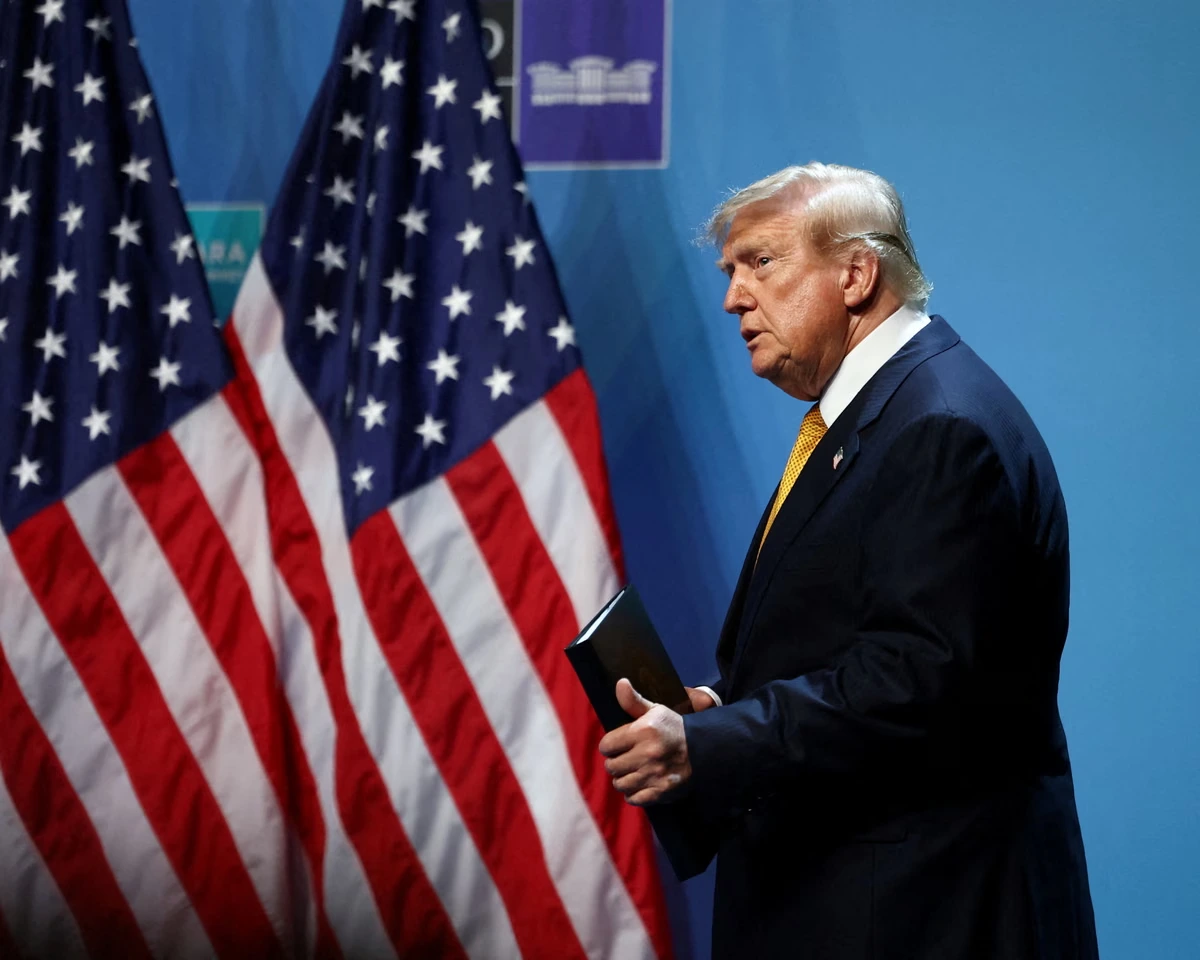
Donald Trump’s relationship with Washington’s Nato allies is nobody’s idea of a happy marriage.
But the US president’s volatile performance at the western military alliance’s annual summit in Ankara this week seemed extreme, even by Trumpian standards. As commentators sought toexplain what happened, their usually capacious stock of Trump-fitting cliches was at risk of exhaustion.
Trump arrived in the Turkish capital last Tuesday in a spectacular funk, visibly angry that the temporary ceasefire arrangement he had agreed with Iran had failed to hold, and threatening to unleash more destruction and mayhem in consequence.
The country’s Islamic leadership, which he praised as “very reasonable” just two weeks earlier, were “scum” and “sick people”, he told journalists as he sat beside Nato’s secretary general, Mark Rutte.
Just as vehemently, he lashed out at the alliance, which has been the cornerstone of collective western security policy since 1949, when it was founded as the North Atlantic Treaty Organization in response to the spread of Soviet communism after the second world war.
Trump was “not happy with Nato”, he said, complaining about the failure of alliance members – including Britain – to help him in the Iran war, rehashing his claims on Greenland despite it being sovereign Danish territory, and demanding the US sever trade ties with Spain because its socialist government (who he denounced as “bad people”) refused to comply with new defence spending targets.
Hours later, he emerged from a meeting – with the leaders he had just lambasted – talking about unity. “There was a lot of love in that room,” Trump said. He had, apparently, never had a Nato meeting that had been so positive.
Trump extended this sudden warmth to Ukraine’s president, Volodymyr Zelenskyy – sitting alongside a leader he has frequently viewed as a bête noire – whom he praised him as “ingenious” for holding his country together in a war against Russia, led by Vladimir Putin, whose political style and cause Trump has long been assumed to prefer.
Terms such as “mercurial” and “whiplash” were predictably applied across much of the media to describe the seemingly capricious conduct. Less obvious was its cause, and possible long-term effect.
Why had Trump suddenly changed his tune on an alliance he has frequently derided as a “paper tiger”, and accused of “ripping off” the US by expecting it cover the lion’s share of expenditure? And what might the consequences be of such unpredictable and, by some measures, abusive behavior?
The answers, according to some analysts, range from relatively straightforward to more complicated – with Trump’s impulsivity, and proclivity to change his mind on a whim, close to the surface of any explanation.
One driver of his sudden shift may have been an affinity for the summit’s host, the Turkish president Recep Tayyip Erdoğan, a strongman leader who has held power for 23 years, and for whom Trump has long expressed admiration despite his Islamist political roots.
At a joint press conference with Erdoğan on Tuesday, Trump said he might not have attended the summit if had not been held in Turkey, with which he said he had a “great relationship”.
“Turkey has been, in many ways, much more loyal than other countries that we thought would be loyal,” he said, before comparing his bond with Erdoğan glowingly in comparison with other leaders. “You never know why a relationship is special.
“Sometimes you get along with the toughest people, like [Erdoğan]. And sometimes you don’t get along with the weakest most pathetic people, maybe you don’t respect them.”
Ian Lesser, a fellow at the German Marshall Fund who attended the summit, said it had a “bipolar quality”, which he attributed to Trump’s chemistry with Erdoğan, whose domestic opponents have labelled as an autocrat who stifled political opposition and freedom of the press.
“The fact that President Trump has this apparently very close relationship with President Erdoğan probably played a role in stabilizing things [and ensuring] that the theatrics didn’t really spill over into the summit.”
“President Trump was keen to be sure that President Erdoğan was able to claim a success from the summit,” added Lesser. “Political personalities play a role in these kinds of relationships, and they’re on full display at summits.
“Trump, more than many, puts his personality out there when he deals with international affairs. He has a tendency to see the world through not so much through alliances, but through individual countries and, above all, individual leaders … he has a sceptical view of alliances.”
Equally effective is the extravagant flattery bestowed by Rutte, a former Dutch prime minister who has made an art of adapting his natural garrulousness to play the role of “Trump whisperer”, frequently praising the US president for “saving” Nato by getting European allies to raise their spending on defence, long a Trump bugbear.
“Rutte is really doing a good job of trying to say to Trump, ‘Hey, it’s working. We’re we’re becoming more capable allies. We hear you,’” suggested Charles Kupchan, a professor of international affairs at Georgetown University and a former senior White House adviser on Europe under Bill Clinton and Barack Obama.
“And I’m guessing that some of those same refrains appeared during the closed the closed meeting,” he said, referring to the private session Trump shared at the summit with 31 fellow heads of allied governments.
His remarkable public change of heart towards Zelenskyy – who was once told by Trump in the White House that “You don’t hold the cards” – may be fueled by disappointment in Putin, for offering no concessions to help end a conflict which has now lasted longer than the first world war, as well as a consciousness of sentiments in US Congress, to which the president had paid little heed in other affairs.
“I think there’s a question of congressional opinion here,” said Lesser. “And as we get closer to the midterm elections, this is obviously going to weigh more heavily.”
Despite the unexpectedly emollient finale, a school of thought has emerged that Trump’s regular bashing of allies will leave a permanent mark – even if he is eventually replaced by an administration with a more traditional view of the transatlantic alliance.
But Kupchan argued that Trump’s rhetorical hostility had not weakened or undermined the alliance, despite a loss of European trust that it could rely on US support. “Stepping back from all the heated rhetoric, and Trump’s demeaning language toward Nato, in some ways, the picture that emerges is a positive one,” he said. “Nato is still Nato. There are still 80,000 US troops in Europe.”
What will change, analysts predict, is that Nato will become a more Europe-led alliance as the US’s European partners make good on their commitment – made at last year’s summit – to spend 5% of GDP on defence by 2025.
Europeans, meanwhile, will continue to be “freaked out” by Trump’s hostile language, Kupchan predicted.
“He relishes his ability to make others freak out, because that’s his style,” he said. “He’s a reality TV star. He wants to keep everybody off balance. So this kind of one moment he’s ready to pull out of Nato, and the next moment he loves Nato.”
Beneath the president’s headline-grabbing posturing may lie a deeper problem of US strategic indecision.
Kupchan – author of a recent article entitled “America does not know its own mind” – warned Trump was a symptom, rather than cause, of a foreign policy malaise. “The underlying problem is the collapse of the political center – the reality that the United States doesn’t really have a foreign policy any more,” he said.
“Every time there’s a presidential election, we swing from one grand strategy to a completely different grand strategy.
“If you’re the chancellor of Germany or the prime minister of Japan and have relied for decades on the US security guarantee, you have to plan for the worst, because the United States is passing through such a prolonged period of political dysfunction that you don’t know whether you can count on Uncle Sam.”