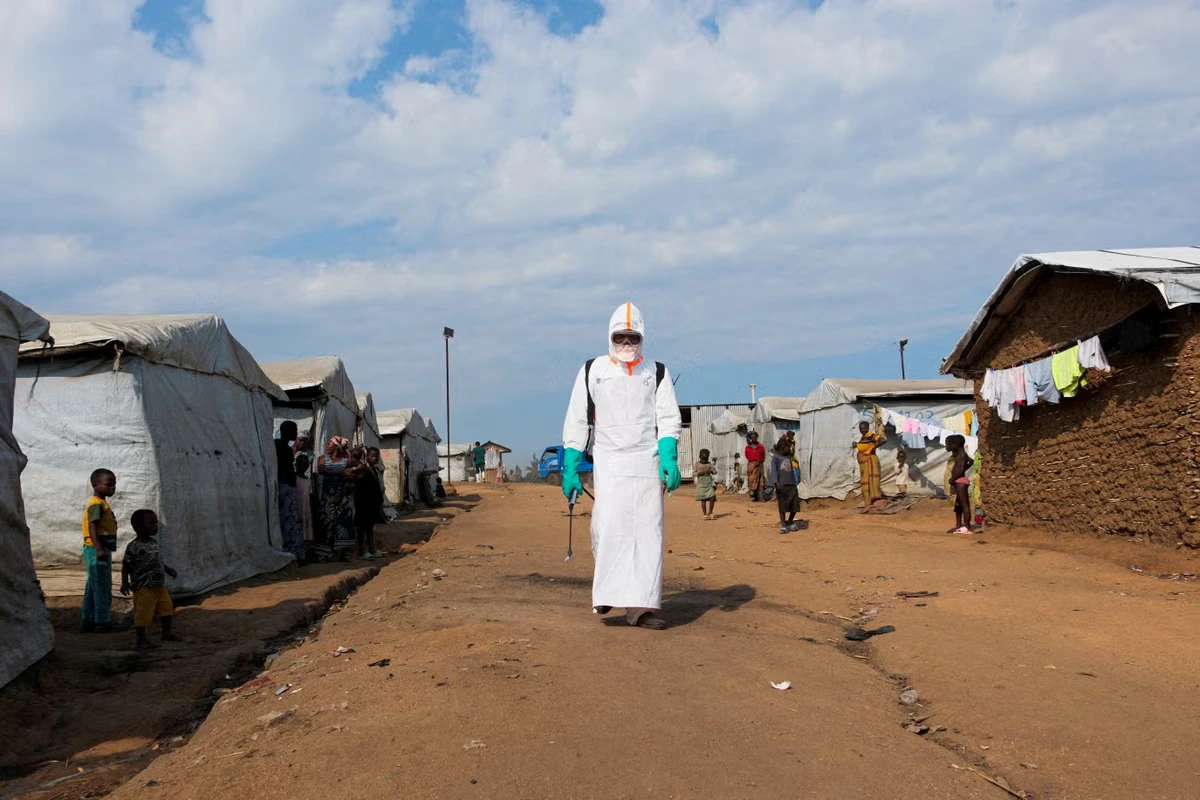
The UK is almost tripling its funding to tackle the deadly Ebola outbreak in the Democratic Republic of Congo (DRC), announcing a further £51.8 million as the virus continues to spread rapidly.
Foreign, Commonwealth & Development Office (FCD) minister Kirsty McNeill told MPs on Tuesday that the additional funding would take the UK’s total commitment to the response to £78.7 million.
The announcement comes as the outbreak continues to outpace the response, killing 2,950 people since the epidemic was declared in mid-May, with 6,100 cases confirmed.
It is the fastest-spreading outbreak ever and the DRC’s deadliest on record, with the World Health Organisation warning that it is on track to surpass the deadliest anywhere – the 2014 to 2016 outbreak in West Africa, which killed more than 11,000 people
UN health workers warned in August that the outbreak in the DRC is continuing to spread “exponentially”, with the wider response hampered in part by cuts to international aid by both the US and UK over the last 18 months. The Independent has repeatedly reported on the growing calls for more aid to be sent to DRC as quickly as possible.
During Foreign Office questions in the House of Commons on Tuesday, Ms McNeill said that the government is working closely with international partners to support the “African-led” Ebola response.
In comments received by The Independent on Monday in response to questions about further funding allocations amid surging case numbers and a doubling of maternal deaths, Ms McNeill said the UK’S Public Health Rapid Support Team has deployed thirteen experts to date to support the response.
The UK is working to “limit the outbreak, model the trajectory and nature of its development, and reduce its wider health and humanitarian impacts, including maternal deaths”, she said.
The FCDO continues to fund the Women’s Integrated Sexual Health (WISH) programme, which supports the delivery of sexual and reproductive healthcare, she added.
They are also working with partners to scale up programmes to protect maternity services, to provide personal protective equipment to frontline responders, improve water, sanitation and hygiene, and strengthen containment measures such as surveillance.
The Independent reported exclusively last week that maternal deaths in the Ebola-affected regions have almost doubled, with women now also accounting for more than half of cases due to taking on traditional roles as carers in the home.
Women also make up a disproportionate number of nurses and midwives, who are among those most at risk of contracting the virus.
In May, as the outbreak was officially confirmed, Rory Stewart, who previously served as the UK’s Africa minister, said of the impact of widespread aid cuts: "Pandemic preparedness – in other words, dealing with an Ebola outbreak or even a new version of a Covid outbreak – requires lots of people on the ground in places like DRC... who are able to detect cases, respond to them, quarantine and prepare responses.”
“It’s all the infrastructure behind that which is being undermined at the moment. And that’s a real threat, of course, to the world,” he told BBC Radio 4.
The additional funds have therefore been welcomed by NGOs, who said it was a clear sign the UK government had “been listening”.
"Today's announcement shows what's possible when the public makes its voice heard in a crisis,” said Adrian Lovett, UK Executive Director of the ONE Campaign, who work to end extreme poverty and preventable disease.
"This money can now be turned into contact tracers, treatment beds and protective equipment on the ground. We urge the government to work with health leaders and local partners to get it there as fast as possible,” he added.
Mr Lovett said they had asked prime minister Andy Burnham to redirect savings from the falling cost of refugee accommodation in the UK, which has come out of the foreign aid budget, rather than taking the additional funds from emergency reserves. “We are seeking further reassurance on this point,” he said.
Caused by the rare Bundibugyo virus, authorities believe the current outbreak had been spreading undetected among communities since at least February.
There is no approved vaccine or treatment, but DRC authorities have begun distributing thousands of Ervebo vaccine, which the WHO said might provide some protection.
Efforts to contain the outbreak have come up against conflict between the government and rebel groups in the eastern region, attacks on health workers and widespread displacement. Misinformation and aid cuts, further decimating and already weak health system, have also slowed the response.
Health workers have gone on several strikes to protest delays in payments, further complicating the situation.
On Tuesday, schools in the DRC reopened despite calls from the country’s teaching union for a delay in restarting classes and sparking fear that it would impact efforts to contain the spread.
This article has been produced as part of The Independent’s Rethinking Global Aid project