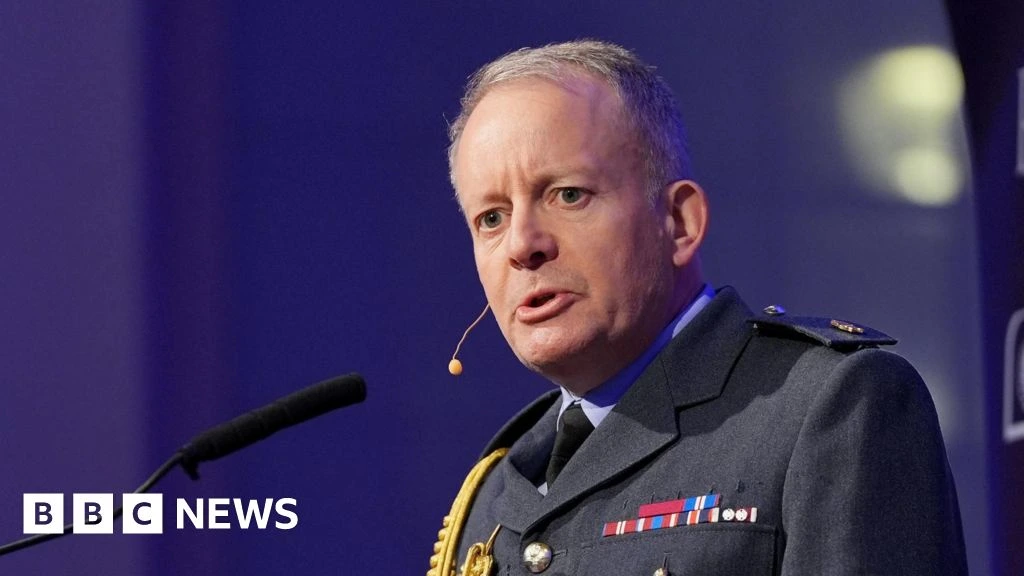
The UK's armed forces will have to "dial back" training and operations if they do not receive more cash than is currently being offered, the chief of the defence staff has warned.
The UK's armed forces will have to "dial back" training and operations if they do not receive more cash than is currently being offered, the chief of the defence staff has warned.
Air Chief Marshal Sir Richard Knighton said the government's Defence Investment Plan (DIP) did not include enough funding to support "day-to-day activities" in the short term.
Air Chief Marshal Sir Richard Knighton said the government's Defence Investment Plan (DIP) did not include enough funding to support "day-to-day activities" in the short term.
John Healey resigned as defence secretary last week, claiming the proposed cash settlement "would reduce the readiness of our Forces and increase the risk to personnel on operations".
John Healey resigned as defence secretary last week, claiming the proposed cash settlement "would reduce the readiness of our Forces and increase the risk to personnel on operations".
In a Commons statement earlier on Tuesday, he said his resignation had been "necessary in securing the future of Britain's armed forces and our alliances".
In a Commons statement earlier on Tuesday, he said his resignation had been "necessary in securing the future of Britain's armed forces and our alliances".
"My decision last week was about our country, not career," he told MPs.
"My decision last week was about our country, not career," he told MPs.
And in a swipe at Chancellor Rachel Reeves, whom he has said was "unwilling" to provide adequate funds to meet the threats facing the nation, he warned that "our adversaries do not follow timetables set by the Treasury".
And in a swipe at Chancellor Rachel Reeves, whom he has said was "unwilling" to provide adequate funds to meet the threats facing the nation, he warned that "our adversaries do not follow timetables set by the Treasury".
The government has committed to increasing defence spending to 3.5% of national income by 2035, in line with allies in the Nato military alliance.
The government has committed to increasing defence spending to 3.5% of national income by 2035, in line with allies in the Nato military alliance.
The defence investment plan was due to be published last week but has been delayed further following Healey's resignation.
The defence investment plan was due to be published last week but has been delayed further following Healey's resignation.
New defence secretary Dan Jarvis is currently reviewing how the money will be spent - but there has been no suggestion from No 10 that extra cash will be found.
New defence secretary Dan Jarvis is currently reviewing how the money will be spent - but there has been no suggestion from No 10 that extra cash will be found.
Healey says the UK needs to be spending 3% of gross domestic product (GDP) on defence by 2030.
Healey says the UK needs to be spending 3% of gross domestic product (GDP) on defence by 2030.
In his Commons resignation statement, he told MPs: "At this dangerous time, I see the current defence investment plans falling well short of what is required, a rise at 0.08% from next year to 2030, no date for reaching 3%, no path to 3.5%.
In his Commons resignation statement, he told MPs: "At this dangerous time, I see the current defence investment plans falling well short of what is required, a rise at 0.08% from next year to 2030, no date for reaching 3%, no path to 3.5%.
"By 2030, well over half of Nato members will be spending 3% or more. And when allies are looking for British leadership, we must not fall behind."
"By 2030, well over half of Nato members will be spending 3% or more. And when allies are looking for British leadership, we must not fall behind."
In his scathing resignation letter last week, Healey warned that the 10-year DIP plan "backloaded" spending increases, when the UK's forces needed to "to speed up readiness to fight is in the first two years".
In his scathing resignation letter last week, Healey warned that the 10-year DIP plan "backloaded" spending increases, when the UK's forces needed to "to speed up readiness to fight is in the first two years".
In his scathing resignation letter last weekSir Richard Knighton echoed Healey's concerns in evidence to the Lords International Relations and Defence Committee on Tuesday morning.
Sir Richard Knighton echoed Healey's concerns in evidence to the Lords International Relations and Defence Committee on Tuesday morning.
"The thing that I'm most concerned about is the level of day-to-day activity funding, the resource departmental expenditure limit, because that funds operational activity and drives exercises and training," he told peers.
"The thing that I'm most concerned about is the level of day-to-day activity funding, the resource departmental expenditure limit, because that funds operational activity and drives exercises and training," he told peers.
"Those are the things that make sure the men and women of our armed forces are as ready as they can be with the equipment that they have got today, and without changes to the settlement, as John Healey set out, then those areas will come under pressure."
"Those are the things that make sure the men and women of our armed forces are as ready as they can be with the equipment that they have got today, and without changes to the settlement, as John Healey set out, then those areas will come under pressure."
He said the new defence secretary had to be given time to review the funding plan, which he said was still to be finalised.
He said the new defence secretary had to be given time to review the funding plan, which he said was still to be finalised.
Sir Richard added: "We will have to dial back our activities and our exercise and operational activity if the level of resource funding that's available to us does not increase.
Sir Richard added: "We will have to dial back our activities and our exercise and operational activity if the level of resource funding that's available to us does not increase.
"Now, that's still to be debated and decided."
"Now, that's still to be debated and decided."
Healey was followed out the door at the MoD by armed forces minister Al Carns, who said in his resignation letter that the level of investment in the DIP was "inadequate to the task" of defending the country.
Healey was followed out the door at the MoD by armed forces minister Al Carns, who said in his resignation letter that the level of investment in the DIP was "inadequate to the task" of defending the country.
was followed out the door at the MoD by armed forces minister Al CarnsIn his Commons resignation statement, Carns added that the DIP did not pay enough attention to drone warfare, and was too focused on traditional defence hardware.
In his Commons resignation statement, Carns added that the DIP did not pay enough attention to drone warfare, and was too focused on traditional defence hardware.
Sir Keir said the government was increasing the defence budget from 2.3% of GDP to 2.6%.
Sir Keir said the government was increasing the defence budget from 2.3% of GDP to 2.6%.
Speaking to reporters at the G7 summit in Evian, France, the PM added that the DIP would give the UK "capability for the future" and he had already reallocated money from other departments to defence.
Speaking to reporters at the G7 summit in Evian, France, the PM added that the DIP would give the UK "capability for the future" and he had already reallocated money from other departments to defence.
Sir Keir added: "Obviously the new defence secretary is reading in, and we're talking to him about how and what we will spend that money on, in terms of capability, and he's got his own thoughts now on what the priorities should be, and so that's the discussion we're in the middle of at the moment."
Sir Keir added: "Obviously the new defence secretary is reading in, and we're talking to him about how and what we will spend that money on, in terms of capability, and he's got his own thoughts now on what the priorities should be, and so that's the discussion we're in the middle of at the moment."