Gone are the days when World Cup games were littered with red cards. Or so we thought.
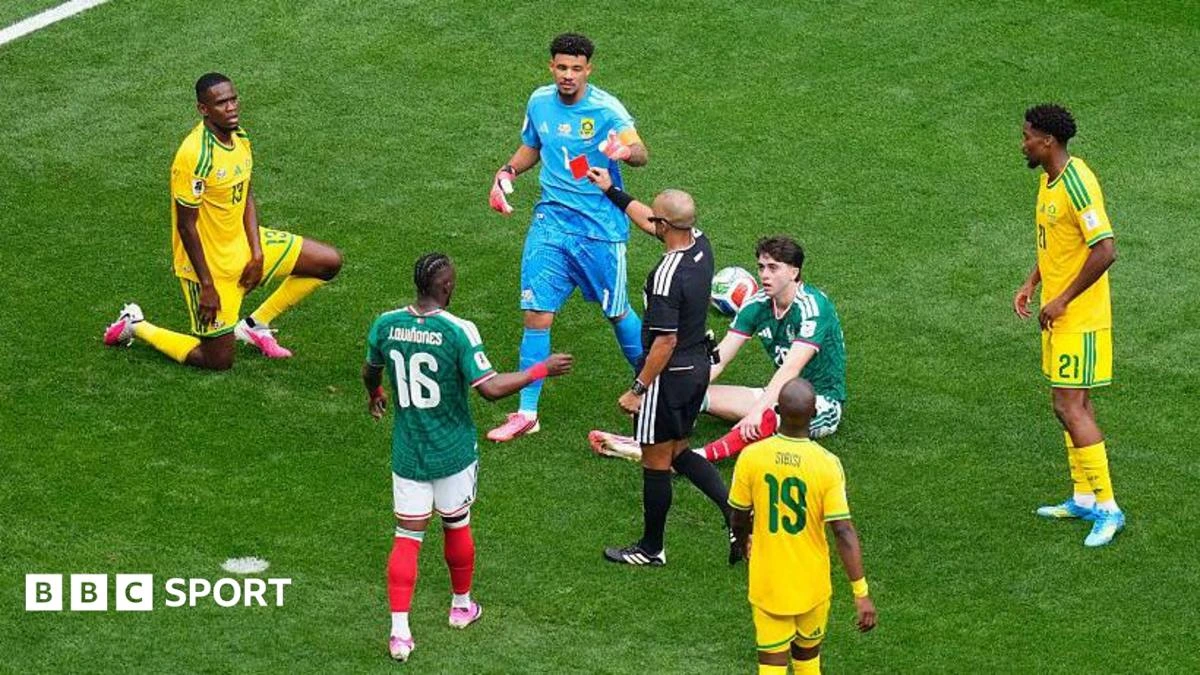
Three reds were shown in the opener on Thursday as Mexico beat South Africa 2-0.
South Africa's Yaya Sithole and Themba Zwane were sent off, and then Mexico's Cesar Montes was dismissed in stoppage time.
Maybe we had been spoiled. The World Cups in Russia and Qatar both saw just four red cards in the whole tournament. The 2026 tournament has nearly matched that already.
It had been 20 years since three players were sent off in one match, in the 2006 finals when 28 players saw red.
That was a remarkable tournament which saw three players dismissed in three separate games, and the all-time record of four reds in Portugal v Netherlands.
Are we about to go back to those days? Will the 2026 World Cup be remembered for red cards being handed out like confetti?
Sometimes red cards are simply justified
In 2017, Pierluigi Collina was appointed as Fifa's new head of referees and it heralded a very different era.
Collina often takes about how decisions should serve as justice - for both teams.
Players should stay on the field unless they have done something which truly deserves a red card.
For instance, under his stewardship the law around denying a goalscoring opportunity (Dogso) when a penalty has been awarded have been hugely relaxed. It is now very difficult to get a red card.
So it should be no surprise that the 2018 and 2022 World Cups saw just the four red cards after he took over.
Refereeing at the start of a tournament often seem to sets the tone. Should we be drawing any conclusions from this match?
In his pre-tournament briefing, the Italian was focused on timewasting and general player behaviour.
There was no talk of a hard stands which should result in a huge spike in red cards.
Sometimes red cards are simply justified. Well, most of them anyway.
Sithole's dismissal for fouling Brian Gutierrez was a simple decision for referee Wilton Sampaio.
The Mexico attacking midfielder was through on goal. Sithole may not have meant to bring him down, but he did. There was no doubt the South African had denied his opponent a clear goalscoring opportunity.
The second dismissal was much more controversial, given to Zwane on a video assistant referee review for violent conduct.
Zwane tussled with Roberto Alvarado, with the Mexican going to ground holding his head.
It looked like a coming together off the ball, but the referee was sent to the pitchside screen by the video assistant referee (VAR), Colombia's Nicolas Gallo.
As Sampaio was shown the replays at the monitor it was difficult to make out what had happened.
Was there really a hand to the head? And if so, was it accidental or did he swing the arm?
When assessing violent conduct, the VARs are told to look for a clenched fist as a sign of aggression. This does not have to be present, but it is an indicator.
Zwane appeared to connect with an open hand to the side of Alvarado's head, not with a closed hand.
It looks exceptionally harsh, and not the kind of clear and obvious decision VAR as introduced for.
Or maybe this is exactly the kind of thing Collina had told his referees and VARs to look out for, falling into the category of poor player behaviour.
Collina has brought in red cards for players who cover their mouths in confrontations, and those who leave the field in protest at a decision. He also wants goals disallowed for blocking on set-pieces.
Perhaps the actions of Zwane fall into this sort of category, a way for Collina to try to reduce the dark arts within the game.
World Cup kicks off in Mexico with Shakira, performers and vibrant fans
VAR, timewasting and subs - World Cup law changes explained
Infantino could have stood up for the World Cup - but he said 'chill, relax'
Let's not panic about the referees just yet
The third red card, again for Dogso, seemed controversial initially.
Khuliso Mudau broke towards the area and looked to skip past Montes, but the South African was stopped in his tracks by a rash tackle.
Mudau was in a slightly wide position so a yellow card seemed the most likely outcome. Sampaio produced the red. Surely the VAR would step in again?
On second viewing it seemed very likely that Mudau's next touch would be to control the ball inside the area. There was no covering defender close.
Mudau would probably have had one touch, and then a shot. The VAR was not likely to get involved and tell the referee he had made a clear and obvious error.
An incident from the Premier League last season is a good comparison. It came in Crystal Palace's 3-3 draw with Bournemouth in October.
Marcos Senesi brought down Ismaila Sarr, with the Palace striker moving into a similar position to Mudau.
Referee Jarred Gillett produced the yellow card, but the VAR sent him to the screen to upgrade it to a red.
Gillett rejected the review, but the Premier League's Key Match Incidents Panel voted that he was wrong. It should have been a red card.
Maybe it provides an indication that Sampaio was right. His decision was certainly supportable.
Collina is not the kind of administrator to launch some kind of crackdown on Dogso. He made his aims clear before the World Cup started.
It would be easy to say this World Cup is about to be blighted by referees throwing around red cards.
There is a danger we fall into a trap, whereas this game may well prove just to be an outlier. A statistical anomaly across a 104-game tournament.
The two on-field red cards probably are, on balance, both correct decisions.
Let's not panic about the referees just yet.
Related topics
Play BBC Sport's new World Cup predictor game
World Cup fixtures and group standings
How to watch the World Cup on the BBC
Everything you need to know about the World Cup