There were four silver trunks in Mary Austin’s attic that she packed in the mid-1980s and hadn’t opened since. It was too painful. Almost 40 years on, in 2022, she opened one. It was crammed with lyrics from songs written by Freddie Mercury – Don’t Stop Me Now, Killer Queen, We Are the Champions and, of course, Bohemian Rhapsody. She shut the case. It was still too painful.
“To say I was overwhelmed is an understatement,” she says. “I couldn’t look at the lyrics. I felt as I did when I originally packed them – that they were his personal belongings and I was being offered an opportunity to delve into them, and I couldn’t do that.” Eventually she asked her two sons to sift through the treasures on her behalf.
The original handwritten lyrics belonged to her. As does Mercury’s house, which she has lived in for more than 30 years. As does half of his estate, which has grown over the decades from an estimated £20-30m to around £150m. In the years since Mercury died, Austin has become extraordinarily rich, although she denies reports that her share of the estate rose to 75% after the death of his parents.
Many of Queen’s fans have accused her of hoarding his treasures, of making a fortune from the band’s legendary frontman without lifting a finger, of denying them and his family access to the most basic truths, including where his ashes were scattered. Meanwhile, Mercury appeared to regard her as the one person in the world he could wholly trust and Austin has quietly dedicated her days to him.
The relationship between Austin and Mercury is captivating. Over the years it has fascinated his fans, not least because she has so rarely talked about it publicly.
We meet at the Guardian offices in London. Austin has a beautiful face (when she smiles, she’s got a touch of Debbie Harry), walks with a stick, and is elegantly but unobtrusively dressed. Everything about her is unobtrusive. Austin is here with her younger son, Jamie, who is in his mid-30s and was born a couple of months after Mercury died in 1991, aged 45. Strangely, he looks a little like the singer, although Mercury is not his father.
She is about to publish Freddie Mercury: A Life in Lyrics, a book that combines the lyrics in their original scratchy form, photographs and her observations on the relationship between both the lyrics and Mercury, and Mercury and herself. As you’d expect of somebody who has guarded his privacy fiercely since his death, it is hardly a kiss’n’tell. Nor is today’s interview. But she is remarkably candid about their life together.
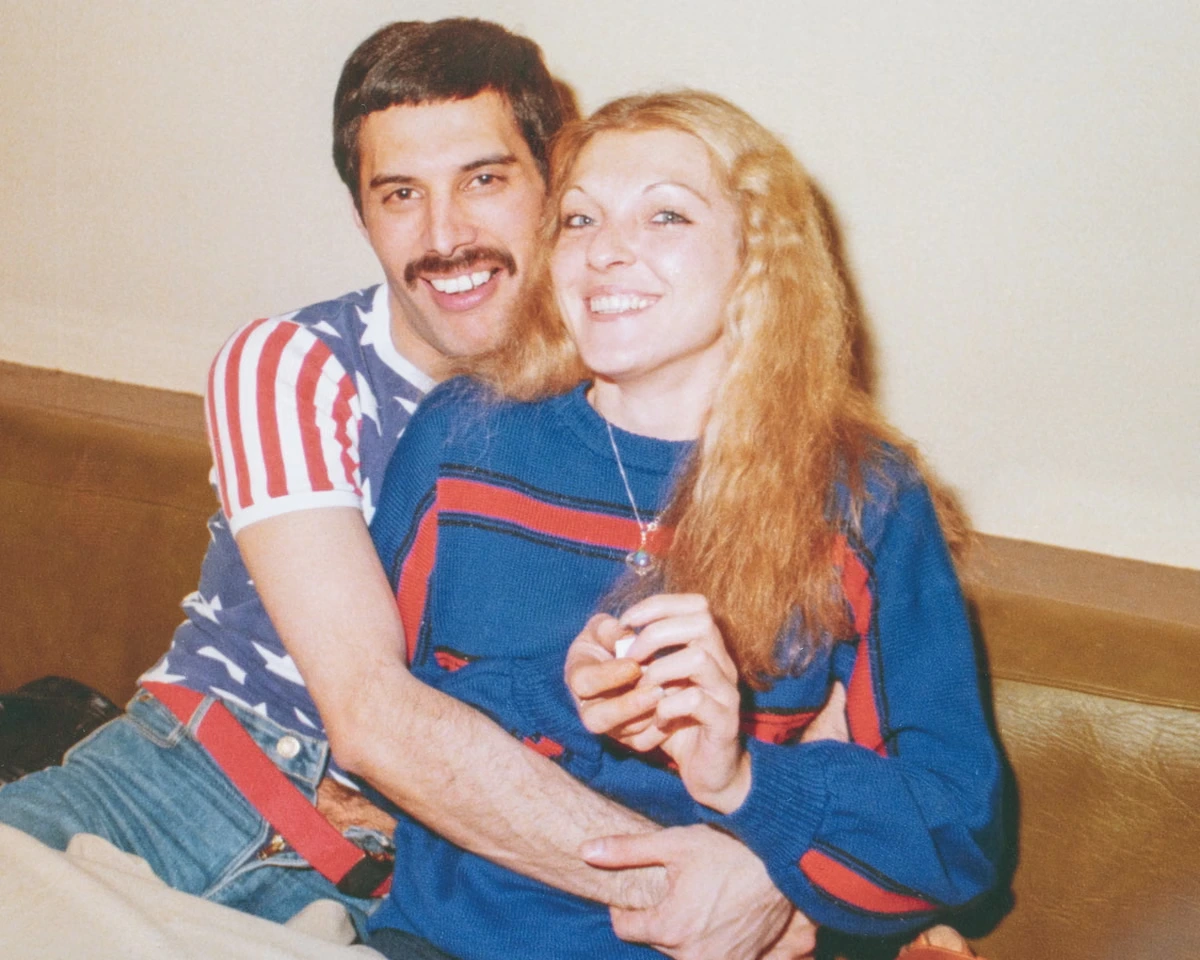
She and Mercury, who was born Farrokh Bulsara 80 years ago this week, were an unlikely couple. He was loud, flamboyant, confident and supremely camp. She was quiet, inhibited, diffident and conservative. He was a rock star in one of the world’s most successful groups; she was a shop assistant turned manager at Biba. He loved flashing the cash, whether to indulge himself or for good causes. She didn’t give a toss about material stuff. He was gay, she was strictly heterosexual.
They met in 1970, when Mercury was running a clothes and textile stall in Kensington Market in London after graduating from his graphic art and design degree. Austin was a friend of Brian May’s, and one day she was at May’s student house when he, Mercury and Roger Taylor were discussing possible names for their new band. May suggested Build Your Own Boat. Mercury proposed Queen.
“They asked what I thought,” she says. “I said I preferred Build Your Own Boat.” Did she really think that? “Oh, no. I thought it was a terrible name. But Brian was my friend. I’d just met Freddie.”
What were her first impressions? “I thought he was too confident for me.” She describes him standing by the fireplace, while she sat on the sofa, and I can see her transported back to the day. “He was full of bravado. I picked up a magazine and started thumbing through it because I felt I shouldn’t be there. Why was I sitting in a conversation I had no part in? Yes, he was very confident and I found it a bit intimidating.”
But they soon became friends and lovers, and within four months, Mercury had suggested they move in together. The idea might have been partly pragmatic, she says. He wanted to live in London and couldn’t afford a place by himself. So they moved in together and split the rent.
They bonded over their difficult childhoods. Mercury was born in Zanzibar, and at seven was sent to a British boarding school near Mumbai. Over the next seven years he saw his parents only once, Austin says. He came to Britain for the first time at 17.
Austin grew up with two deaf parents who struggled for money. Her mother was a cleaner and her father a factory worker. Her mother died when Austin was 15, and she found herself bringing up her younger sisters. Both she and Mercury felt they had been robbed of their childhoods. “Freddie could see the sadness in me that he felt within himself, and vice versa.”
She soon discovered he wasn’t quite as sure of himself as he appeared. “It was a mix of real confidence and bravado. I think the mix was to cover and protect who he really was.” Not surprisingly, Mercury was confused by his identity. He was born in Africa to Parsi Indian parents and spoke with an English plum in his mouth. At the time, brown pop stars were few and far between.
As a Queen-loving child, I had no idea he was Indian. “He hid that well,” Austin says. Does she think he was passing as white English? “Yes. He’d stay out of the sun because his skin would darken, and he didn’t want that. With Freddie, you just saw what he wanted you to see. He’d get stopped in the street by police and they said, where are you from, and when he said Bombay they arrested him, because they thought he was taking the proverbial.”
Did he speak Indian languages? “Never in front of me. His parents would speak Gujarati, but he spoke English back.”
Despite the band being called Queen and Mercury being outrageously camp, when I was young it never crossed my mind that he was gay. This was partly because he was going out with Austin, and partly because it was the glam rock era, when any self-respecting male pop star wore makeup, high heels and frocks.
Austin says she always had her suspicions, though. She makes her young self sound rather prudish. “We were walking down Kensington High Street one day, maybe a month after we met, and he pointed to an ex-girlfriend across the road and said, ‘Ah, that’s my ex-girlfriend, she’s bisexual.’” He stopped to chat to her. “And by the time he’d looked back for me, I’d gone. I just thought, mmm, I don’t know what that is, but it’s not for me.” You sound horrified, I say. No, she says, that’s not right. “I was intimidated by it. He apologised later. In all those 20 years I knew him, it was probably the only time he apologised.”
What did he have to apologise for? “I don’t know. I said, I think this is maybe not for me …” Even now, she’s not sure why she reacted like that. “Retrospectively, I can say he could have been on a fishing trip.” You thought he was testing to see whether you were bisexual too? She nods. “But I didn’t want a menage a trois. I’m heterosexual. I don’t stretch that far, you know.”
But she adored being with him. Austin had only had two short-lived relationships before Mercury. “He was different from the others. He was more creative. He was just more interesting. He was always thinking about going to see things. Not just bands. Like he’d go to see the film Cabaret over and over again. I loved listening to him explain why he enjoyed it so much. I enjoyed the journey around his mind. It was like reading a book. You were always on this journey with him.”
They moved in together in 1971, and were soon engaged. Mercury was desperate for success, which didn’t come quickly. “I remember him saying, ‘I am very mindful I am getting older to be a successful musician.’” He was 26 when Queen signed a major recording contract with EMI, and their second single, Seven Seas of Rhye, was a Top 10 hit. This was followed by Killer Queen, which reached No 2.
Austin says their relationship began to change. Mercury’s bravado was replaced by a genuine confidence, and he was becoming focused. Austin found she was servicing his needs more. “He’d suddenly say, ‘I need a piano. Where can I get a piano?’ … I’d say, ‘I don’t know, but I’ll try to find out.’ So, of course, I find the piano.” It was an upright the owners were getting rid of.
Did the piano change him? “Yes, there was much more purposeful energy. He would sit at the piano, play the odd key, hum a bit and he looked very happy. Transported.” By now they were spending less time together. When she was working at Biba, he would often be sleeping. When she returned home, he would be preparing for a gig.
They’d been living together for four years when Mercury said he had something to tell her. He struggled to get the words out. He said, ‘I think I’m bisexual.’ I said ‘No, Freddie, I think you’re gay.’” He didn’t argue. Was that a huge upset? “No, it was a huge relief, because I wasn’t sure whether we were travelling in the same direction any more. Some time earlier I saw a dress and thought, that would be a really nice wedding dress. I asked Freddie, is it worth me buying it, and he looked at me and shook his head. So I knew from there on …”
But this is what made their relationship so special, says Austin. She had been devastated by the uncertainty, and now she could reconcile herself to a different life. “We became better friends and it became a better relationship. I was six-and-a-half stone. I was really stressed. And suddenly I’m not stressed any more.” For 18 months, they continued living together. By now, Mercury was open with her about the men in his life. His first long-term partner was the show business manager David Minns, she says. “No, we won’t go down that road. We’re talking chaos here.”
Austin became Mercury’s PA, and Mercury appeared to think her duties included refereeing his tempestuous relationship with Minns. “There were arguments and fights and I learned to stay outside because I was aware of how chaotic the relationship could be. The longer it went on, the more distance I created because it was burnout time.” For you? “Yes, I mean, there’s PA-ing and PA-ing!”
What was life like as Mercury’s PA? “I became his girl Friday. Miss Reliable. His workhorse.” Did she resent that? “I’m not big on the ego. No, I didn’t resent it, because I’m very practical. I knew that if I didn’t work for him I’d have to work somewhere for someone.” Did she begin to feel more like an employee than a friend? “No, but if he had treated me as an employee I would have sucked it up, because I’d know it’s because he’s in a foul mood or annoyed with someone or maybe I’d done something and not realised. We’d be honest with each other. He once told me I was inefficient, and I totally agreed.” What’s the worst thing he said to her? “You’re inefficient.”
Queen and Mercury became a phenomenon. In 1975, Bohemian Rhapsody was released. Singles were usually three minutes long. This was a six-minute operetta with a nonsense story, and random references to Galileo, Figaro and Scaramouche. Queen were told by their management it was a suicide single. Bohemian Rhapsody was No 1 for nine weeks and became the biggest-selling single of the 1970s. The band were as unpredictable as they were successful, segueing from classic pop (Don’t Stop Me Now) to prog rock (Innuendo), heavy rock (Seven Seas of Rhye), opera (Bohemian Rhapsody), seaside ditties (Seaside Rendezvous), rockabilly (Crazy Little Thing Called Love), synth pop (Radio Gaga), disco and hiphop (Another One Bites the Dust).
Mercury had an astonishing four-octave vocal range, from baritone up to falsetto. Billboard voted him the third greatest rock lead singer of all time (behind only Mick Jagger and Stevie Nicks); ChartMasters ranks Queen as the second bestselling band of all time, behind only the Beatles. In 1985, when their popularity appeared to be waning, they wiped the floor with every other act at Live Aid. And, if anything, their popularity has increased since Mercury’s death. The 2018 film Bohemian Rhapsody earned almost $1bn at the box office, the highest grossing music biopic in history.
Did fame change Mercury? “It changed the shape of him,” says Austin, “but not his core. You can’t get on the bus any more, for example. The shape changes externally, but inside you remain the same. You have to. You don’t survive this business if you don’t, because your ego will just take over and annihilate you.”
Was he ever in danger of his ego taking over? “I saw glimmers of it.” When? She says it started when the band was being managed by John Reid. “They were travelling, they were successful and there were certain interesting conversations you overhear. ‘Why are we playing in a certain territory?’ I won’t say where, it’s so disrespectful.” Mercury thought certain countries were too small for Queen. “That was interesting to me.”
By the late 1970s, Mercury was frequenting New York’s underground leather bars and clubs. He then moved to Munich, where he reached peak promiscuity. He gave very few interviews during his lifetime, because he said the media portrayed him as an “ogre”, but in a rare one in 1985, he said: “I used to be just an old slag who got up every morning, scratched his head, and wondered who he wanted to fuck today. I just lived for sex. I’m a very sexual person but I’m much more choosy now than I used to be.” Two years later, he told his friend, the journalist David Wigg, “I’ve stopped going out. I’ve almost become a nun. I thought sex was very important to me … I lived through sex … now I’ve just gone completely the other way. It’s frightened me to death. I’ve just stopped having sex.”
In October 1986, the British tabloids reported that he had taken an HIV test, which he denied; he said he was perfectly healthy. Mercury had, in fact, tested positive, and six months later his doctors confirmed his HIV had progressed to Aids. He told his inner circle: his partner Jim Hutton, Queen’s manager Jim Beach, and Austin.
“He wanted to live his life,” she says. “It’s sad; you want to live life and then you realise maybe you’ve stretched the book a little bit too far and the spine is going to crack. Does that make sense as an analogy?” But she believes he was at his happiest in the decadent years. “I think he was at his freest in New York. He wasn’t being chased. In America, he could move from state to state. He could disappear when they were on tour. But he could also do that in France and he did it in Munich. Wherever there was larger acceptance of his sexuality, he was happy.”
Does she think he had any regrets? “He always said he regretted nothing. But you never know.” She stops. “There was a time when he said that he wished he could talk about being addicted to cocaine. He was talking to me about it, so I don’t know who he wished he could be talking to. I think he was actually thinking aloud. This was way before New York, and the excesses.”
Did the cocaine change him? “No, I was amazed. I didn’t do it. But I used to watch people and think, how d’you do it? How d’you drink to the excess that you drink?” Did he drink a lot? “Yeah.” And did she ever take drugs? “No. Well, I did puff on a spliff once.”
Mercury was fantastically creative in his final years. There was his 1988 operatic collaboration with Montserrat Caballé, Barcelona; Innuendo, the final Queen album released in his lifetime, in 1991; and the posthumous album, Made in Heaven, in 1995. Mercury was living with Hutton at Garden Lodge in Kensington, a house originally built for the painter Cecil Rea and his wife, the sculptor Constance Halford. He adored the house and its Japanese-style gardens. Austin lived less than a mile away, and she had made sure Garden Lodge was just how he wanted it.
A couple of years before Mercury died, when Austin was almost 40, she had her first son Richard with her then partner. Mercury became Richard’s godfather. I ask if he doted on him. “Well, he knew he had Aids, and he felt he should never touch Richard, go near him, because there was so little known about the virus at the time.” She didn’t share the anxiety, she says. When Mercury was dying, Austin was pregnant with her second son, Jamie. “I was there next to his bed, I was holding his hand, I was doing whatever I needed to do.”
There have been numerous books written about Mercury. One published last year suggested he had a secret daughter who subsequently died. Austin is not convinced. “He never told me he had a daughter, and I can’t imagine him ever keeping that secret.” She giggles. “Sorry!”
The press was merciless towards the end. “The British media had a huge impact, and sculpted the way he lived his life,” Austin says. “There were photographers outside Garden Lodge and I remember a bike was coming through to collect their film, and the courier asked if there was any news, and someone shouted, ‘No, he’s not dead yet.’” How long was this before he died? “Two weeks maybe. They were waiting, vulture-like. They’d wait for him when he had doctors’ appointments and had to leave the house. Freddie needed decoys. It got chaotic.”
A day before he died, Mercury issued a press release saying he had Aids. It would have been easy for him to say he had pneumonia. Although he had lied about it before, he wanted his legacy to be an acceptance of and support for people with Aids.
As for Austin, she split up with the father of her boys before Jamie was born. She later married, but that didn’t last. Does she think her love for Mercury affected her relationships with other men? “I think I have bad taste,” she says. Has she ever chosen well? “Post Freddie, no.”
Can she remember the last words he said to her? Silence. Eventually she answers. “I was holding his hand. He was on morphine and in and out of consciousness, and he falls back to sleep. And I stand there for quite a while and he finally comes round again and he just said, ‘My old faithful.’ So I felt a bit like a dog. I wasn’t flattered.” She laughs. It’s one of the saddest laughs I’ve heard.
Had he ever told her he loved her? “No. No, he was not a man who … He bought things.” Did she believe him when he said he had written the song Love of My Life for her? No, she says, that’s apocryphal. “He never said it was about me. He wrote Lily of the Valley about me.” Lily of the Valley is a much more gnomic song about his changing sexuality and relationship with Austin. I ask whether he was the love of her life. “I think I can say, in retrospect, so far, yes, he is the love of my life.”
Mercury might not have told Austin he loved her, but in a 1985 interview, he said: “The only friend I’ve got is Mary, and I don’t want anybody else. We believe in each other, that’s enough for me.”
He called Austin his common-law wife and, years before he died, told her that she would inherit the house and 50% of his fortune and future royalties. She told him flat out she didn’t want Garden Lodge. “I said, I don’t want the house, I’ve worked hard for you to live in this. And he said, if everything had gone to plan you would have been my wife, and this would have been rightly yours.” Ultimately, she says, she felt it was her duty to accept the inheritance.
Does she think he did it out of love or as an apology? She cringes. “I don’t know. There’s more on that list than you realise, I’m afraid.” Such as? “Oh, lots.” Guilt? “Could be, but I think not. If you put your thinking cap on, you’ll get there.”
I think Austin may mean that it was his payback for her discretion. (A former partner and manager, Paul Prenter, was fired by Mercury and sold his story to the Sun.) And perhaps Mercury left her so much because she was the only person he could trust to carry out his final wishes. He insisted he didn’t want the house turned into a museum. “Back in the day, museums were very dusty and stuffy and he didn’t see himself as dusty and stuffy.” And he didn’t want anybody to know where his ashes had been scattered. Austin will take that secret to her grave.
It’s been the cause of much friction. Not least between her and Mercury’s surviving family. “I think if I was Freddie’s parents, Freddie’s sister, and I wasn’t allowed to know where his ashes have been scattered, I would be upset and offended, but that’s the job he asked me to do. And I did it. I kept saying to them, ‘I’m really, really sorry – I can’t tell you.’” Did they accept that? “His mother did, yes.”
Austin says she struggled so much after Mercury’s death. “It took me a long time to get over the moment of death – that transition between, you’re going to die, to the day he does die, to the day after, to the week after, to the month after. That’s for me, emotionally, how it went. But because I was pregnant, I realised, I can’t do this to my child. I’ve got to do whatever I need to do, and I used that to defer any pain.”
It wasn’t simply his death that traumatised her – the will led to a lot of antagonism. Hutton was left £500,000 by Mercury and told he would have to leave Garden Lodge after three months so Austin could move in. He claimed Mercury had told him he could continue living there and resented Austin; in 2010, he died of lung cancer. Today, Austin says she didn’t have any choice. “It had nothing to do with me. It was all down to the executors of the will.” Despite her reluctance to move into Garden Lodge, it gave her huge comfort. “I could still be with him.”
The subsequent years have been fairly solitary, though, she says. While Mercury had many social circles, she says she has never had any. “I’m a loner. I keep myself company.” Has she enjoyed her own company? “Yes, but now I’m getting much older, I’m getting bored with it. I get bored with fixating on how my back hurts and I’ve got to find another physio, because it’s not living life any more.”
In the end, Austin got her sons and Sotheby’s to empty the silver trunks, assess the value of Mercury’s belongings and prepare for auction. Austin thought, this way, his true fans would end up with his treasures. But that’s not how it worked out. Much of it went to the super-rich, who simply regard it as an investment. The auction raised £40m, and again fans suggested Austin was just in it for herself. Does that bother her? “No, they have a right to their opinion. But I’m 75, I’m going to die. And I looked at everything in the house, and I looked at my boys, and I thought, this is going to be a burden for you.”
She says she has no regrets about selling his collection, but others are not so positive. It was reported that Mercury’s sister, Kashmira, anonymously spent £3m buying back family mementoes. Austin says she doesn’t know if this is true, but the thought saddens her. “We did reach out to her before the sale to see if she wanted anything.” She says their relationship is delicate, and she hopes it’s recovering.
As for the house – which, until the Sotheby’s auction, was largely unchanged since Mercury had lived in it – she now realises he understood how important it would be to her. “I lived in the house which he wanted me to live in and explored it for 20 years. The house was full of him; the memories. He realised how much I loved him, and how much I would need that house.” But now, she says, it’s time to move on. Garden Lodge is on sale for £30m. She hopes it goes to a family with children who will enjoy it as much as she and her boys have.
Has the inheritance been a blessing or a curse? “Mostly, it’s been really difficult.” What’s the most extravagant thing she has bought herself? Nothing really, she says. “I bought my husband two Ferraris,” she says, with contempt. He asked for a second? “Yeah. And I was like, you can have it, but you have to go.”
Initially, after the trunks were opened, her sons and Sotheby’s trawled through them. But gradually she overcame her aversion, and once she found herself able to look, she couldn’t turn away. Not only were the lyrics significant pop historical documents, she realised she could contextualise them, because she was there when most were written. If she was going to sell off his collection, she would make sure there was something for the fans, by publishing a book.
How did her boys feel about going through Mercury’s possessions? Astonished, she says. This is where the story gets really strange. “The boys had no idea till they were in their late 20s.” They had no idea how much he had left or its value? No, she says, they had no idea of anything. “They knew nothing about Queen, because I never told them. I never told them about Freddie. Ask Jamie when you see him. Ask him when he first realised.” Jamie is in another room, looking after her clothes for the photoshoot, while we chat.
So how did he think they had got the money to buy the house? “Jamie thought we’d inherited the house from his great-grandfather.” Because you told him that? “No, he made it up. When he was young, he brought his friend to the house. In my head I can see them close to the piano, mid-conversation, photographs are on the piano, and Jamie is telling his friend, ‘Yes, the house used to belong to my great-grandfather.’ And I thought, wherever did you get that from?”
Were there no pictures of Freddie in the house? “There were, on the piano, but Jamie never asked. Nobody asked. They were just there.” Did the boys know anything about the inheritance? “No.” At what point did she tell them that she had inherited Mercury’s house and money and he was the love of her life? How did that conversation go? “It never did. I never talk to them about money. Money goes into the bank account if you need to pay for anything.” Have the boys got Ferraris? “No, my eldest has got a third-hand Mini that used to be mine, then Jamie’s, because he’s really sentimental, and Jamie and I share a Tesla.”
Did she not think she was keeping something important from them? “No, because they were young boys growing into teenagers and young men. I’ve read so many psychology books about young boys and how many hormone changes they go through and how complex they are, and I thought, you have to enjoy your life. Your childhood is key to who you are.” It seems she is thinking back to her childhood and Mercury’s.
When did Jamie realise it was Mercury’s house? “He’s 34 now. He had no idea till pre-Sotheby’s auction discussions four years ago, when I realised I had to tell him.” Was he gobsmacked? “You ask him.” Did he know about Queen? “I don’t know. Ask him.” Did he listen to their music? “I haven’t even asked him that question. I just didn’t want him to grow up being anybody else other than himself. I’d lived around Freddie, and how d’you ever describe anyone like Freddie? It takes a lifetime. And it took my lifetime, even though he’s been dead for so much of it.”
It doesn’t seem healthy to me to live guarding such a massive secret from your children. Does she think it screwed her up? “No, because talking about him used to make me cry. Why would I do that to make myself upset?”
I ask who will inherit the money when she dies, expecting her to reel off a list of charities. But she doesn’t. “It’s going to go to my children, and it will find its way as it normally does – death duties, and the tax man.” Will much of it go to charity? “A good tranche goes to Elton and the Aids foundation.” Is she friendly with Elton John? “No, I don’t think they warmed to me.” She laughs, embarrassed. Why not? “I don’t know.”
You keep telling me about people who haven’t warmed to you or dislike you, I say. “I don’t think about it, is the truth,” she says. “The music business has taught me to think outside everything. I think it’s very predatory. I like to sit on the wall, I like to watch the world go round. I find it really interesting. Maybe that’s because my life’s boring.”
We head to the photo studio. She walks slowly, with the support of her stick, and seems excited at the prospect of me talking to Jamie about Mercury. I feel I’m about to have the conversation she still can’t face herself.
I tell Jamie his mother said he knew nothing about Mercury till he was an adult and that he told friends the house was inherited from his great-grandfather. He looks sheepish and tells me it wasn’t quite like that. “So, when I was younger, there was a tendency for parents to speak about my mother’s association with Freddie, and I didn’t really want that association. I just wanted to be seen for me. So I would tell people I was at school with that it was actually inherited by my grandfather.”
But you knew all along? “Well, obviously everyone knows who Freddie Mercury is. It’s true that my mother decided not to talk about Freddie, but there were lots of Freddie’s CDs in the house. One of the first bands I listened to was Queen because the house was filled with them.”
Austin listens intently. “I knew my mother had a relationship with Freddie,” Jamie says. She looks tearful. Did he ever tell her he knew? “We never discussed it as a family. It was very difficult even when I was an adult for Mum to talk about it. There was a great deal of emotion. The loss was still there. It was obvious to me and my brother how painful it was for my mother to speak about it. When you see that kind of discomfort and pain, it’s not something you want to talk about. So we learned to be respectful of that.”
Even when he was a toddler, he says, he was aware of journalists stalking Garden Lodge. “There were paparazzi outside our house when we were young, people climbing the fence of the house. I remember on the anniversaries of Freddie’s death the garden would be full of flowers brought in by the police. There would be hundreds of people in the street outside. This continued till I was much older, 12, in my teens. The police would set up barricades on the anniversary.”
Has talking about it all changed his relationship with his mother? “Hugely. It was a huge moment for the whole family. And it took years from the first time we talked about it. That was the opening of the door, as it were.”
He looks at Austin. “Now I have such an incredible appreciation of everything you went through.” He looks back at me. “Mum was grieving. She’s giving birth to me two months after Freddie passed, she’s moving into Garden Lodge when I’m six months old and my brother is just over two. She doesn’t have a partner at the time. And she’s left alone with all this and no support structure.”
He turns back to her. “It’s strange, because I lived 30 years of it in a very different way from you. But I have such a starkly different appreciation of how difficult everything was for you and why you made the decisions you did to protect us the best you could. Now she’s in her 70s and she feels she had the support structure to close the door on that chapter.”
Jamie tells me he has never met anybody as “humble” as his mother. “To the point where you don’t believe anyone is interested in anything you have to say or no one wants to speak to you. And you just want to do this for Freddie and to celebrate him.”
Despite the wealth and the home, it sounds as if it’s been extremely lonely at times, I say to Austin. She blinks back tears. “Yep. Sorry, I’m reliving it and getting emotional.” She says she doesn’t have a clue what the future holds, but she knows it’s finally time to move on. It’s time to declutter her life. And, in a strange way, today’s conversation seems to be part of that process.
When she considers everything that’s happened, Austin says, she thinks maybe she isn’t so boring after all. “You need your whole lifetime to realise that. You don’t realise at 19 that your life is going to be unusual. Then at 75 you realise, wow, my life has been unusual. You’re suddenly looking back and thinking, yeah, I do stand alone.”