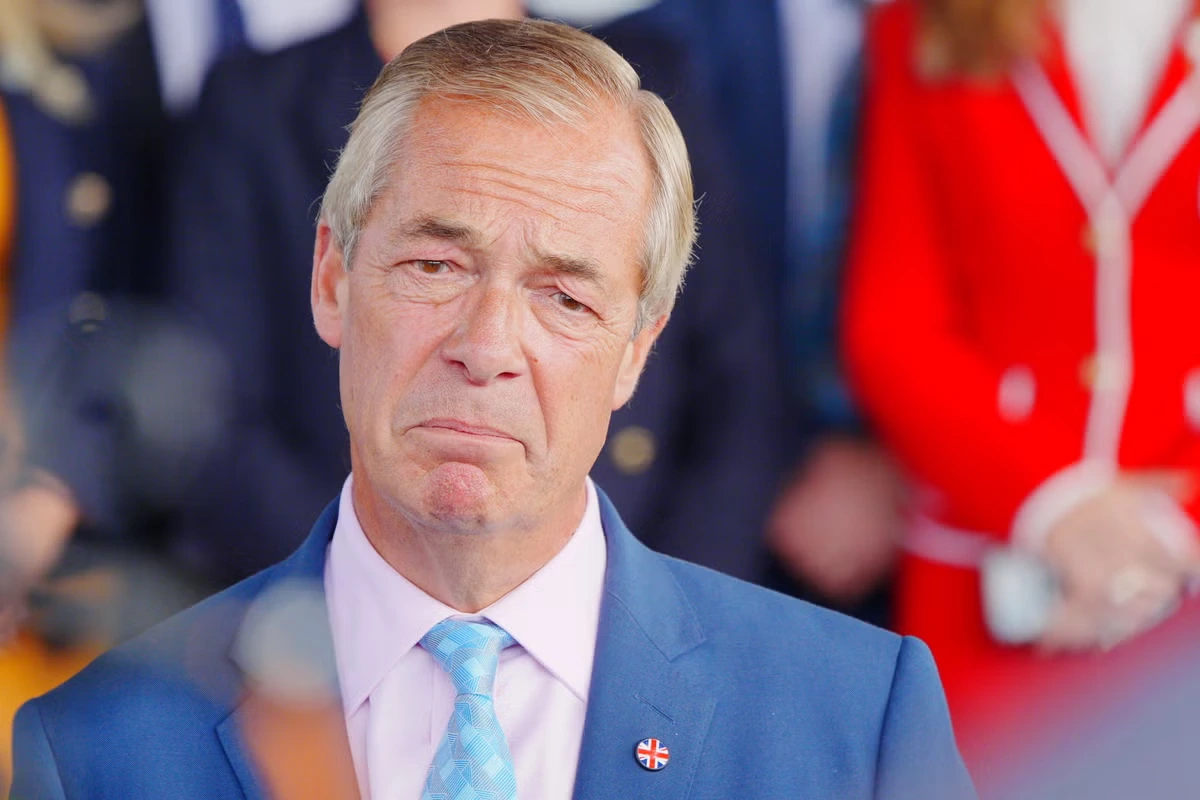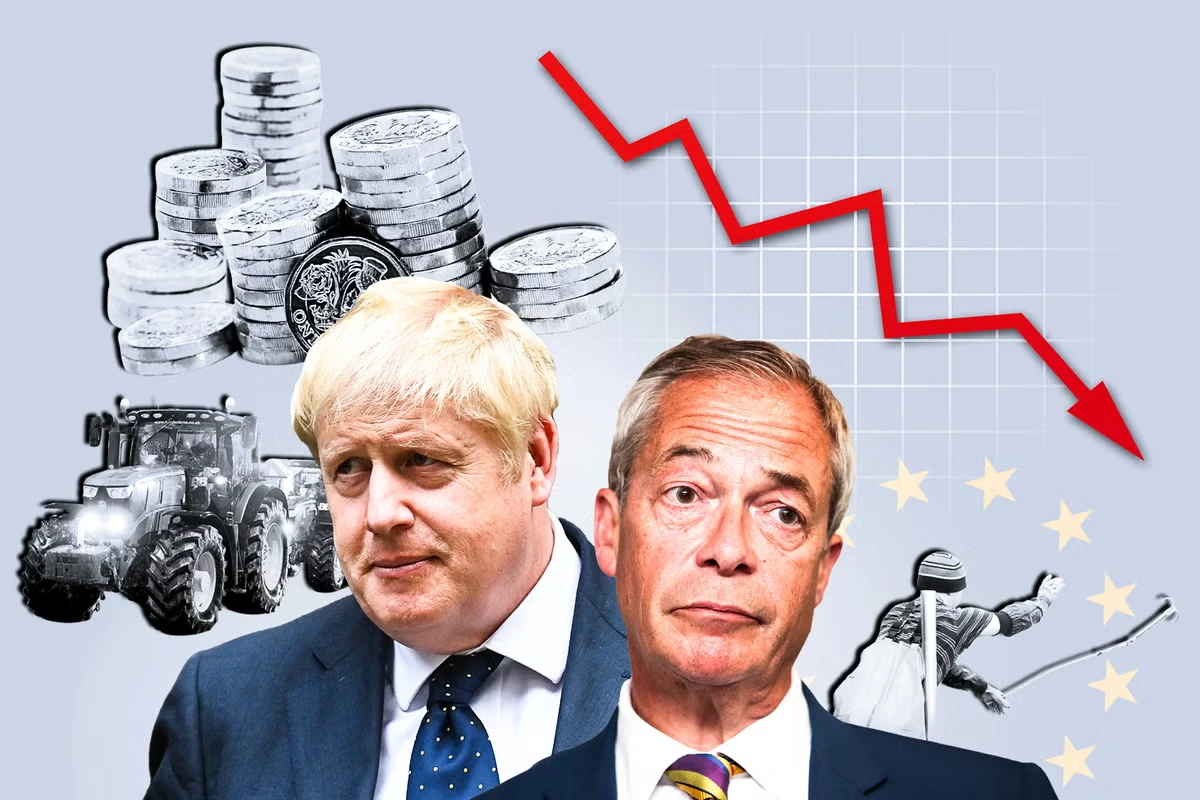
“Let June 23 go down in history as our independence day,” Nigel Farage declared as he addressed a fist-pumping crowd of Leave supporters in one of the most-watched clips from, arguably, the all-time dramatic night of British politics.
Speaking to the impromptu gathering, along with the nation through the cameras of the watching media, Mr Farage said the result would be a “victory for real people, a victory of ordinary people, a victory for decent people”.
The country had, just, voted to leave the European Union following a campaign that promised sovereignty, as well as an extra £350m for the NHS, a curb on immigration and control of British waters.
But within 24 hours, Britain had lost its prime minister David Cameron as the country slipped into a four-year period of political chaos centred on EU withdrawal negotiations, before finally the agreement was signed at the initial cost of £30.9bn.
Ten years on from the referendum, and six years on from the leaving the EU, Brexit appears to have missed the mark.
“People are increasingly realising that they are feeling the Brexit effects on pockets,purses,jobs and opportunities,” Labour peer Neil Kinnock told The Independent. “They are also recognising that the glib promises made by Farage and other Brexiters were garbage.”
A day after Sir Keir Starmer stepped down as prime minister — the sixth to leave No 10 since the Brexit referendum —The Independent counts the cost of Brexit:
As part of the withdrawal agreement, the UK government agreed to a settlement with the EU, with the latest figure released by the Treasury showing that it stood at around £30.9bn.
Paid mostly over the five years since the UK left the bloc, it was broken down into two components.
The first was £9.4bn paid for during the transition period up to the end of 2020, as required as if it were a member state.
The second was the reste à liquider — the outstanding budget commitments for projects — with £16.2bn paid off by December 2025. A further £5.3bn is due before 2065.
Following Britain’s exit from the EU single market, the Office for Budget Responsibility, the independent Treasury watchdog estimated Brexit’s impact would lead to a 4 per cent reduction in potential productivity of the UK economy by mid-2030.
But there are more stark estimates that have since emerged.
A research paper updated this month by the US National Bureau of Economic Research shows that UK GDP per head is between 6 per cent and 8 per cent lower as a result of the UK voting for Brexit a decade ago.
Researchers used combined modelling to draw their conclusions, but also show a ‘synthetic’ version of the UK without Brexit, finding an upper-bound GDP gap as high as 11 per cent by late 2025.
Initial uncertainty created after the referendum was a major factor of the hit, according to the paper, as was the rising trade barriers after the UK left the single market.
Compared with EU countries, the US, Canada, Iceland, Norway, Switzerland and Japan, the researchers found Britain to be lagging in comparison.
The paper concluded: "In the case of Brexit, there was a substantial economic impact on the United Kingdom, but it arose gradually over the subsequent decade.”
From David Cameron’s decision to step down hours after the result of the EU referendum, all the way to Sir Keir Starmer announcing his resignation on Monday, the Brexit fallout has brought a level of chaos to the country’s political leadership.
Factors, of course, include the Covid pandemic and the world market turmoil, but Brexit has also added its own pressures.
After Mr Cameron stepped down within 24 hours of the referendum result, the onus fell on Theresa May to negotiate a Brexit withdrawal agreement, but she couldn’t get her proposed deal out of parliament, and stepped down in May 2019.
Mr Johnson came in promising to break the deadlock — and did. But his leadership was severely damaged by scandals including the “Partygate” affair during Covid.
Next up was Liz Truss who, lasting as prime minister for just 49 days, unveiled a disastrous mini-budget which saw the pound fall and government borrowing costs surge.
Rishi Sunak lasted almost two years, but oversaw much of the “Levelling Up” programme, designed to spread wealth across the UK but later criticised for failings in delivery.
Finally, Sir Keir took the reins at the 2024 general election. He faced a balancing act on handling Brexit as he faces fierce opposition in targeting a EU reset programme to improve relations with the bloc, but stood down on June 22.
As the UK left the EU, the country’s trading relationship “changed fundamentally”, according to House of Commons research briefing published this month which found the country’s trade performance in goods suffered.
There are no tariffs on trade in goods with the EU, provided certain conditions are met. But other barriers to trade are now higher as a result of Brexit.
UK goods exports were 15.5 per cent lower in 2025 compared with 2018 in real terms, according to figures from the Office for National Statistics (ONS).
It is a different story for the UK’s export of services, which has grown strongly in recent years.
In 2025, the EU still accounted for 41 per cent of exports for goods and services combined, despite the signing of new free trade agreements signed following Brexit.
The largest market for UK exports was United States, accounting for 22 per cent, followed by Germany (7 per cent), Ireland (6 per cent) and the Netherlands (6 per cent)
The value of the sterling slumped after the EU referendum, from $1.50 to $1.33, and although it has since risen it still remains short of pre-Brexit times. The consequence of a weaker pound is that imports to the UK are more expensive.
A study from 2021 by estimated that the fall had added around 3 per cent to consumer prices, adding an average £870 to the UK household bill.
The increase, worsened by the cost-of-living crisis, has also impacted businesses, which in turn have seen their production costs go up, contributing to lower growth in wages, according to a report by the London School of Economics this year.
Author Thomas Sampson wrote: “A decade on, we now have enough evidence to conclude that Brexit has been an economic failure.”
The demise of the UK’s fishing industry has long been an emotive subject of concern, and was an issue jumped on by Brexit campaigners who promised to “take back control” of British waters.
One publicity stunt saw Nigel Farage lead a flotilla of boats up the River Thames.
But despite leaving the EU, British waters remain open to vessels from France, Germany and Spain. Mr Johnson did secure an uplift in fishing quotas for UK vessels, but last year Sir Keir angered the fishing industry when he extended an agreement allowing European vessels to operate in UK waters until 2038.
In 2024, the size of the UK’s fishing fleet was at 5,232, compared to 5,824 in 2020 – a loss of 592 vessels.
The farming industry faced, arguably, one of the biggest changes following Brexit with the slow withdrawal of EU subsidies, which were then replaced by a UK policy which saw farmers rewarded for delivering environmental benefits.
The move has proved unpopular for many, who claim the government, which also unveiled hugely changes to inheritance tax, was not backing British farming.
Farmers have also had to face trade barriers caused by the EU withdrawal, with latest HMRC data analysed by the National Farmers’ Union showing a 37 per cent fall in farming exports to the EU since 2019.
Tellingly, a poll run by trade outlet Farmers Weekly found that just 18 per cent of people thought the impact of Brexit had been positive. More than two-thirds (68 per cent) said it had been negative.
A central part to the Leave campaign was to cut down immigration. But after leaving the EU, and the introduction of a points-based immigration system aimed a prioritising skilled workers, immigration surged.
This was partly down to labour shortages in health and social care during the Covid pandemic.
Figures from the Office for National Statistics show that long-term immigration to the UK, where people change the country they live for a a year or more, rose to a peak of 1.5m in year ending March 2023. This fell to 813,000 by December 2025, a figure that is still nearly 20,000 higher than the level at the time of the EU referendum.
The data also shows that the proportion of immigrants are no longer EU citizens, but people outside the EU bloc, with most arriving for study. Meanwhile, as a result of Brexit, UK nationals lost free movement to and within the EU.
Following the EU referendum, the Tory government began a programme of “Levelling Up” to spread wealth across the UK and, in part, replace EU funding for deprived areas of the country.
A total of £4.8bn was assigned for three waves of funding across the UK, and was backed up with further funding pots such as the £3.2bn Towns Fund and £3.5bn UK Shared Properity Fund.
But in its review of the funding, the National Audit Office found that delays in the award of funding had put back many local authority projects, and that there was a poor departmental understanding of what has worked previously on local growth programmes.
Despite the NAO later finding significant improvements had been made, there has been criticism by regional leaders over the use of the money. A report by the University of Liverpool found that “Levelling Up” had been a “total failure”, based on the argument it failed to reach the areas most in need.
Meanwhile, latest HM Treasury shows that despite the gulf in public spending per head narrowing between London and the UK average since Brexit six years ago, there is still a signficant gap. Spend per head when excluding social protection such as benefits in London was £10,079 in 2024/25, compared to the UK average of £8,029.
Two-thirds of the public in 2016 thought Mr Cameron was right to call the referendum, but that figure has now fallen to 43 per cent, according to a study, while the number saying it was the wrong decision has risen from 24 per cent to 38 per cent.
The research by Ipsos, King’s College London and think tank UK in a Changing Europe suggested attitudes over the past 10 years have changed towards both the EU and the referendum itself.
Also, the number of people who say Brexit is going worse than they had predicted has almost doubled in the past five years, from 27 per cent in 2021 to 48 per cent today – more than those saying it was going as well as or better than expected.
The study polled 2,245 adults across Great Britain between 15 and 20 May this year.
Sign up to our free Europe: The Way Back newsletter here or by using the form below:
What you will get by joining:
There are even more benefits if you subscribe for just £1 for seven months: