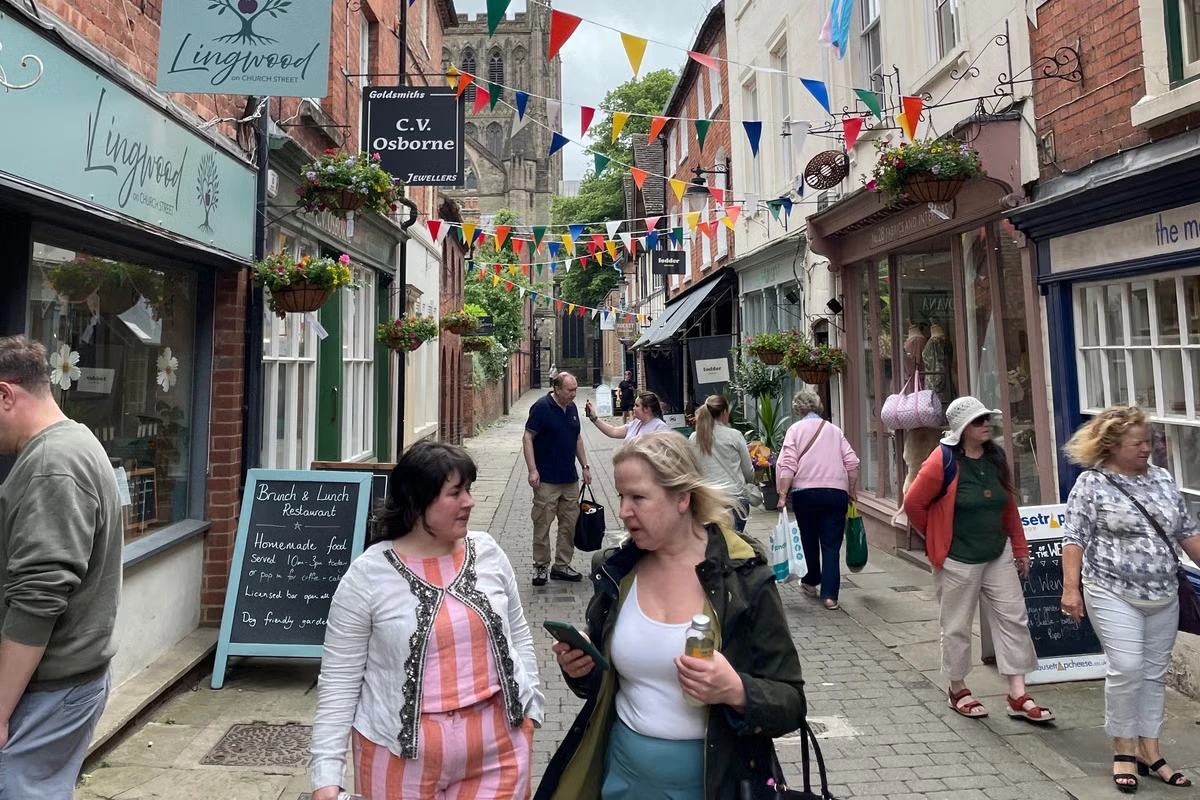
Humbly situated next to Hereford’s magnificent Gothic-style cathedral, stands a bronze statue of, arguably, its most famous son.
Sir Edward Elgar, who wrote masterpieces like Allegro for Strings during his seven-year stay in the city, is sculptured leaning against his Sunbeam motorcycle, chin raised, and looking across the conserved grounds of the huge church.
Behind him is St John Street, where there are no less than six listed buildings all banded closely together, and 100 metres away the world’s largest medieval map, Mappa Mundi, is on display at the visitor centre.
On the bright June morning we visit, there are dozens of uniformed children from Hereford Cathedral School, the sixth oldest school in the country, along with a few camera-happy tourists who pass by.
Hereford is undoubtedly a city rich in heritage, and one with hopes of becoming the UK City of Culture in 2029.
But under the surface, there is frustration brewing.
For also within the eyeline of Sir Edward is the city’s Venetian-styled library and museum, which, built in 1873, showcased the county’s proud history until 2023, when it shut to be turned into an £18m world-class museum.
The problem is that the construction, backed by £5m in post-Brexit funding by the Tory government in 2021, still hasn’t started.
It’s a similar story for the library. Set to move to the Maylord Shopping Centre after getting £3m government funding, a change in political party running the council in 2023 saw the plan altered to move the library into the boarded-up Shirehall instead. For now, the library is in its second temporary home on the ground floor of the Town Hall.
Both projects were part-funded by a “Levelling Up” funding pot called the Towns Fund, announced in 2021 by then communities secretary Robert Jenrick with a £22.4m award for Hereford, aimed at boosting prosperity and opportunity.
But for now, the city, with a population of more than 60,000, has no standalone library or county museum in the city centre. The centre does still have a council-run Tudor-themed museum called the Old House Hereford.
“It is inexplicable and inexcusable,” said city councillor Jeremy Milln. “The money was warmly welcomed and there was great excitement about what would be on offer. But complexities and political upheaval have left us wondering when the projects will happen.
“It’s a great shame to be without a county museum for so long, and a poor reflection on our cultural responsibility in telling the history of our county. We have failed to deliver on our key landmark projects as yet.”
Stronger Hereford, the group managing the funding, has defended the delays, describing the projects as complex and hit by escalating costs. Chair Abigail Appleton also pointed to other projects funded under the scheme which had been rolled out, including a new football 3G pitch, regenerated pavilion on the bank of the River Wye and a community market garden scheme called Grow Local.
However, the library and county museum are a source of irritation in the city centre.
They also offer further disappointment for those who backed Brexit, with the Towns Fund money - £3.6bn was issued nationwide - aimed at delivering change in less well-off towns and cities after the EU withdrawal agreement was signed.
In Herefordshire, 59 per cent of people voted to leave in the EU referendum 10 years ago.
“I don’t know why were promised so much,” said Ian Prescott. The 64-year-old said the offering in the library was now “so small” and the city, without its planned county museum, had “tripped itself up”.
He added: “So much was said for Brexit; the benefits it would bring, the more money we would get. Then we had announcements for a sparkling new library and museum here in Hereford, but you don’t see any work happening yet, do you?
“I’m not sure if it’s the government’s fault or local leaders, but I can say that I didn’t vote last time, but would vote Remain if given the opportunity again.”
Semi-retired Martin Grant, 64, said: “The situation [library and museum] follows the narrative of Brexit. Voters were duped, and now they’re waking up and realising they are even more neglected despite Westminster’s pledges.”
Cleaner Tracey Morris, 62, used to take her grandchildren to the museum and library before it closed. “It’s been closed so long, you give up hope, along with a lot of things promised,” she said.
Hereford’s story does not appear uncommon. In 2023, the National Audit Office, the independent public spending watchdog, found inflation, skills shortages and construction issues had contributed to local authorities delivering funded “Levelling Up” projects.
The government’s own assessement on Towns Fund projects found money issued was perceived as insufficient to cover management and delivery costs of projects. In response, it extended the timescale to spend the cash from next year to 2028.
Worryingly, at a local Stronger Hereford board meeting, the museum and library projects were given “red ratings” with a warning that there was “no indication at this stage about the final scale of the intimated budget shortfall or timescales for it to be resolved”.
According to Stronger Hereford’s website, the new library will open at the end of this year. Hereford Museum Service Support Group has said the current estimate for the museum reopening is 2027.
Speaking to The Independent, Ms Appleton said she had confidence the projects would go ahead as she called for “tenacity to realise the vision” from those left frustrated in the city. She also refused to let it overshadow success of the Towns Deal fund, which has also seen a new digital skills centre opened and a cycle track.
Money also went toward a fleet of “Zipper” electric buses which, although popular in the city, now face uncertainty as funding runs out.
Out of the £22.4m awarded to Hereford from the Towns Fund, £15m had been committed for projects, with some also receiving revenue from other sources.
At the regenerated Castle Green Pavilion, which now benefits from a restaurant and viewing area over the River Wye after Towns Deal funding, Paddy Nugent, chairman of the group that runs it, said: “I know there has been issues on the more complex projects, but from our perspective it has been successful.”
Ms Appleton said she was proud of how the city’s groups had worked together to spend the money on projects that increased opportunities in education, sport and culture.
She added: “Yes, two of our flagship projects have encountered more challenges including cost escalation and structural complexity. It’s not unusual in the sector at any time and we’ve also faced the impact of world events. These are complex and ambitious projects in historic landmark buildings.”
Herefordshire council’s cabinet member for community services and assets, councillor Harry Bramer, said the museum and library projects were “large and complex”. He said work was ongoing to finish off designs and create cost estimates. He added: “As with any publicly-funded major projects these are kept under continual review to monitor and forecast costs, timings and resources in the interests of taxpayers.”
Back at Sir Edward’s statue, one wonders what the great composer, whose famous work expressed patriotism and pomp, would have made of the ongoing loss of one of the city’s cultural treasures, particularly following the unearthing of the Herefordshire Hoard, which for now has been loaned to Jorvik Viking Centre in York.
One might also consider his thoughts on the fall of Britain’s standing on the world stage, especially post-Brexit, from the empire age he adored.
Sign up to our free Europe: The Way Back newsletter here or by using the form below:
What you will get by joining:
There are even more benefits if you subscribe for just £1 for seven months: