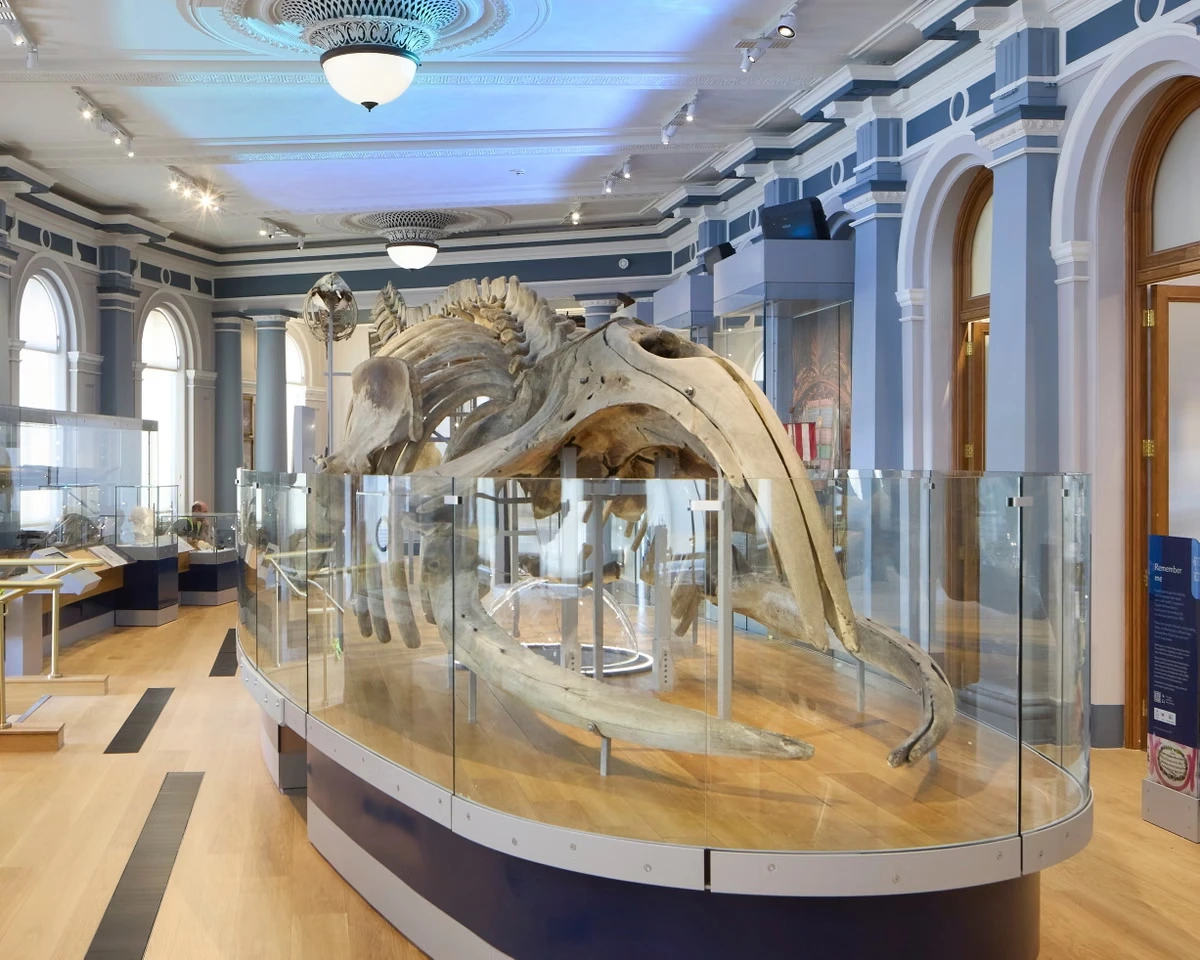
The star attraction of Hull’s revamped and revitalised Maritime Museum is a colossal 40ft-long skeleton of an North Atlantic right whale, beached more than a century ago. The remains of this leviathan dominate an exhibition space scarcely large enough to contain its stupendous bulk. Children can crawl into its ribcage, like junior Jonahs, popping up in a clear plastic dome as digital images of swimming whales slowly unspool across the ceiling.
Docile, leisurely and extremely blubbery – which meant that harpooned carcasses conveniently floated, as well as yielding copious quantities of valuable oil – the North Atlantic right whale was hunted almost to extinction during the whaling era. Today, it’s estimated that there are fewer than 400 left.
At the other end of the cetacean scale is a delicately carved whale that can fit into the palm of your hand, studded with miniature harpoons designed for use as toothpicks. It forms part of the museum’s world class collection of scrimshaw, the niche and intensely fiddly folk art of carving and decorating pieces of ivory or bone. Crewmen would while away the long hours “scrimshandering”, inscribing whales’ teeth and walrus tusks with images of ships and patriotic Britannias, or tableaux from their travels and portraits of loved ones. Other bounties on display include the spiralled rapiers of narwhal tusks, surreally fashioned into hatstands and bedposts.
Hull’s geography ensured that its history was indisputably maritime. Set at the confluence of the River Hull and Humber estuary, it prospered, successively, through trading, whaling and fishing. Latterly, its historic relationship with the sea has been renewed through the production of wind turbine blades for offshore arrays at the city’s Alexandra Dock. And Hull and the Humber remain one of the UK’s busiest port complexes.
Nonetheless, the sense of city out on a limb, and one that has seen better days, still persists. Hull’s centre is pockmarked with vacant shops, and its docklands, which took a pounding during the second world war, remain apologetically gap-toothed in places, despite the crowded marina and upscale warehouse conversions.
The poet Philip Larkin, Hull’s most infamous adopted son, who measured out his life in coffee spoons as head librarian of the city’s university, wrote of “the surprise of a large town … where only salesmen and relations come, within a terminate and fishy-smelling pastoral of ships up streets ...” Larkin had an ambivalent relationship with Hull, but a statue of him, erected in 2010, now greets you at the city’s Paragon station.
When the dock offices first opened in 1871, Larkin’s “pastoral of ships up streets” would have been an even more emphatic reality. At that time, Hull’s skyline was more ships’ masts than church spires, with vessels crammed into a network of docks. Set on a prominent site overlooking the now infilled Queen’s Dock, the dock offices exude a chest-puffing, Victorian mercantile bombast. Originally designed by Christopher Wray, whose career encompassed a spell in Calcutta’s public works department, the building’s florid and fruity neoclassical style is embellished with Neptunian details such as sea monsters, fishing nets and trident-like railings. An unconventional triangular plan was crowned by chunky pepperpot cupolas at its three corners.
Now listed Grade II*, it was converted into the city’s Maritime Museum in 1975. (The museum itself began life in 1912 as the more prosaic Museum of Fisheries and Shipping in the city’s Pickering Park.) Over time, however, the Museum of Hull, as it was known, became tired, shabby and ripe for a reboot. Only two of its four floors were publicly accessible and the main exhibition space was painted shiny grey and lurid Germolene pink.
“You also couldn’t read the whole room as a volume because there was this big ramp in the middle going up to a mezzanine level,” says Claire Humphrey, senior architect with conservation specialist Purcell, which oversaw the remodelling. The intrusive ramp has been removed and the colour scheme toned down to a more historically accurate and visually palatable palette: subtle marine blues set against a glacially white ceiling.
The £20.4m project follows on from Hull’s successful stint as City of Culture in 2017. Funding came jointly from Hull city council, which contributed £11.8mn, along with the National Lottery Heritage Fund, which allocated £7.7m. The remainder was raised through private donations. The rebooting has enabled the museum to double its public space and show 50% more objects from its expansive collection. Around 1,300 artefacts are now on display across the galleries and open storage spaces, many being seen by the public for the first time.
Underscored by a reframed approach to curation, new display systems bring Hull’s maritime cornucopia more vividly to life, from dockers’ tools and a stuffed polar bear, to Inuit bootees and a so-called “mermaid” (actually a rather hideous chimera of a monkey fused with a fish). A veritable regatta of model ships, pedantically accurate to the last detail, illustrates the shift from sail to steam, an advance that supercharged the shipping and fishing industries. One of the museum’s most cherished artefacts is a carved wooden figurehead of a bounding dog from the Sirius, the first steamship to complete a transatlantic crossing entirely under steam power in 1838.
Other sections explore the rich currents of migration that flowed through Hull, propitiously poised between Old and New Worlds. You can also learn about Lillian Bilocca, the “headscarf revolutionary” who doughtily campaigned to improve safety on fishing fleets in the 1960s. In 150 years of commercial trawling out of Hull, more than 6,000 crewmen were lost, now commemorated in the museum’s simple and dignified memorial space. Yet despite Bilocca’s success, which undoubtedly saved lives, she was ostracised and blacklisted.
Throughout, the aim has been to carefully restore, repair and and revive, a strategy involving, at times, heroic feats of painstaking toil. The setpiece space of the Court Room, with its heraldic shields of Hanseatic League ports and columns of red and pink scagliola resembling an Italian delicatessen counter, has been renovated to serve as an events venue. Restoring the intricate ceiling decorations of intertwined foliage and starfish required a team of eight conservators working aloft on scaffolding platforms for six weeks, hand-cleaning the plaster with cotton buds to remove decades of accumulated grime. “We were aiming to create the best room in Hull,” says Humphrey, “and I think we achieved it.”
The deep dive into Hull’s 800-year-old maritime history does not end with the museum. The remodelled building forms part of a wider circuit that takes in the re-landscaped Queen’s Gardens, originally designed by modernist architect Frederick Gibberd, and a new visitor centre for the Arctic Corsair, a historic trawler (think of it as Hull’s Cutty Sark) that will be permanently berthed in a cavernous dry dock within the North End Shipyard. Associated urban realm improvements literally pave the way for a more structured and civilised experience for both tourists and locals, with a vibe that aims to be more Copenhagen than Humberside.
In leveraging Hull’s maritime history in an unsentimental way – after all, the mechanisms of trade and extraction are notoriously unsentimental – these initiatives suggest the possibility of a different kind of civic future. In this context, the museum’s deftly handled and uplifting restoration will surely help to turn the tide.