Sir Keir Starmer has lashed out at political leaders at home and abroad for “trying to tear our country apart” after his home was targeted in an arson attack last year.
It comes after two men were found guilty of plotting to damage property by an Old Bailey jury this week. The court heard that a Russian-speaking mastermind known as “El Money” paid the two men to set fire to homes and a car linked to Sir Keir to spark fear and “unrest” in Britain.
The arson incidents and the arrests of the suspects triggered a wave of false online speculation about the possible motive, including one conspiracy theory which falsely claimed that the arsonists were male prostitutes seeking revenge on the PM.
Asked about the attack, and the online conspiracies which followed, the prime minister told reporters on the fringes of the G7 Summit: “There are many actors who want to divide our country and to cause conflict in our country. Some of the evidence that came out of trial speaks for itself, but there are wider issues here.”
“We see this the whole time”, he said. The PM argued there are “actors here in this country” who are “more than happy to indulge in tearing our country apart”, as well as “those from outside our country who are trying to find ways to exploit division... to destabilise our democracy”.
“We need to be really clear in relation to that and we need to fight it at every twist and every turn”, he added.
Following the convictions of Ukrainian Roman Lavrynovych, 22, and Romanian Stanislav Carpiuc, 27, Sir Keir said justice had been done, as well as arguing the attacks on his property had to be seen in the context of the West’s support for Ukraine in the face of Russian aggression.
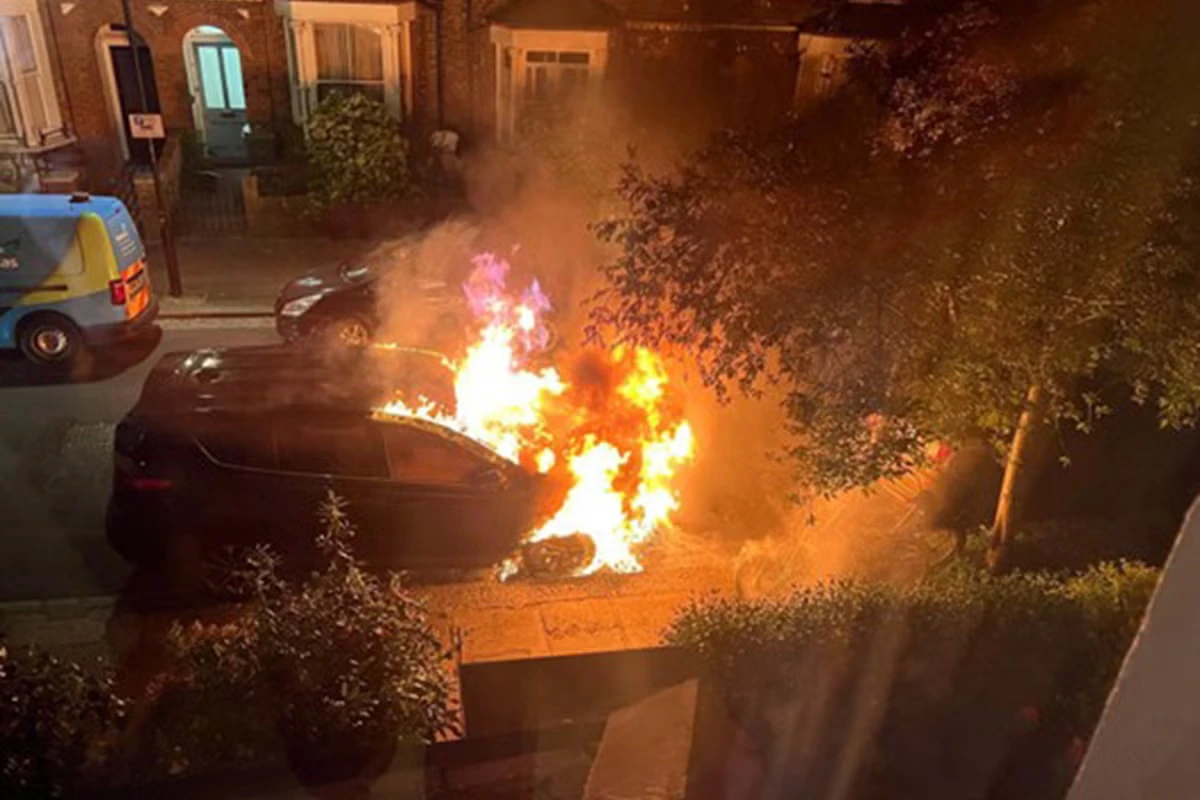
Last May, a Toyota Rav4 which was once owned by Sir Keir was set alight in a street in Kentish Town, north London.
Days later, two houses were set ablaze, including a north London home occupied by the prime minister’s sister-in-law and her family which he still owns.
Asked about the convictions, the PM told reporters at the G7 summit on Tuesday: “Well, obviously it was a bad attack, and all the details have now come out in court and justice has been done, so I’m pleased in that respect, particularly for my family who were affected by it.
“I think it has to be seen in its broader context. Here we are in the G7.
“We’ve just had the Ukraine session and actually there was real unity in the room, in the G7, about the fact that Ukraine is doing better now, regaining territory, that the sanctions are having a real impact on Russia and a real sense that now is the moment for all of us as a G7 to ramp up the pressure.”
Following an Old Bailey trial, Lavrynovych was also convicted of damaging two properties by fire being reckless as to whether life was endangered on May 11 and 12 last year.
The attacks were orchestrated by El Money over the Telegram messaging service.
El Money offered Lavrynovych £3,000 in cryptocurrency if the blazes were filmed and got on the news.
Following the convictions, Commander Helen Flanagan, head of Counter Terrorism Policing London, said there was nothing to indicate El Money was a “state threat”.
However, the motivation behind the attacks had been to “cause concern” and “disruption” in the community within the UK and “fear” for the prime minister, she said.
A third defendant, Ukrainian Petro Pochynok, 35, was cleared of conspiracy to commit arson.
Downing Street said Russia was one of the foreign states involved in spreading disinformation online.
A Downing Street spokeswoman said: “As you would expect, the prime minister will be concerned about any incident linked to his property, which clearly puts lives at risk and that is our overarching position on this.
“But we also know that Russia and other foreign states seek to exploit division in British society, including by sowing discord online through disinformation, and that’s why we are working with law enforcement and groups across society to stamp out hate crime, promote social cohesion and hold those who conduct disinformation campaigns to account.
“That involves both legislative and non-legislative actions that make it harder to spread false information in the online environment and reduce its impact.”