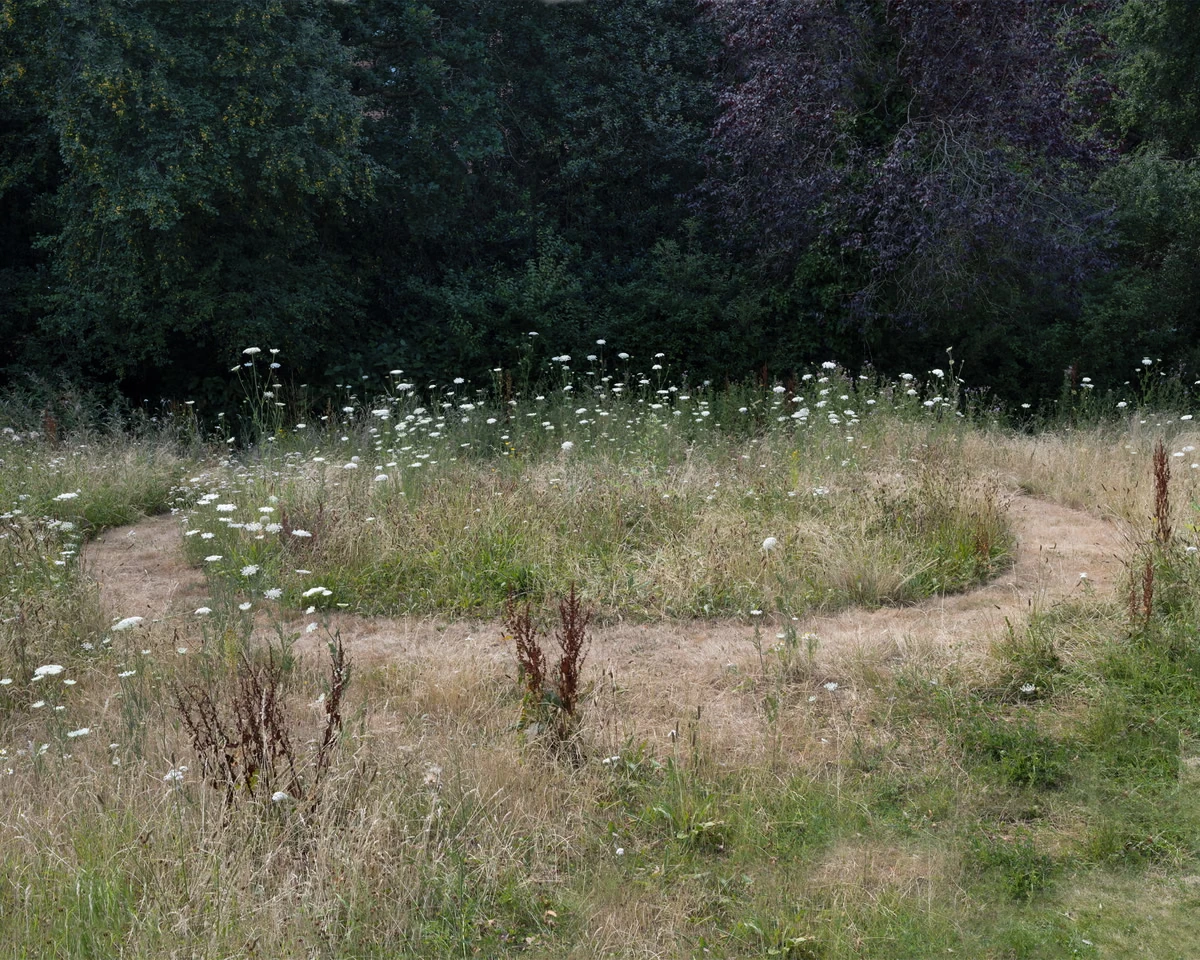
In 1983, an open-topped truck unloaded an unusual cargo in Kensington Gardens: 83 hunks of turf cut from Cae’n y Coed, a wooded hillside in the Ffestiniog valley. The ring of turf measuring eight metres in diameter that was removed from the park beside the Serpentine Gallery in west London to make space for the Welsh sods was then trucked from London to north Wales.
So began Sod Swap, a piece of sculptural defiance by David Nash, which has had an unexpected and epic afterlife. More than 40 years later, photographic artist Mike Perry restaged the work as Reverse Sod Swap, exchanging exactly the same amount of turf between Springfield Park in Hackney, east London, and pastureland in Pembrokeshire, with strikingly different results. With twin works acquiring new relevance in a time of extinction and climate crises, the sod swapping is now the subject of a new book.
It all began, says Nash, who is 80 and still working with wood and trees, with his own “bloody-mindedness”. He was invited to contribute to a new Serpentine gallery show of British sculpture. He submitted an idea of some wood sculptures for an indoor gallery because he felt too many outdoor sculptures were “like UFOs, they came and they went”, as he puts it. “But the gallery said: ‘Oh, David, you’re an outside artist, so we’d like you to participate in the outdoor space.”
Nash, who made his very outdoorsy Ash Dome and Wooden Boulder a few years before, bristled. He’d actually created an outdoor piece for a Serpentine show when he was a postgrad student at Chelsea Art School in 1970. When he tried to secure it in the ground he was told he couldn’t touch the Kensington Gardens turf because it belonged to the queen.
So this time, he plotted to rough up the manicured London park’s immaculate lawns by installing a ring of wild grassland from north Wales while also challenging definitions of “sculpture”. There was a lot of “bright red metal” around in the early 80s, says Nash wryly. “I wanted to create something that didn’t need to be cleaned.”
Sod Swap, he says, was a declaration of his identity. “I was very keen that what I put in had a sense of where it came from, which was where I was, which was north Wales.” When he realised he would have to dig up a load of Kensington turf, he decided to take that back to Wales. “That became the swap, and I liked the connotation of being a sod. It was nothing to do with the environment, really, but it turned out to be.”
Nash was anticipating a reaction and he got one. After several worried meetings about the dig, and head-scratching from council officials about the risk of “invasive” Welsh plants contaminating Kensington Gardens, Sod Swap went ahead. “He’s very subversive, David,” says Perry. “He doesn’t look it, but he is. The Serpentine expected him to bring in a big wooden sculpture. And he said: ‘No, I’m going to cut up your lawn.’ He wanted to show who he is as a person but also what sculpture could be – it doesn’t have to be a solid object on a plinth. It can be an ephemeral piece of organic material.”
In 2023, when Perry started a rewilding and art project on 4.9 hectares (12 acres) of farmland in west Wales, he wondered if he might revisit Nash’s concept, four decades on. Slightly nervously, he contacted Nash, and was relieved when the sculptor gave an enthusiastic “yes”. A week later, Perry drove over to north Wales, where Nash took him to see the site of the Kensington Garden sods. Amazingly, 40 years on, they could still detect a faint circle in mossy grass now punctuated by mature trees.
The Welsh turf hadn’t lasted so long in London. After the show ended, the gallery planned to simply to remove the turf but, thankfully for Nash, the “archangels of art outside”, Sue Clifford and Angela King, stepped in. The two co-founders of environmental arts charity Common Ground hurriedly found another unlikely London home for Nash’s Welsh sods: in the lawns of Kenwood House on Hampstead Heath.
Clifford and King also had the bright idea of convening ecologists to count the species in each turf circle. The Welsh sods held 28 different species, including grasses, wildflowers, brambles and even nettles, while the manicured sods cut from Kensington Gardens were made up of a meagre three different species of grass. Suddenly, Nash’s little challenge to the art world held an ecological message, highlighting the biodiversity to be found in rural meadowlands and the sterile quality of urban parks.
While Nash’s little piece of Wales acclimatised to Hampstead Heath, the artist conscientiously watered the London turf at Cae’ny Coed, even buying a secondhand mower so he could keep it in the condition to which it was accustomed. The original plan was to return it to Kensington Gardens, but Nash says the Arts Council told him they had run out of project money and couldn’t afford to transport it back. Sod Swap became permanent.
Eventually, after 10 years at Kenwood House, English Heritage removed the Welsh sods. “The London turf stayed in Wales,” remembers Nash. “Chestnut trees I planted grew and grew and shaded the turf, and moss came in. There were daisies from London which came up for about five years but then disappeared. I kept up mowing it as if it was in London for 20 years until it was virtually all moss and then I thought I would let it go.” Over the years, artists, curators and students made a pilgrimage to visit it.
Reverse Sod Swap was “a kind of biographical piece for me,” says Perry. He lived in London for 20 years before moving to an old farm by the sea in north Pembrokeshire. “My parents retired down here so I’ve always been going between east London and west Wales,” he says. The landscape and seascape of the Pembrokeshire Coast national park still looks gorgeous but “it’s a very melancholy thing walking down to the sea because there’s nothing in the hedges. They’re stripped right back and the grass is just mown 24/7 by so many sheep. The chair of the RSPB [Royal Society for the Protection of Birds] said national parks are where wildlife goes to die.”
Perry had hoped Reverse Sod Swap would be an ecological statement, but he couldn’t have anticipated just how much of a statement it would make. In Wales, he took the turf from pasture still heavily grazed by sheep belonging to a tenant farmer. At the London end, he was given “a really poor” plot in Springfield Park with “bad bits of soil from everywhere and a little bit of grass out of all sorts of rough material. But I quite liked it because there were giant burdocks and ‘weeds’ and thistles. I liked that mix.”
Perry’s first challenge was to replicate the dimensions. Nash couldn’t remember the exact size of his 1983 turf circles but Perry dug out the old catalogue statement, which noted that there were 83 sods measuring 90x30cm (35x12in) in size. He then followed Nash’s idea of making little wooden “stretchers” to carry each sod from the ground to the waiting lorry. On the journey to Wales, they twice stopped at motorway services to water the precious sods.
In the two-and-a-half years since Reverse Sod Swap, Perry has been surprised by how the project has continued to transfix him. “David put his hand on my shoulder and looked me in the eye and said: ‘Mike, when you make work outside, things happen.’ I didn’t really know what he meant. But what’s amazing is that the work is living and changing all the time – it keeps giving me new images and new findings.”
After the reverse transplant, botanists surveyed the transplanted turfs and, strikingly, found the reverse of Nash’s 1983 swap. The turf taken from Springfield Park contained 39 species in total, whereas the Welsh sheep-grazed turf contained just four species. And so, across four decades, the two works starkly illustrate the loss of rural biodiversity – a loss often disguised by the superficially unchanging character of the British landscape, with its patchwork of hedges, fields and woods. But Reverse Sod Swap also reveals a more hopeful trend in London, where species have been revived by urban rewilding efforts, from creating wildflower areas in parks to building new sustainable urban drainage areas.
Perry is encouraged by what he sees when he returns to London and walks down the Grand Union canal. “It feels like there’s butterflies, there’s rough stuff. It’s not scientific because there are obviously areas in Wales that can’t be farmed and there’s amazing biodiversity, but I was just really trying to make a point through art.”
Nash is touched by the longevity of his Sod Swap, and the ecological message it has taken on. “What Mike has done is an amazing bonus,” he says. “My Sod Swap highlighted the paucity of plant species in London, not that that was my main intention. Reverse Sod Swap is much more pertinent environmentally because it’s highlighting the paucity of rural land. We artists put work out there and hope people will see it and make something of it – be stimulated or take it on as part of their awareness.”
-
Reverse Sod Swap by Mike Perry and David Nash is published by Little Toller on 16 October (£25). To support the Guardian, order your copy at guardianbookshop.com. Delivery charges may apply.