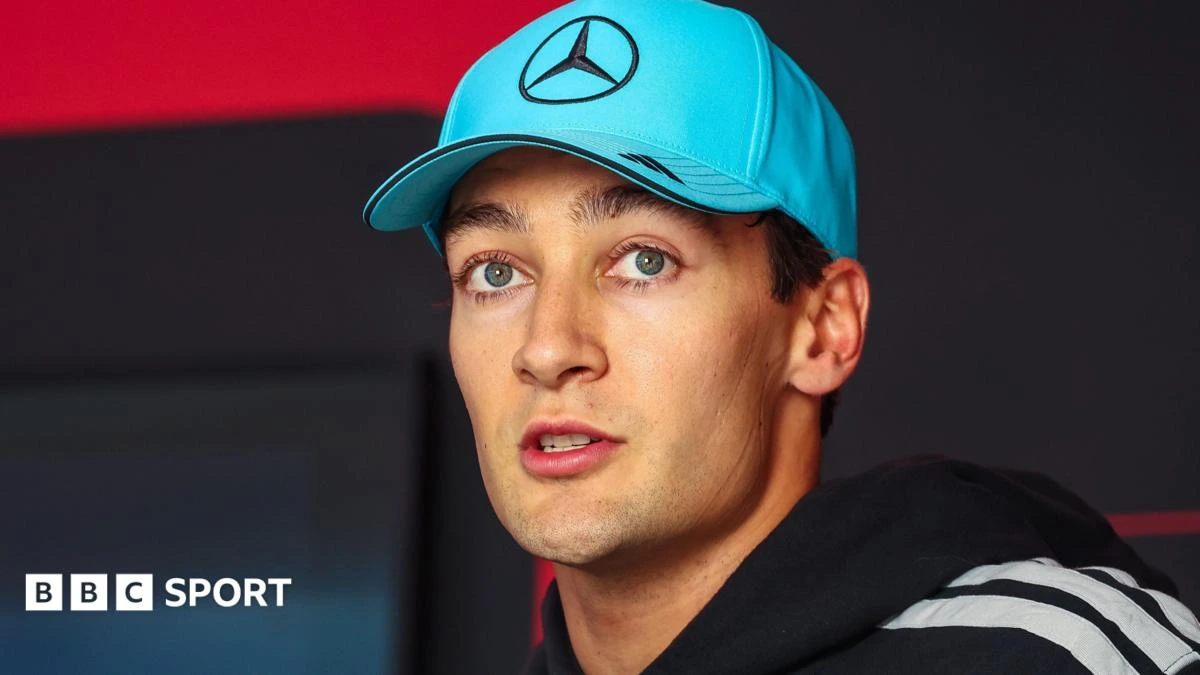
George Russell says a "serious issue" with the straight-line performance of his Mercedes is making his title fight with team-mate Kimi Antonelli "impossible".
Russell qualified fourth for the Belgian Grand Prix, and was 0.508 seconds slower than the 19-year-old Italian, who took his sixth pole position in 10 races.
The Briton said that the majority of his deficit to Antonelli could be explained by a mystery lack of speed on the straights.
"When I cross the line, you see you're half a second down, it feels pretty rubbish," Russell said. "But when you realise more than 75% of that's coming from the power-unit, you feel a bit better.
"I was pleased with my lap. When I look at the corners, there's a lot of corners I was faster. There's definitely corners I needed to improve. But the corners look like a normal fight you'd have for a pole. The straights is not."
Russell has been struggling for pace in comparison with Antonelli all weekend at the classic Spa-Francorchamps circuit in Belgium.
He ended Friday practice more than a second adrift, and had been told by his team that the deficit was explained by the way he was driving the corners.
The team recognised that the issue was that Russell was less comfortable with the car in the medium and high-speed corners of the middle sector. That meant he was making corrections to the steering that Antonelli did not have to do. These cost speed, which needed to be filled in with battery power. As electrical energy is limited, that left Russell down on deployment in the final third of the lap.
But after hard work over the weekend Russell made significant inroads into that issue, and Mercedes admitted they were still seeing a straight-line discrepancy that they could not yet explain.
Russell, who heads into the race 25 points behind Antonelli, said: "There's a serious issue at play here and the team are working so hard to resolve it.
"But every lap I do, when I see I'm down anywhere from 0.2-0.6secs in the straights, it's pretty infuriating.
"My whole focus for the last 36 hours has been on straight-line speed. It hasn't been focused on the set-up, the tyres or anything, because we're all trying to solve what is going on. And even my last lap, for some reason, I lost another 0.15secs to myself, just on the straight.
"You're watching (the display) on your steering wheel, just losing speed when you're full gas in the straight. You feel powerless. So, we don't know what's going on.
"I don't think it's the power unit, to be honest. But there's something slowing us down in the straights. And the team are really, really on it now to try and solve it.
"Battling against Kimi is very tough in a fair fight. When we are in this situation, it's impossible."
Mercedes trackside engineering director Andrew Shovlin said: "George continued to suffer from poor deployment into the final chicane, which cost him a grid position.
"We're investigating what's causing this as a priority as there is a clear loss that we cannot explain by driving style."
Antonelli takes Belgium pole from Verstappen
Belgian GP Qualifying Review: To Tow or Not to Tow?
New cars neuter challenge of 'different Spa'
Spa has a reputation as one of the greatest race tracks on the planet, but this weekend's grand prix has confirmed fears that the new engines introduced this year have neutered much of its challenge.
The track's most iconic corner, the flat-out swerves known as Eau Rouge, has been easily flat out on a qualifying lap for the best part of two decades.
But the fact that the new engines are energy starved has now taken the challenge away from what had been Spa's most challenging corner, the fast downhill double left-hander known as Pouhon.
The layout of the circuit means that the batteries are used up on the long run from the first corner, La Source, to the Les Combes chicane. The second sector - of which Pouhon is the highlight - is used for recharging so the battery is full again for the long run from Stavelot to the final chicane.
This means that, while the engines have a total of about 1,000bhp when on full deployment, the cars are being powered only by the internal combustion engine in the middle sector, so corner entry speeds are much slower.
So, although the cars entered Pouhon flat-out, just as they did last year, the turn-in speed was much slower, and Antonelli said his car started recovering energy from the apex onwards.
Antonelli said: "From the apex after we had no deployment, so it was easy. It was flat all the way. It was not like last year."
McLaren's Lando Norris, who qualified third before a 10-place grid penalty was applied, said Pouhon was "not a corner any more".
Max Verstappen, who qualified second for Red Bull, said: "It is not only Pouhon. It is the whole track. It is a different Spa.
"For most of sector two you run just on the engine, what is, 450-500bhp, something like that. Which is less than or more or less (the same as) an F3 car has but with F1 downforce. So you can imagine that is not very exciting to drive.
"But I don't want to sit here and complain again because someone will probably shoot me outside the door.
"I am mentally adjusting to it and trying to make the best out of it even though it is not what I love to do in Formula 1. But I can also sit at home and drive nothing but that also doesn't do anything so I am just trying my best."
Belgian Grand Prix
19 July at 14:00 BST
Live commentary on BBC Radio 5 Sports Extra 2; live text updates on BBC Sport website and app
Verstappen's remarks are a reflection of the fact that F1 as a sport has recognised that the current engines are flawed, and that mistakes were made in the regulation process.
Steps have already been taken this year to improve the situation, and more will be taken in the next two years by adjusting the ratio of the internal combustion to electrical power from close to 50:50 to 60:40 in two steps by 2028.
Williams driver Carlos Sainz said: "No one is enjoying the qualifying lap as much as last year. It is clear we have lost quite a bit with these cars around Spa.
"Having said that, I don't want to keep belittling my own sport, because it is not going to do any good.
"We all know this is not good enough, it needs to change, it will change, it will evolve. Hopefully next year it is a step better, and the year after another step better and the year after another step better.
"But whoever saw these simulations in 2022 and 2023 and didn't look at it and say: 'How can we even accept that?' needs to review what happened there because it should have never happened."
McLaren team principal Andrea Stella said that the rules had positives as well as negatives, as the varying states of electrical charge, and the ability of the drivers to choose when to deploy energy, had led to a significant increase in overtaking, even if this is not always what most would regard as "pure racing".
Stella said: "Some of the circuits, which are particularly long, very demanding in terms of electrical energy, they do change their character. This we have to acknowledge.
"Some improvements have been applied at the start of the season to minimise that. They have made the situation a little better. But it's important that we implement the changes for 2027 to see these trades coming back, which will not be to a full extent because there will be some limitations in terms of energy deployment. So somehow we'll have to kind of get used to it.
"And on the other side, we'll have to see what incrementally we (can) keep improving in these power-unit regulations such that we can retain the character of some challenging corners where, if you don't approach fast, the corner is no longer a corner, because one can be a corner at 280/290km/h but if you approach it at 270, it's a flat corner and relatively easy.
"These regulations have also brought some new features in the way we go racing. Some may like it, some may not. But we see many overtakings. And this overtaking, if you want, is the flip side of the energy starvation.
"So there's a few aspects, some of them to be improved, some of them to be protected."
Antonelli looks in a world of his own
How will the racing look on Sunday? At the moment, it's too early to say.
Before the weekend, the nature of the circuit did not seem to lend itself to the "yo-yo racing" that has characterised some grands prix in 2026, but the teams have chosen different deployment strategies so there may be an element of it.
In any case, Antonelli already looks in a world of his own, and his biggest concern is protecting his lead on the first lap, which is notoriously difficult in the face of the long run to Les Combes and the slipstream effect.
Antonelli said: "Just going to try to get a good start and lead into Turn Five. Max is a tough opponent and for sure he will go for it. But just try to really do everything right in our control and see what happens."
Verstappen said: "The gap (to Antonelli in terms of pace) is big. Even with a perfect draft (from team-mate Isack Hadjar in qualifying), we are still over 0.3sec behind. So for me it will be about looking in the mirrors and trying to fight them off."
Related topics
Andrew Benson Q&A: Send us your questions