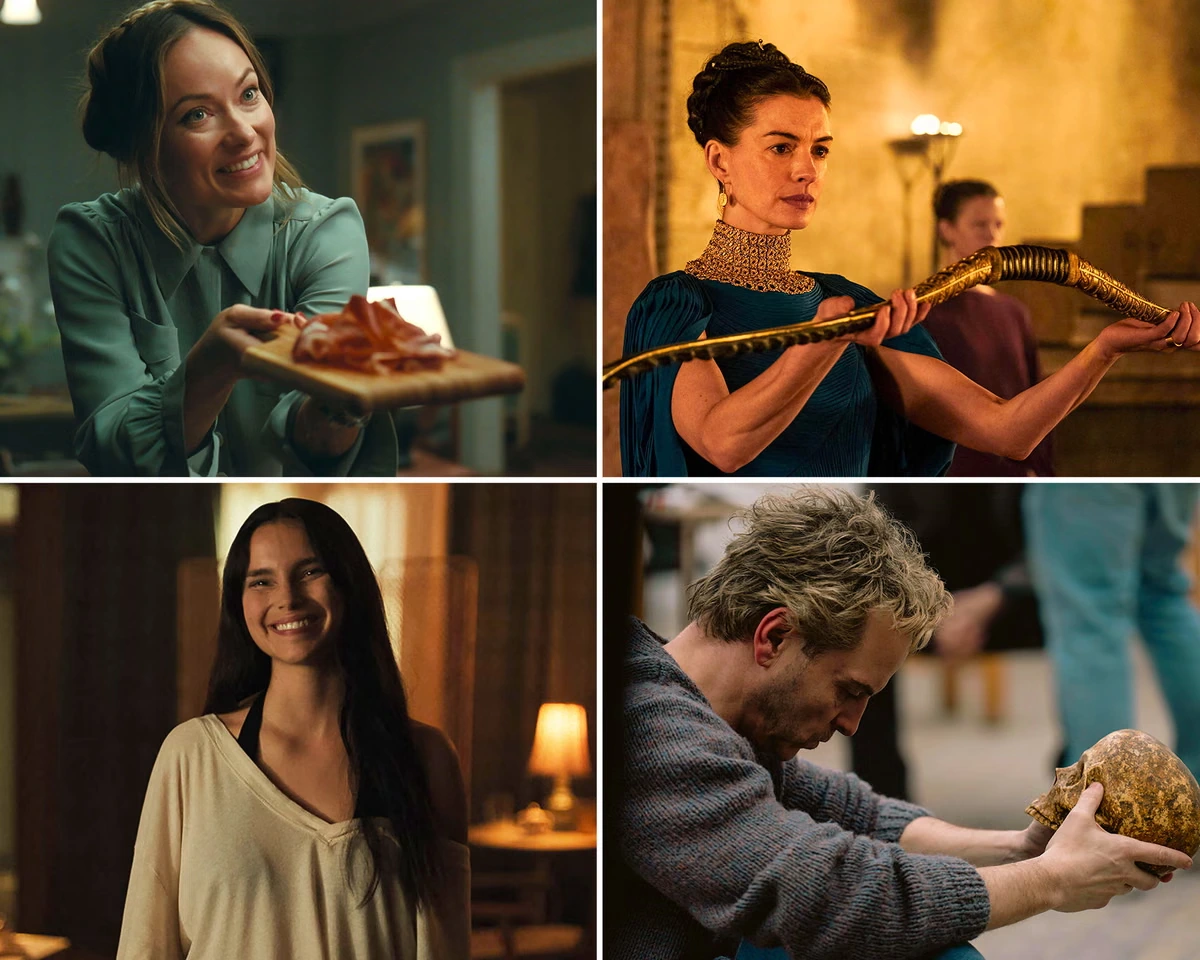
House of the Dragon is a massive television series. Over two seasons, the prequel to Game of Thrones has seduced viewers with its plotting, backstabbing, candlelit meetings about war, and massive sheep-munching dragons. Olivia Cooke’s dad, however, did not get the memo.
We’re in London, on a stormy summer afternoon, and Cooke is sipping a bottle of neon juice (“Tell me if my teeth go purple”). Her dad texted her yesterday. She gets her phone and pulls up a photo of a television screen, with the first season of House of the Dragon loaded up and ready to go. “He said: ‘Raining outside, so starting a binge-watch.’” She laughs. “I was like, great, Dad, worked on it for six years, hope you like, kiss kiss.” What was his review? “Yes, I like it. Quite violent.” He was planning to watch another episode after he’d picked up Cooke’s nephew from school.
Cooke may be just 32, but to be fair to her dad, there is a lot of her work to catch up on. The actor grew up in Oldham. When she was 18, she moved to Vancouver to join the cast of another prequel, the Psycho spin-off Bates Motel. After that, she lived in New York for a few busy but unhappy years, before moving back to London, just before the pandemic (shooting the film Pixie in Belfast, she realised: “Oh my God, I don’t have to beat down my sense of humour any more”). She has made movies, starring in Steven Spielberg’s Ready Player One and with Riz Ahmed in Sound of Metal. She was a brilliant Becky Sharp in ITV’s adaptation of Vanity Fair and appeared briefly as the MI5 agent Sid in spy thriller Slow Horses. But House of the Dragon, in which she plays the scheming and morally murky Alicent Hightower, has been a gamechanger.
The series is based on the George RR Martin book Fire & Blood, and while it is never easy to be succinct about the world of Westeros, the rough gist of it is this: Alicent was childhood best friends with Rhaenyra Targaryen (played as an adult by Emma D’Arcy), and betrays her by marrying Rhaenyra’s father, King Viserys, to become queen. She then bore lots of ethically dubious blond heirs to the Iron Throne (season one), went to war with Rhaenyra for the crown after Viserys’s death (season two), and, in the finale, waved the white flag and made a deal to give up her son to Rhaenyra, in order to support Rhaenyra’s claim to be the true queen.
In short, you could say that as season three approaches, Alicent has a lot on her plate. One reviewer called her “the saddest woman in Westeros”, but Cooke is not so sure that the description fits. “I don’t think she really has time to reflect on how she is feeling inside,” she says.
Alicent has been a divisive figure among fans of the show, particularly in the earlier days, when the character worked against Rhaenyra’s claim to the throne. But Cooke has noticed that recently Alicent has been a focal point for some queer women and non-binary people. “Alicent is a product of the patriarchy,” she says. In season one, her marriage to the king was engineered by her father, though recent episodes have seen “an unravelling of everything that she’s learned, and she’s becoming liberated, in a sense. I don’t want to say that she is living the queer experience, because she’s definitely not, but I don’t know if there’s something that is relatable there.”
Other viewers are less supportive. “It can be quite vitriolic at times. I don’t want this to come across as ‘Woe is me’, because I’m very grateful for the job,” Cooke says, carefully, “but to field insults when you’re just walking down the street …”
I assumed that it would be mostly digital, but it’s in the real world, too? “Yeah! They want a picture with you, then afterwards, they’ll say, ‘I fucking hate your character, by the way,’ or, ‘Your character’s a cunt.’” What do you say to that? “I sort of laugh and say: ‘Well, you can delete that picture,’” she shrugs. “I don’t know what you can do. I just try and take it in my stride.”
Cooke got rid of her own Instagram six months ago. In person, she is funny and friendly, and when I ask her what made her ditch it for good, her reason is charmingly specific. “I was sick of seeing 21-year-old looksmaxxers being like: ‘If you follow a program, this is what you can do,’ and it’s a side-by-side picture of him at 14, going through puberty, and him now, saying: ‘Look at the transformation.’” Her algorithm had picked up on her morbid fascination with physical extremes. “It’s a lot. It’s very navel-gazy, and it distorts your mental image of your body and your self. And I think that has trickled into our industry, as well.” It was too much for her brain to handle, so she deleted her account and hasn’t looked back.
For a short period of time, she was a meme herself. “Was I?” she says, looking suddenly panicked. Not recently, don’t worry, I say, but the negroni … “Oh yes,” she replies, visibly relieved. When Cooke and D’Arcy were first promoting House of the Dragon, a clip of the pair discussing their favourite drinks went viral. D’Arcy had said their drink of choice was a negroni sbagliato (“with prosecco in it”). “Ooh, stunnin’,” Cooke replied.
“I just think it was interesting that in our attention-deficit economy, that after a very wide-ranging career, that was the thing I was most notable for,” she says today. “But like everything, it lasted for about 15 minutes.” Has she had to remove that word from her vocabulary? “What, sbagliato? That was maybe the second time I’d ever said it.”
No, I mean “stunning”.
“Oh! Maybe. Just initially. Out of annoyance.” She has often said that she can be contrary. “And I can get a bit of an attitude when it comes to these things, but it was all good-natured. It was just very bizarre.”
On the subject of unexpected hits, at the end of last summer Cooke starred in the very fun, very pulpy thriller The Girlfriend, which turned out to be another smash. In it, her character, the ambitious estate agent Cherry Laine, went head to head with her boyfriend Daniel’s mother, the rich art dealer Laura, played by Robin Wright, who also directed the series (Laura thinks Cherry’s a social climber; Cherry thinks Laura’s a snob). It was moreish and addictive, but its success took Cooke by surprise, simply because there is so much TV coming out on streaming every week. “I didn’t expect it to capture people’s attention like that.” But she can see why it did. “Girlfriend and mother-in-law relationships, that’s quite potent. There’s a lot of nuance and passive aggression to dig into and exacerbate and exaggerate.”
As with Alicent, audiences were divided about whether they supported Cherry or Laura. Cooke’s mum was on Cherry’s side – “I was like, yeah, because you can’t differentiate between me and any character I play” – though, given some of its more explicit scenes, her dad described it as “being a bit like a radio play for him”. Though considering that – spoiler alert – Laura had pretended her own son had died in order to get him away from Cherry, a shocking number of people were on the mum’s side. “Boy mums,” says Cooke conspiratorially. “A lot of boy mums were on Laura’s side.”
As well as all the flashy melodrama, it had a point to make about snobbery and the British class system. Daniel was from a rich family, and Cherry from a poor one. No matter how much she tried to fit in to his world, it was never quite good enough. “To try to get into those networks, it’s like trying to cut through steel with a twig,” says Cooke, poetically. “It’s impossible to penetrate, and Cherry had to learn the hard way. But it’s the same now. It’s really hard to navigate the upper echelons of society. I mean, not that I would want to,” she laughs. “But it’s a whole culture to itself.”
Cooke has spoken before about the challenges of being an actor from a working-class background, with a northern accent, and how the entertainment industry is built on the kind of networks and pre-existing connections that exist in those upper echelons of society. She jokes that her mum now scoffs whenever she refers to herself as working class. “She’s like, you’re not working class any more,” she laughs. “I think my sensibility is still working class. I just have become, against all odds, very successful in my field.”
When she was eight, Cooke started going to the Oldham Theatre Workshop, a youth theatre group that also nurtured the likes of Anna Friel, Suranne Jones and Joseph Gilgun. At the time, it was at the end of her street. “My mum was just like, ballet’s not worked out, let’s chuck her in there.” What went wrong with ballet? “My mum said I answered the teacher back too many times.” (When casting The Girlfriend, Wright said she chose Cooke because she had “moxie”.) Had she expressed any interest in performing before? “I was the eldest daughter of two, and a child of divorce,” she says, drily. “So there was a lot of ‘Look at me, love me’.”
She feels strongly that there should be more drama workshops available to young people, particularly from working-class areas. “There is a huge amount of talent to be found in these places, but you need to fund them, and it can’t just be the Harrow and Eton lot, because you’re only going to get one side of the story, and it’s not going to be truthful.” Without groups such as the Oldham Theatre Workshop, TV, film and theatre all starts to look the same. “It just becomes completely homogenised, and it’s fucking boring.” A pause, then she laughs: “She says, getting riled up.”
But talking about it is important, she continues. “I thought with a Labour government, these things would be prioritised, but it feels like it’s not.” There is less and less funding for the arts, and she is clear about what is being lost. “Even if you don’t want to be an actor, it’s important to have a place to go and express yourself, and not be locked in your room on your phone. You’re able to develop social skills. Children today are so isolated. And with the rise of the manosphere, the antidote to that is play, and showing boys that they can be tender and emotional, and that it’s beautiful and cool and mind-expanding to be on stage.”
Cooke has to head off to a meeting, about a top-secret script. She has three films coming out in the near future. There are two horrors: Visitation, in which she plays a nun, and Brides, which is more of a gothic romance. There is a film about the crime novelist Patricia Highsmith – originally called Switzerland, though it may now have a new name – which will be directed by Anton Corbijn. He made Cooke’s favourite film, the Joy Division biopic Control, so she was happy to get the chance to grill him about that.
Meanwhile, House of the Dragon is due to end with a fourth and final season. As ever, in Westeros, it’s impossible to say who will make it out alive. “In the book, I survive until the end of the story,” she says, meaning that Alicent might well be in with a chance. “So good behaviour-willing, I won’t get the chop.” Her dad, then, has got even more catching up to do.
Season three of House of the Dragon starts on HBO Max, Sky Atlantic & Now on 22 June.