CJ Reay quilted so hard all summer that now he needs glasses. “After four months of doing it, I found myself getting really bad headaches towards the end, so I had an eye test,” says Reay. “I totally ruined my summer!”
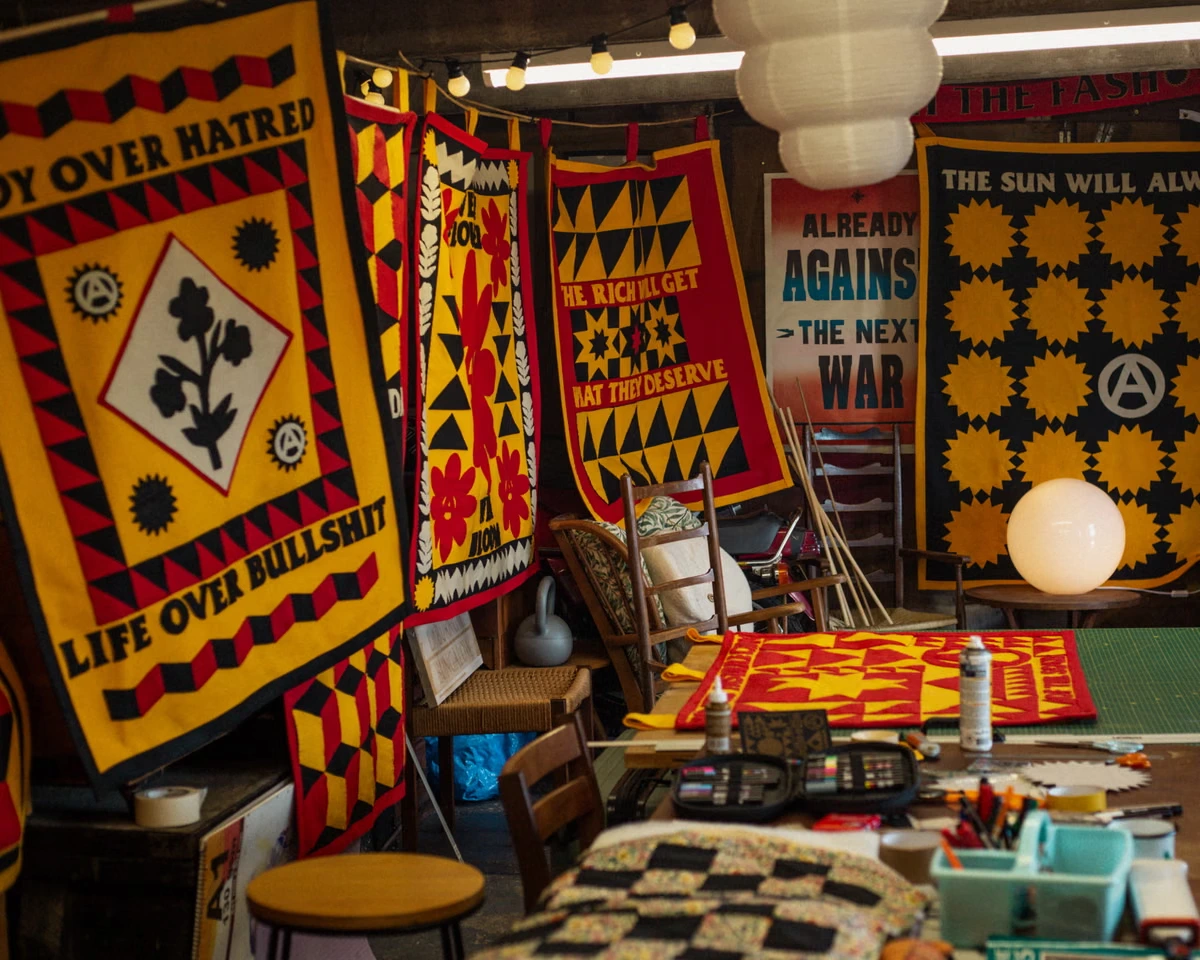
If that sounds extreme, he had given himself a relatively extreme task: to produce 14 of his Anarchist Prayer Quilts, adapting the slogan-forward graphic poster work that has become his calling card as Black Lodge Press to the medium of felt and applique.
If you’ve so much as walked past a DIY space or left-leaning festival or event in the UK in recent years, you will have clocked Reay’s style. Centred around the old Friz Quadrata typeface made famous by Black Flag, his prints proclaim sentiments such as, “Queer utopias are not fantasies / Queer utopias are necessities!” or “No great men! Only the great many!”, in two-tone riso print juxtaposed against vintage imagery.
Reay cites punk band Crass’s artist Gee Vaucher as one influence, Barbara Kruger as another. “Kruger often asks questions and I love that,” he says. “It makes you think about the nature of authority and conformity. So I try to do that, and I never try to do anything overtly negative. It’s about trying to celebrate rather than denigrate.”
The quilts follow on from two recent textile-based commissions. Last year, Reay worked with Bradford’s longstanding 1 in 12 anarchist social club to make banners celebrating its ethos, and with Barnsley Civic on a project inspired by banners made by striking miners’ wives. It got Reay learning rabidly about Welsh quilts, Amish quilts and the radical sewing histories detailed in Jess Bailey’s Many Hands Make a Quilt; the way that certain quilting blocks recur between disparate communities, marked by specific local quirks.
“I fell in love with this classic quilt star that was made in a tiny village in Durham called Pity Me at the end of the 19th century,” he says. “It was weird as it’s this place that probably most people have never heard of, but some of my best friends live there.”
As we nerd out about quilts – yes, he knows felt applique isn’t technically a quilt – Reay repeatedly uses the word “beautiful”. Beauty is important to him, he says. “Anarchy is often referred to as ‘the beautiful idea’. I wanted something that was representative of that, but also of something strictly human. It sounds so weird but the need to defend human culture has become really important to me, with everything being incorporated into digital machinery, or AI slop. It feels like everything is so fake now that to make art that’s real is almost slightly revolutionary.”
One long quilt declares: “May every data centre crumble to dust / May the machines of death turn to ruin & rust / May the flowers bloom & concrete split / May the last tech lord choke on his own bullshit.” The medium makes it: the juxtaposition of soft and human versus hard, robotic and accelerationist. While Reay isn’t religious, he calls them the prayer quilts “because art is a representation of a person’s soul in some ways. When I see AI art it feels like a total contradiction of what it is to be human and to make art. This is literally me with sore fingers, sewing in my garage.”
Reay, 38, is very genial company. Now based in East Yorkshire, he grew up near Carlisle in the town where the BNP had its HQ and printed its newspaper. Punk had already introduced him to antifascism, and he became part of a community that organised fundraising gigs and flyered outside the party’s meetings. “It was a bit intense at points because it’s not a big community there,” he says. He went to Newcastle to study politics and sociology. He didn’t enjoy university but at the city’s radical Star and Shadow arts space, he “learned the craft of DIY culture – met people who made zines, put on gigs, learned how to screenprint. That was such a crucial thing, for me to be able to have a go.”
While he worked in LGBTQ+ sexual health, Reay and friends started Newcastle Nerd Punks, distributing comics, zines and alternative listings guides. Art was always a “side hustle” until the pandemic, when his style had solidified and he decided to try it on posters. His stuff blew up online, first a design simply reading “Destroy fascism”, then one that better crystallised the spirit of the project: “Growing a garden is a beautiful & radical act.” Today, he says, “that’s still the one that everybody talks to me about and loves”.
Black Lodge Press was born, named in tribute to Twin Peaks and David Lynch. Today Reay has 145,000 Instagram followers and you can see his work in DIY spaces from Falmouth to Glasgow, but he refuses to treat it like a money-spinner, only opening his web store a handful of times a year to allow him to work on projects like the quilts – or his allotment “and just being a bit lazy”, he says. “I have funny feelings about contributing to that culture of consumption that is so rampant. I don’t want to be like, ‘Here’s another slogan, let’s pop it on a T-shirt.’ That seems a bit vacuous.”
What makes a good slogan? “Nothing too obvious. A bit of room for interpretation.” Humour is important. “Maybe it’s a cheeky northern thing,” he says, “but everything’s done with a twinkle in the eye, as my dad would say. I find overt seriousness a bit embarrassing. Life is absurd so I have to look at stuff with an edge of absurdity.” More serious was when he realised that two years before Palestine Action was proscribed, he had made a zine about them, with artwork declaring, “Direct action gets results.” “After that ruling, I realised, ‘Fuck, I can’t sell the zine any more.’ It’s absolutely bonkers.”
Between the recent clampdown on protests across Europe, and algorithms shaping political discourse, the power of zines has become more apparent to Reay. “They’ve been used as radical pamphlets throughout the 20th century, guiding underground communities whether punk or Aids activists,” he says. “People being able to talk freely without censorship and permission is an amazing thing. With the state of the internet, I’m actively espousing going back to underground distribution networks and print zines, because there is no freedom of speech on Elon Musk or Zuckerberg’s platforms.”
Speaking of Musk, earlier this year I saw an egregious crib of Reay’s aesthetic: a Tesla bearing a sticker in that Friz Quadrata typeface reading: “Anti-Elon Tesla Club.” The cognitive dissonance almost made me want to lay down under its wheels. He laughs. “I didn’t make that. I don’t own a Tesla either. I’ve got a rusty old van!” Now that it’s so popular, Reay’s work is readily ripped off, which he’s mostly happy about, giving DIY communities a visual language to turn to their own needs.
Seeing his work everywhere is “really nice and kind of weird at the same time”, says Reay. “Somebody last year said, ‘You’re like the “Live, Laugh, Love” of the anarchist community.’ Oh, fuck! Thanks?! It does feel a little bit like that sometimes.” When everyone knows you for one aesthetic, it’s hard to avoid getting stuck. Hence the quilts as one new direction; they’ve also inspired Reay’s first book, due in January. And at last year’s Glastonbury, he was invited to install a real-life anarchist gardeners’ club.
Reay comes back to his popularity. “It’s all part of resistance to capitalism, fascism and tech, so to be kind of synonymous with that is great in many ways. But yeah,” he laughs, “I do worry about the ‘Live, Laugh, Love’ situation.”