Tschabalala Self is relentlessly positive and unstoppably optimistic. The US artist is waiting for the unveiling of Lady in Blue, her new sculpture for the fourth plinth in Trafalgar Square, London, a towering, colourful painted bronze of a black woman striding (positively, optimistically) into the future. Self seems resolutely hopeful about the work, which is pretty impressive considering what happened to her last public sculpture in the UK. “Yeah,” she says, speaking from her home in upstate New York. “I mean, that was a completely racist act.”
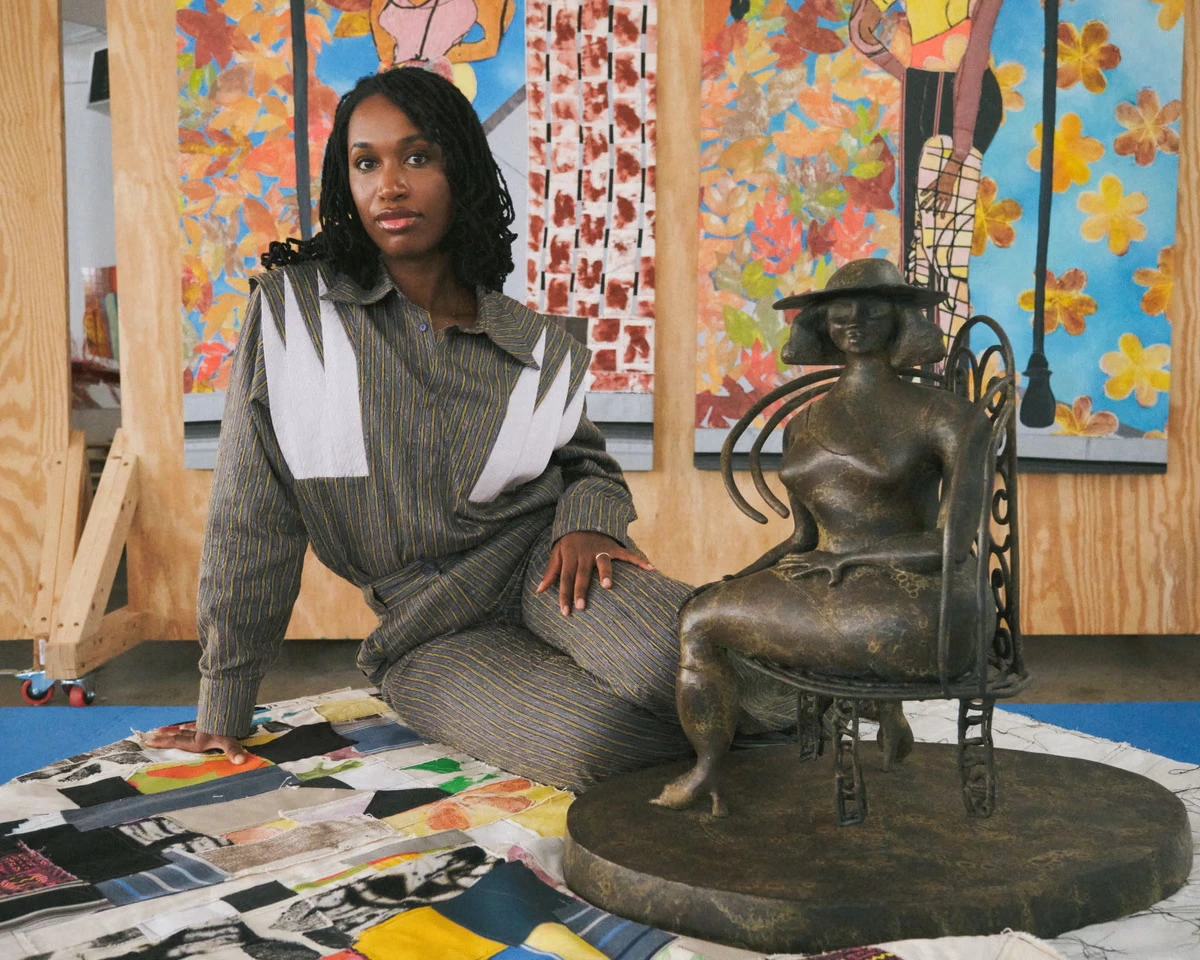
In 2022, Self unveiled Seated at Coal Drops Yard in King’s Cross, London. Like Lady in Blue, it was a vast, brightly painted bronze depiction of a black woman, this time seated demurely on a chair. After being shown at Coal Drops Yard without incident, it was moved to the De La Warr Pavilion in Bexhill-on-Sea, where the reception wasn’t quite as warm. “Within the first week,” says Self, “it was spraypainted white, but only on the skin of the sculpture.” As vandalism goes, it doesn’t get much more pointed, or racist. “The first feeling I had was just pain that my sculpture had been harmed. That someone had enacted violence on an object I had imbued with love and affection.”
The Pavilion wanted to organise a protest in response to the vandalism, but Self pushed for a community cleanup day instead. “I felt like that would be more cathartic, because a lot of people were appalled.” Hundreds queued to take part and, by the end of the day, all the paint had been removed, leaving nothing for the restorers to do. “That wasn’t my first time experiencing racism,” says Self, “but it was the first time my sculpture had been defaced.”
Born in Harlem, New York, in 1990, Self has an ultra-distinctive approach to collaged pop figuration and political idealism, which has made her a young star in the art world. Her work is in MoMA, the Guggenheim and the Whitney in New York and the Albertina Museum in Vienna. She has had exhibitions at the Hammer Museum in Los Angeles and the ICA Boston and is represented by some of the world’s chicest commercial galleries. Her work is a lurid, vivid, super-colourful, mega-joyful celebration of everyday bodies. She’s like a politically engaged, millennial New York version of the French pop modernist Niki de Saint Phalle, famed for her appealingly exuberant “Nanas”.
“The central message of my work is that all people should feel embodied,” she says. “They should feel confident and comfortable: empowered in their body. I think that’s a human right. My work is really about allowing people to understand that their physical experience is something they should relish, and to enjoy the physicality of a lived experience.”
Self talks like this a lot – positively, optimistically, almost politically, about the idea of bodies and “vessels” and confidence. “Mere personhood,” she says, “is an act of dignity. It’s courageous to be a human being. That is an act worth valuing.”
This empowering, direct, hopeful message sets Self a little at odds with the hyper-critical, seriously conceptual and often lofty artworks that have sat on the fourth plinth in recent years. How does Lady in Blue sit with Teresa Margolles’s wall of life-masks taken from hundreds of transgender and non-binary people, which it’s replacing, or Samson Kambalu’s defiantly anti-colonialist portrait of Pan-African preacher John Chilembwe in 2022? Self’s work looks almost shockingly simple and joyful in comparison. Where’s the invective, the anger, the criticality, the radicalism we’ve come to expect from contemporary art?
It turns out that joy twinned with simplicity is the radical thing. “Let’s say you’re a designer, right?” says Self. “To make something simple but functional is seen as the height of conceptual rigour. But somehow when it comes to fine arts, people equate simplicity with something being devoid of conceptual rigour.”
So Self rejects all of that, opting for legibility above all else. “If an artwork doesn’t move a large group of people from different educational, class and racial backgrounds, if it doesn’t move people in a relatively uniform way, I would say that’s more of a deficit of the maker than the audience. If the art’s strong enough, it should be legible to some degree to whoever comes across it. That’s part of the skill of being a great artist.”
When people discuss Self’s work, they often emphasise that this is art that celebrates black bodies. Does she feel this is too reductive for someone with such a wide-ranging message? “It is over-simplistic and very limiting. The work is often described in that context, but that’s very superficial. All of the figures are black because I make figures that reflect my physical experience. But they are meant to represent human experience that’s not limited by racial identity.”
So Self wants Lady in Blue to be seen as a quotidian figure. Viewers have been willing to accept Antony Gormley’s use of his own body as a stand-in for wider humanity for decades, but the idea that a black woman could be an “everyperson, an everywoman” is still “a large intellectual leap for a lot of people”, Self says. “One of my first prompts was to present the figure as a woman. If people are not able to readily identify with the figure because she is black, that’s a larger social phenomenon that needs to be unpacked.”
Some of that unpacking was done in the wake of the vandalism of her work at the De La Warr Pavilion, but that traumatic event must still cast a shadow over this new project. Especially because the fourth plinth isn’t in the grounds of an art gallery in a small seaside town: it’s smack bang in the middle of the most famous public square in London. That means a much bigger audience, with a lot more opinions. Is she worried?
“I’m ready for a whole gamut of reactions. I’m not nervous – I think everyone is entitled to their own opinion of the sculpture. Each will shed light on to some facet of the reality we’re all currently living.”
I believe her, but she’d be forgiven for feeling anxious about people disliking her work on this huge public stage after what has happened previously. “It’s not about the artwork being liked. It’s not about the artwork being loved. It’s about the artwork doing its work. And the work is challenging people to have conversations, to unpack previously held beliefs and make room for new ones.”
One thing seems certain: Lady in Blue is going somewhere. Striding, stomping, marching forwards, she’s got places to be and no one is getting in her way. Self says the figure is walking towards our collective future, and in the process rejecting all the heavy history embodied in the other sculptures and the architecture of Trafalgar Square. “It’s about there being space for all in places that were formerly weighted down by antiquated gestures, belief systems and impossibilities,” she says. “I didn’t want to make an artwork that was reactionary to the history that has already happened. I wanted to make something that was a beacon that could shed light into a possible future.”
So what is this possible future? What does Self see coming our way? “I hope all of us can have physical, mental, political space to live our lives freely, without our freedoms interrupting the freedoms of others.” She laughs and adds: “Not that that sounds too American.” It’s the most American thing I’ve ever heard, I reply. “I just want everyone to be able to be free,” she adds. “Doesn’t everyone want that?”
Simplicity, joy, embodiment and – above all – freedom. Self’s future sounds as bright and colourful as her towering blue sculpture.