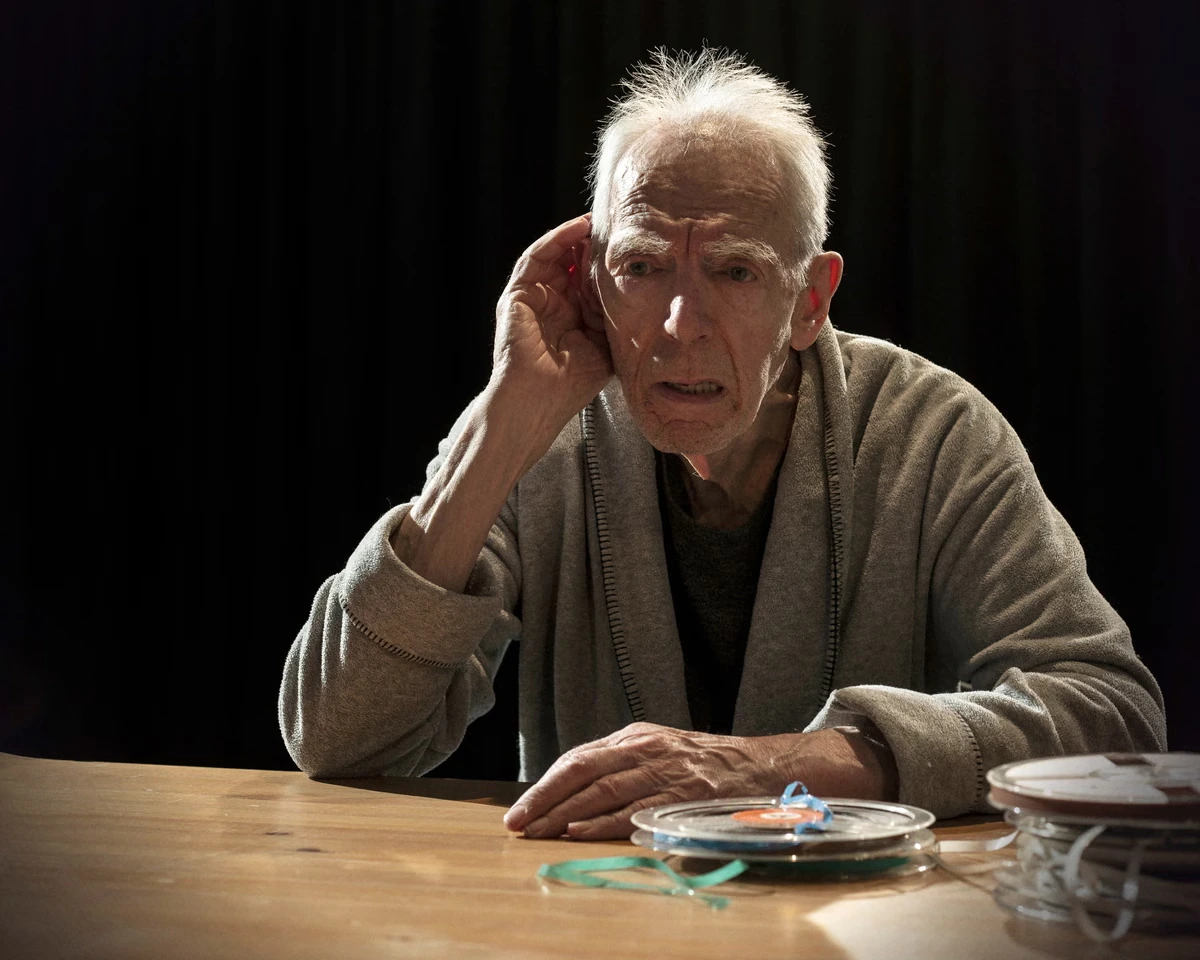
What a lot of Krapp. Pardon my French but Samuel Beckett’s haunting 1958 masterpiece about regret and isolation is having a moment. Stephen Rea recently took Krapp’s Last Tape on an international tour, Gary Oldman returned to the stage after decades away to deliver the tragicomic one-man show and this summer Stockard Channing will direct it at the Edinburgh fringe, with David Westhead as Krapp. Beckett’s eponymous loner, who sits in his dark den and ritually listens to tapes he made as a younger man, is riding a new wave of popularity.
Peter Marinker first played Krapp half a lifetime ago and is preparing to star in a new production, reusing the tapes he recorded in 1983. How does he feel listening back now? “I thought of redoing them – it could have been better,” he says when we meet at the tiny Cockpit theatre in London. That assessment matches the spirit of the self-lacerating Krapp who looks back not just in anger but anguish. Marinker quotes Dennis Potter, who said we should consider our past with “tender contempt”. He adds wryly: “That rang a bell.”
At 84, Marinker is older than most Krapps – Beckett gave this sad clown’s age as 69 – and his portrayal of a man sifting through his memories will be further coloured by the actor’s symptoms of Alzheimer’s disease. He was diagnosed two years ago. “I had been playing Gandalf in a musical version of The Lord of the Rings at the Watermill,” he says. “I would have these little dropouts on stage and I’d just pause and then carry on.” As the memory lapses continued, an understudy eventually took over. “At least I got to take my wife and see the play,” he says with a smile. “I didn’t know it was Alzheimer’s, but then I had an MRI.”
He later got a role in Netflix series Death by Lightning: “I did manage to learn the lines, but it was quite a challenge.” For Krapp’s Last Tape, he will receive in-ear prompts if required. The revival was suggested by the Cockpit’s director, Dave Wybrow, who sees it partly as an opportunity to revisit themes from Waiting for Godot, which they did together. “All the way through Godot, there’s the misremembered and half-remembered,” says Wybrow. “Godot means something completely different if you’ve known people with Alzheimer’s.”
Marinker saw Beckett’s own German-language production of Godot at the Royal Court in 1976: “I didn’t get it but I started finding any bits of Beckett that I could.” Raised in the Canadian Prairies, he made his school acting debut in a role that oddly foreshadowed Beckett’s 1980 play Rockaby. “I went to a boarding school with an English teacher who had been an actor and I think that was the seed. My first performance was as a grandmother. It was a boys’ school, and the curtain went up, and I was knitting in a rocking chair. And the howl of laughter of the boys!”
In the early 00s, Beckett’s publisher John Calder and Marinker co-founded the Godot Company to stage his works. Edward Beckett, the playwright’s nephew who became executor of his estate, “likes what Peter does” says Wybrow. As such, they have the blessing for changes to Krapp’s traditional costume of too-short trousers, waistcoat and “surprising” boots. Marinker will be wearing “my wife’s dressing gown”. He asks: “I wonder whether I could be barefoot?” Wybrow replies: “The only thing is you’ve got to slip on the banana skin.”
That’s because Krapp, shown to be an addict in several ways, can’t resist his beloved bananas. In a play with heavily detailed stage directions, Krapp strokes, peels and munches them with as much curiosity as when he pronounces “spooool”, enjoying the taste of language too. In what is very much an old man’s play, such moments add what Wybrow calls “a childish level of engagement with the world”.
The costume is his wife’s but his Irish accent on stage is “my mother’s voice”, says Marinker, “because she read lots of things to me”. His performance will draw on his past – he describes his own Krapp-like study at home, “filled with chaos and recordings of all the things I’ve done” – but also his recent interest in biologist Jeremy Griffith’s research into intellect and instinct, which chimes with Krapp’s inner conflict.
Marinker clearly relishes returning to fringe theatre, a passion subsidised by his colourful work on video game franchises including Dark Souls, playing fantastical roles such as the serpent Darkstalker Kaathe. His voice acting was honed on BBC radio – “I did a lot of Poetry Please, Words and Music” – and recording books for the Royal National Institute of Blind People. He even turns up in Paddington in Peru. “I thought I’d be doing Paddington,” he says mischievously. “But no, I was an old bear.” Over his career he has been heard more than seen. “What is good is that you’re invisible.” Working with Pierce Brosnan on The Tailor of Panama, he saw the Bond star mobbed by crowds. “And I thought, no … You don’t want that.”
Amid such recollections, Marinker peppers our conversation with lines from Beckett. When his memory fails, he refers to Beckett’s searching poem What Is the Word, written after the playwright’s late symptoms of aphasia. And, with a voice full of curiosity, Marinker closes our conversation reading me a recent poem of his own, A Foggy Brain in London Town. It ends quite beautifully:
Well it’s the lost memories
Where? When? Who?
What?
I can’t tell you
I fish without a bait
there’s nothing on the hook
What have I forgotten this time?
I just can’t tell you
But I am telling you,
NOW.