In 2015, a group of Grand Theft Auto developers from Rockstar North took their first trips to Miami to do field research for the next game in the phenomenally popular crime series. “Before you’re doing hyper-organised research trips, you’re immersing yourself in the place and its history, the vibe of it,” Rob Nelson, one of the lead developers on GTA VI, tells me. “[You see] the physical places you want to move characters through, the experiences you want them to have, and the juxtaposition between the extremes of society that are in Miami.”
I wondered: did people ever recognise them on any of their research trips? Did locals know what they were doing? This is the biggest game in the world, after all; I imagine it would be difficult to go entirely undercover. “We’re always semi-undercover,” he says. “But if you have a bunch of dorks going through a terrifying neighbourhood, you do stick out a bit.”
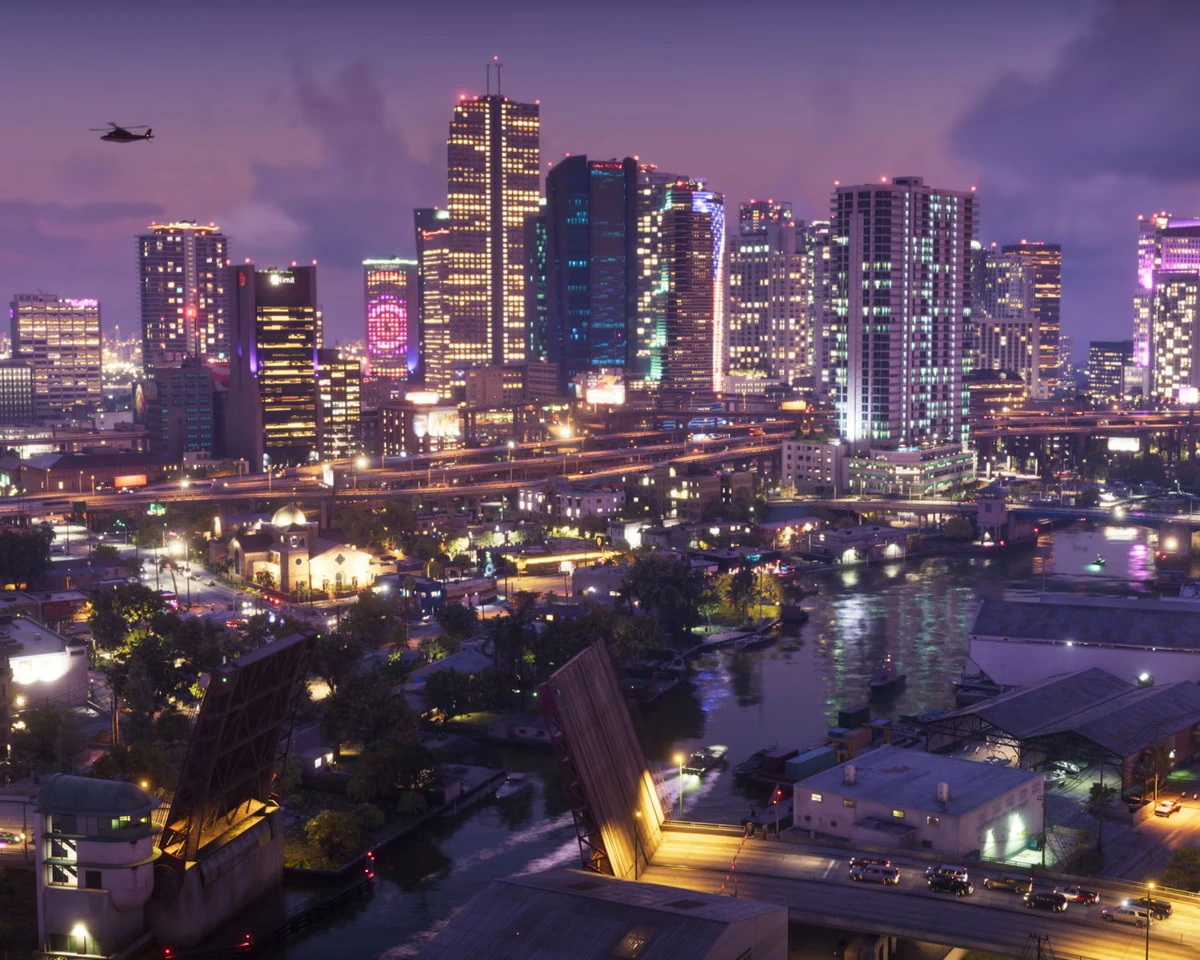
Grand Theft Auto VI is finally out next week, more than 10 years since those first exploratory trips. A few weeks ago, I spent the day at Rockstar North’s headquarters in Edinburgh, watching as Nelson and fellow senior exec Jennifer Kolbe took me through Vice City, the fictional version of Miami that has emerged from all that work. The setting always comes first for Rockstar games: the developers immerse themselves in the real-life version of the place they want to create, before they ask what they want to do within it and what they want to offer players. From there emerge the story that Rockstar’s writers want to tell and the characters players will later meet. This time that story is about a criminal couple on the run named Jason and Lucia.
Grand Theft Auto V (2013) and Red Dead Redemption 2 (2018) conjure fascinatingly detailed versions of the US: one a microcosm of California, the other of the old west. GTA VI takes us to Leonida, virtual Florida, and as with Rockstar’s previous games it is gratuitously, absurdly detailed, from the macro level to the micro; from architecture and geography down to the smallest of details – such as the clothes that the pedestrians are wearing, the street art, the flyers on cafe walls and the insides of fridges. As Nelson and I freely explored Vice City, we discussed the effort and motivations that went into the making of this ultra-maximalist game. You can read more about it in the Guardian’s Saturday magazine later this week.
Grand Theft Auto VI was made by an enormous team of almost 5,000 people, but there is a relatively small number of decision-makers at the top, most of whom have been at Rockstar for a very long time. (Lead writer Rupert Humphries, for instance, has been at the company since 2008.) They each take responsibility for the elements of the game that they are most suited to and that they care about most. “The game is so vast that no one person could hold enough of it in their heads,” Nelson tells me. His purview is design, narrative and animation, with a little casting on the side: Nelson’s background is in character art and animation, and his attention to detail is abundantly evident in his demonstration of the game. He takes huge delight in showing me tiny details, such as the way that Jason eats a hot dog or how, as he walks around a gas station, he can take bites of a donut with one hand while sipping a beer with the other.
When Jason starts running, he hikes the six-pack of beers he’s carrying into the crook of his arm, the liquid inside the bottles sloshing around. At one point in my Vice City ridealong, Nelson gets briefly upset during a jewellery store stick-up when the placement of one of the security guards’ feet doesn’t look right. The level of detail in this game is simply out of reach for any other game developer thanks to Rockstar’s abundance of money and time, and the patience from its parent company, Take-Two Interactive.
Rockstar’s worlds are believable because, despite their rampant excess, they are grounded in the real places they are based on and real experiences developers had in those places. Jennifer Kolbe says that during research for Grand Theft Auto IV, which was set in the New-York-inspired Liberty City, “people who had lived in New York all their lives were going to places they would never go to ... We then give that experience to players.”
Nelson reminisces about staying out in a Miami nightclub until 4am and then getting up a few hours later to be driven around a racetrack with a momentous hangover. They went on a ridealong with cops in South Beach, and hung out in weird bars in the Florida Keys. “Some of our team, especially the artists, are very intrepid,” he says. “They’ll go wandering in all sorts of places with their cameras. They’re fearless.”
Rockstar is famous for its depictions of the US – particularly American cities. But I have always wondered what this team could do in a different setting. Could Rockstar ever envision a GTA set outside of America? “Never say never, but there’s still so much to do in America,” Nelson says. I ask whether Rockstar’s outsider status, as a bunch of developers based mostly outside of the US (though it has offices in New York and San Diego), gives it a unique take on a country so vast and full of contradictions. “I think we’re all outsiders to this version of America,” he says. “It doesn’t matter where you live … no one experiences the America that we’re portraying here in its fullness.”
What to play
One of the few games brave enough to release in the dead zone surrounding GTA VI is Tanuki: Pon’s Summer, a whimsical delight of a game about a chubby raccoon trying to rebuild the shrine he calls home. I played an earlier version at Tokyo game show a couple of years back, and am delighted to discover that it’s come out brilliantly. “Arriving alongside November’s blue wave, Tanuki: Pon’s Summer is a game of quiet restoration that feels perfectly suited to the current moment,” as writer Christian Donlan puts it in a review out this week. “Tasked with repairing an ancient shrine in the weeks leading up to a local festival, you’ll find yourself cleaning out trash, mending broken arches and slowly bringing a small rural community back together.”
Available on: Xbox (on Game Pass), Switch, PC
Estimated playtime:
six hours
What to read
-
The brilliant cooperative indie darling Big Walk has become mired in AI controversy after the Independent games festival awards put out a statement on its stance about the use of large language models in nominated games. Out of what appears to be an abundance of caution, Big Walk’s House House developers disclosed to the IGF jurors that they used an LLM to help solve a coding problem during the game’s development. The fallout has illustrated how vociferous the anti-AI sentiment is among gaming creatives and has raised difficult questions about where to draw the line.
-
Nintendo is hiring a historian/librarian to help preserve and document the creation of its games and hardware.
-
A documentary film about the final years of legendary developer BioWare is coming, from Canada’s Super Channel. The studio was closed by EA last month after a 30-year run creating some of the most influential RPGs ever made.
What to click
Question Block
Please do keep sending in your questions and comments about GTA VI – next week’s issue will be a big Q&A about the game. In the meantime, reader Tim asks:
“I’m really worried about spoilers, to the point where I’m thinking of drawing up a joke contract for my son to sign so he agrees not to spoil it (teenagers these days just seem to blast through story mode, whereas I like to savour it). In a world where South Park contained Red Dead Redemption 2 spoilers, how the hell can we avoid them? Any tips??”
Honestly, you might be fighting a losing battle unless you a) stay off the internet entirely and b) speak to nobody at all in person who might possibly be playing it. GTA VI is a massive game that should, rightly, take weeks or months to work your way through, but we all know that a thousand content creators will have somehow gotten through the entire thing and put all of the footage on YouTube within days of its release.
The great thing about Rockstar games, though, is that outside of the story you really are creating your own experience, choosing what to do and how to spend your time, how your Jason and Lucia act. And nobody can spoil that for you.
If you have a question for Question Block – or anything else to say about the newsletter – hit reply or email us at [email protected].