So much for Brexit, then. Far from the United Kingdom liberating itself from European entanglements and forging a new, ever-closer, ever-more special relationship with the United States, those in defence circles are wondering what we do for protection if, or when, America leaves Nato.
Specifically, what will we do without the famous American nuclear umbrella – the essential deterrent against Russian aggression that has kept the peace in the Western end of our continent for close on 80 years>
According to reports, at a time when Russia seems intent on testing Nato countries’ resolve, Britain is in talks with Germany to help fund our Trident nuclear deterrent programme, as part of a push for a Europe-wide defence system. How’s that going to go down Washington – and Moscow?
Now matter however low-key the negotiations, and indeterminate the designs so far – and the Anglo-German proposal for a new European nuclear umbrella is, apparently, at best, more of a parasol – the idea that British, French and German authorities are in discussions should come as something of a relief.
We already know how hostile the Trump administration is towards the European Union, how sceptical they feel about the cost and usefulness of Nato, how fond of, and sympathetic to, Vladimir Putin they are, and we’ve heard their openly contemptuous opinions about European governments sliding into “cultural erasure”. What happens if the Yankees go home?
But the Germans are keen on the idea because, first, they are even closer geographically to the Russians than we are; second, because the French have traditionally not committed their independent nuclear deterrent to Nato, and may continue to operate it entirely for purely French security; and third, because Emmanuel Macron will be out next year, and Marine Le Pen may well decide, like Trump, that Putin is her friend and the Germans fret too much about the East.
Le Pen is also obviously more Eurosceptic than Chancellor Friedrich Merz, to say the least. For the first time since the Elysee treaty was signed by de Gaulle and Adenauer in 1963, these two great continental powers could be about to grow apart on strategic questions of economic and national security. A Le Pen victory would be a turning point – and it hardly bears contemplating if the Russophile Nigel Farage and Germany’s own Alice Weidel, co-leader of the hard-right AfD, also took over. That’s a nightmare for a different column.
Germany under the Christian Democrats, therefore, looks to the UK and its Trident programme, which is of course puny by comparison with the US – and dependent on American missile technology – but is at least something if Germany, for legal, cultural and historic reasons doesn’t want to develop a deterrent of her own, contrary to non-proliferation agreements.
The British look favourably towards Germany helping out on Trident because they are skint. Germany brings money, engineering and industrial capacity to the table; the British bring long experience and know-how in the field, not just in the technical side but on theory and practice of nuclear deterrence – including how surprisingly irrelevant a submarine-based force of intercontinental missiles with nuclear warheads can turn out to be, being of no use in, for example, the Falklands, Afghanistan, Iraq or, now, Iran.
So the key questions are: who owns the bomb, whose defence it is committed to, and who gets to decide to use it?
Unlike France’s, Britain’s nuclear force is already dedicated to Nato usage, and would similarly be available post-Nato. What is still the case now, however, is that a theoretical decision to bomb Moscow rests with London, notwithstanding the North Atlantic Treaty. That is true even if (theoretically) such an attack would be in answer to the Russians bombing Berlin.
In other words – and this is an open question – how much say would the Germans want over the use of the nuclear weaponry, or, more to the point, the threat of its use? Could Chancellor Merz press the red button unilaterally? And, inevitably, what would the American view be on all this, given that the UK’s “independent” deterrent depends on US technology and maintenance?
Would the White House want to upset Putin by, in effect, allowing the Germans access and possibly use of the British deterrent? Apart from anything else, there’s a lot of historical baggage cluttering up such a scenario.
Talking of which, it was, after all, the Germans who invented these long-range missiles, with its dastardly supersonic V2, at the end of a previous European war we’d all rather forget. Perhaps the best way forward would be to pool their collective expertise, and some sovereignty, and develop a formidable nuclear deterrent with, to borrow Ernest Bevin’s old phrase, a European flag on top of it (as well as the Union jack).
The Euro-nuke would be the most potent symbol of European unity of all, with all European nations nestling under its protection. It would irritate the Americans, frighten the Russians, and give practical purpose and expression to our common European interests.
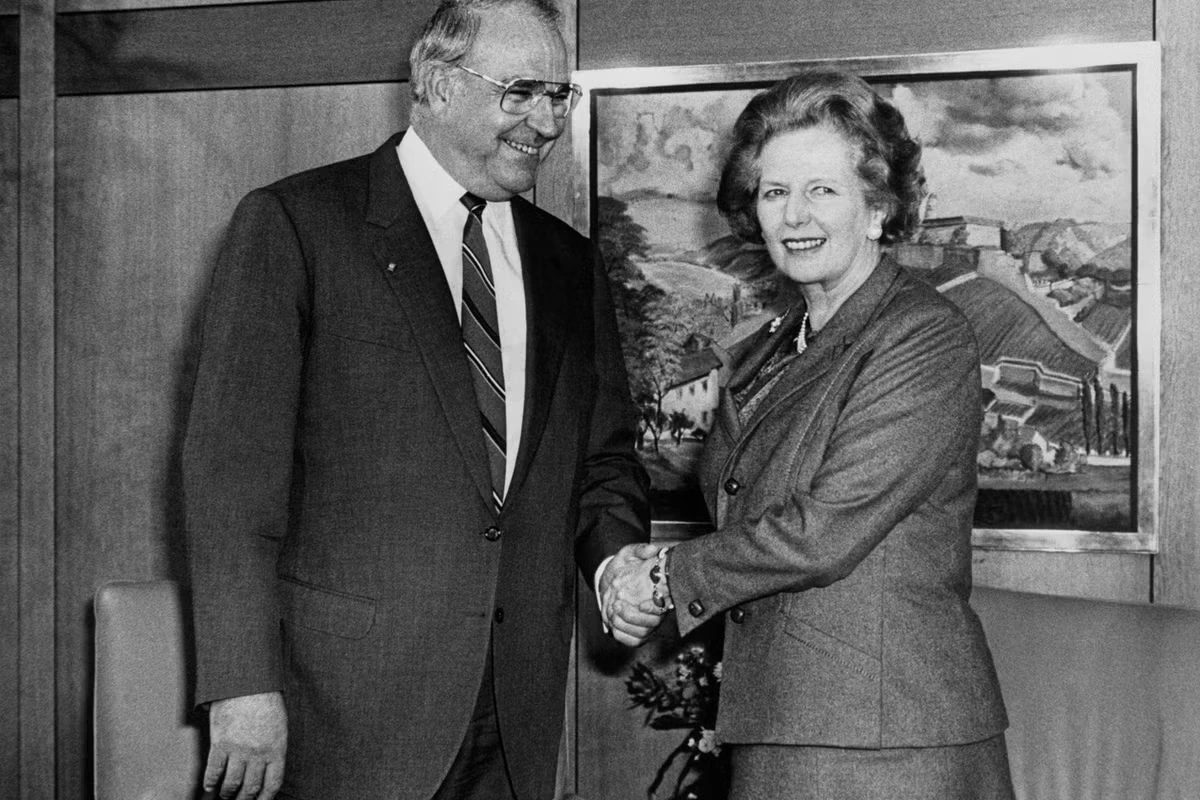
We have long since moved beyond the 1950s, when the very idea of German rearmament was anathema, and the decision to allow West Germany to join Nato was deeply controversial. As late as 1989, some – most notably, Margaret Thatcher – still feared the consequences of German reunification.
Yet Germany is now a trusted partner, and a Europe with her at its heart is increasingly capable of providing for its own defence. Perhaps, after all, the European project has something to be said for it.
Sign up to the Independent’s free Europe: The Way Back newsletter here, or by using the form below: