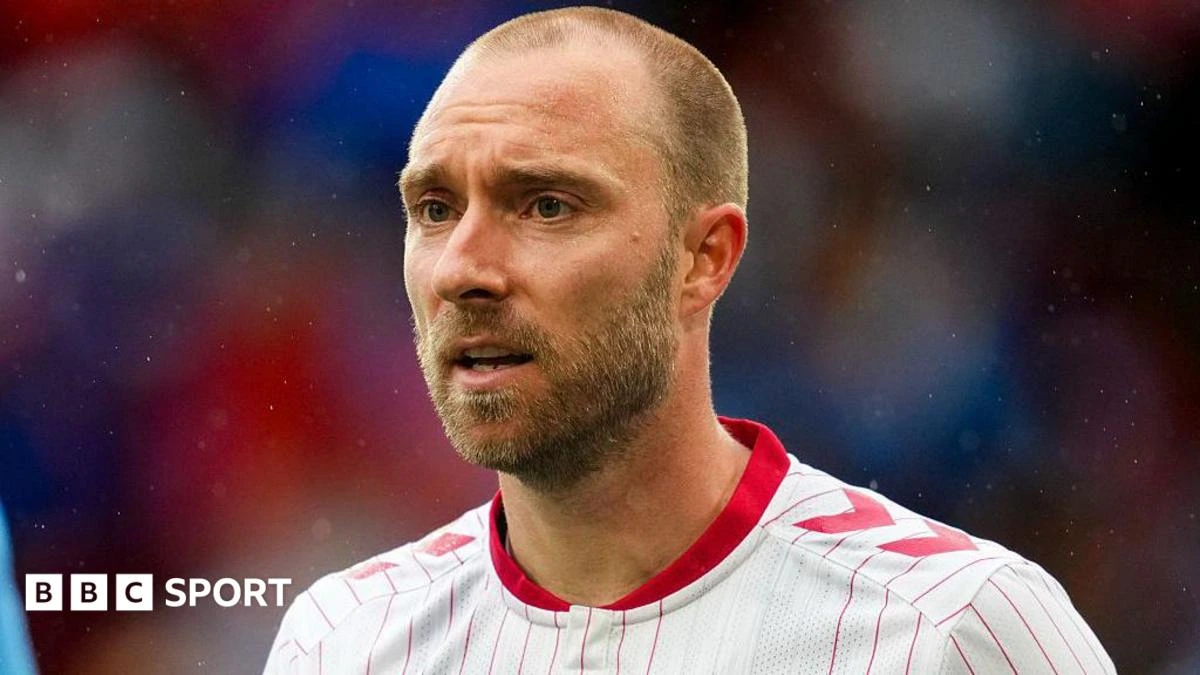
When Christian Eriksen collapsed during Denmark's 2-1 friendly victory over Ukraine on Sunday, he was assisted by a device which was fitted to support his heart after he suffered a cardiac arrest during a Euro 2020 match.
The implantable cardioverter defibrillator (ICD) sits in Eriksen's chest, with wires connecting it to his heart. It provides a shock to either restart the heart if it stops beating, or to jolt it back into a regular rhythm if abnormalities are detected.
"The pacemaker responded as it should," said Denmark's national team doctor Morten Boesen on Sunday.
The sight of Eriksen dropping to the turf, before being surrounded by visibly upset team-mates while being treated by medical staff behind a makeshift curtain, was frighteningly reminiscent of his previous collapse, which shocked football fans around the world.
So, how can athletes return to elite-level sport after having an ICD fitted, what are the risks, and what happens when the device goes off?
'Athletes will never say stop'
The need for an ICD - which is around half the size of a mobile phone - to be fitted can be caused by a variety of different health conditions, including heart failure, coronary heart disease, and arhythmias.
Depending on the exact illness an athlete is suffering from, a return to competition is possible.
"All cases are individual," says Dr. Amanda Lahti, a doctor and researcher in sports medicine.
"It is a shared decision model – you take opinions from the club, the player, their agent, and medical experts, looking at the risks and the potential benefits. You then take a collective decision about whether a player can continue with their career or if they should stop.
"The difficulty with that is the athlete themselves has the final word, and they will never say 'stop'. They are willing to take risks that perhaps you or I would not."
When Eriksen suffered his cardiac arrest in June 2021, he was playing his club football for Inter Milan in Italy's Serie A, one of a minority of leagues which prohibits players fitted with an ICD from competing.
Eriksen made his return first with Brentford and then Manchester United in the Premier League, where there is no blanket rule, and players must undergo individual testing to assess whether they are healthy enough to play.
"I don't see any risk, no," he told BBC Sport in 2022. "I have an ICD, if anything would happen then I am safe."
World football's governing body Fifa, and its European counterpart Uefa, allow players with ICDs to participate in their competitions, as does Germany's Bundesliga, where Eriksen spent the past season playing for Wolfsburg.
The medical view on sport and cardiac issues has shifted over time.
"Around the millennium, everyone was just told no – you don't take part in any sport, not even recreational," says Dr. Lahti.
"But then we could see that athletes that did not listen to that advice and tested themselves in sport. For many of them, the ICD worked even better than we thought.
"ICDs today are very good. They tolerate physical contact and most often they defibrilate fast. But it's not 100% - there is no guarantee that you survive."
'Mini explosion inside me blew me backwards'
Being fitted with an ICD can be worrying for patients concerned about the possibility of it going off.
"Rather than being scared and anxious about it, it's about treating it as a friend, as something that can save you", says former England cricketer James Taylor, who retired aged 26 after being diagnosed with a genetic heart disease and fitted with an ICD.
"I had only had it a month before it kicked in - I was on stage, talking about the device ironically, and then it went off.
"It is like a mini explosion in my chest. It blew me backwards about a metre or so. I was conscious the whole time but I can't remember much after it went off. It all happened so fast.
"The guy talking to me said he could see something pulsing under my eye, so that was obviously my body unwell and reacting. But it worked."
ICDs can also cause what are known as inappropriate shocks - instances where the device is erroneously activated.
"I was on holiday once in Antigua and the ICD picked up what it thought was my heartbeat going at 500 beats per minute, but it was actually the pool pump.
"I was suddenly blown through the water and didn't know what happened. After a few seconds I realised my device had gone off and thought I must be really unwell.
"You can do a mobile download – I put a device over my chest and then it sends all the info to my doctors, and they told me my heart was fine and it shouldn't have gone off. I wasn't aware that could even happen."
Overall, though, Taylor's ICD provides him with reassurance and allows him to feel confident playing sports like golf and padel.
"It's a scary place to be when your life could change at any second," he says.
"It can isolate you, because if it goes off you lose your independence. For example, you can't drive because you lose your license for a certain amount of time.
"But I lead a great life and I use my coping mechanisms from being an international sportsman. You don't always succeed, and have to be prepared for setbacks to keep yourself in a consistent headspace."
'It was hard to accept walking away'
Deciding whether or not to try to return to elite sport, having dedicated their lives to it, is a deeply personal and immensely difficult call for athletes with an ICD.
"Mine was the same as Eriksen's. There was no obvious heart defect they could put a finger on," says Clive Clarke, a former footballer who was fitted with an ICD at the age of 27 after suffering a cardiac arrest in the changing room while playing for Leicester City in 2007.
"I got myself back fit to play a few months later and knew I could play at a high level again, it was just whether I was willing to push myself to the max.
"I came to the decision that no, I wasn't in the headspace to do that. Around that time there had been a couple of deaths on the pitch. I had a young family, a wife and a one-year-old daughter, so I decided to say 'I love football and it's my living but I'll walk away from it'.
"It was hard to accept. I knew I was very lucky to survive a cardiac arrest but at the same time wondered how I could have played all those games and training sessions just for that to go and happen."
For some, the potential impact on those around them in a team is a big consideration.
"I'm currently on my third ICD. It gives you reassurance and confidence to get back to everyday things," Clarke adds.
"Mine only went off once. I was in Ireland buying race horses, at a sale, and I was walking past a horse and I thought it had kicked me because I felt this massive shock and it was more in my back than my chest. I was in hospital for a week after that.
"I'm not so sure players should be allowed to play with an ICD. [I would be worried about] the impact on all the team-mates and staff if something happens. You have to consider the consequences if something was to go wrong."