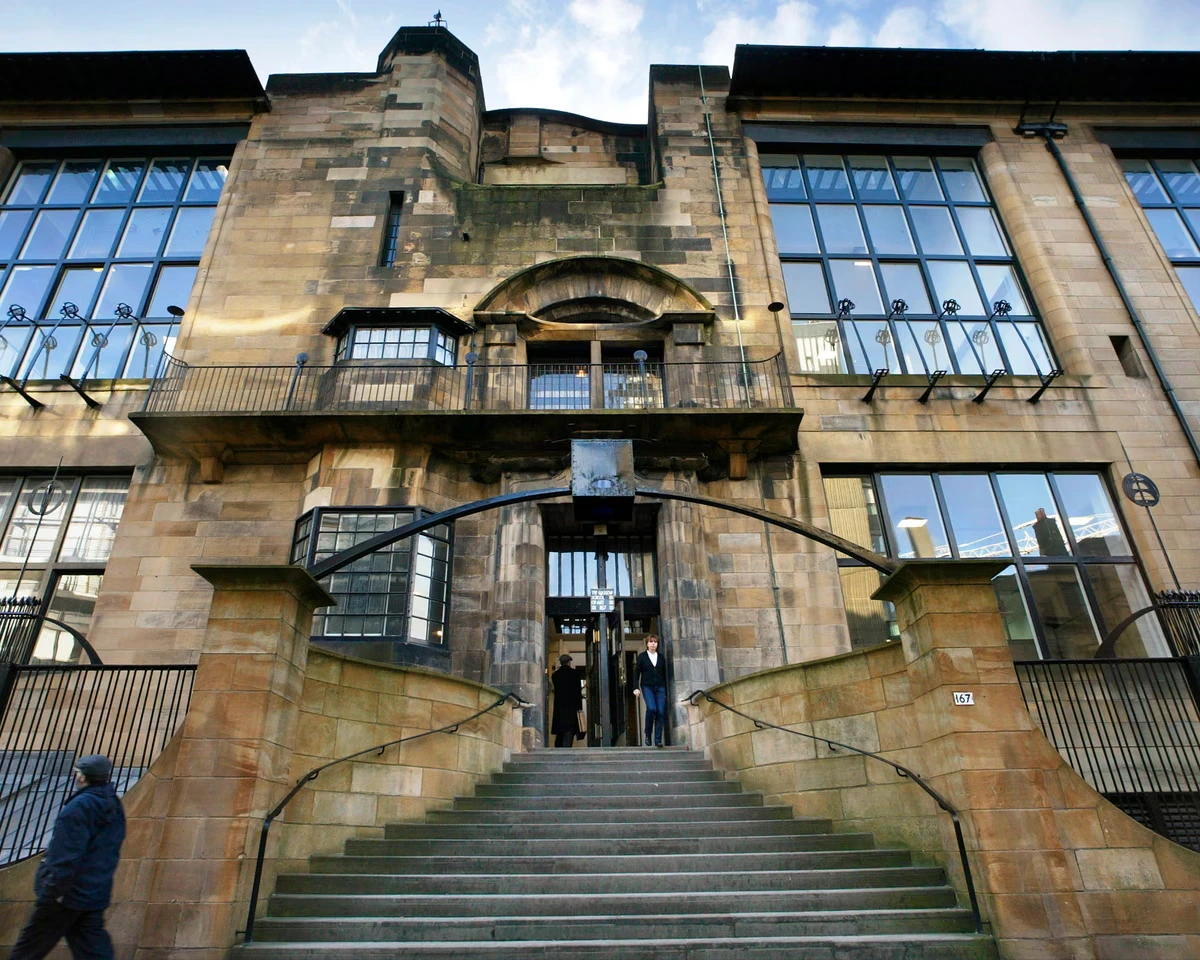
Doubly destroyed by two fires, Scotland’s finest piece of architecture, the Mackintosh building at the Glasgow School of Art (GSA), cuts a lamentable sight, its charred carcass tightly shrouded in white plastic sheeting, like a vacuum-packed Christo sculpture.
A 12-year saga of destruction, rebuilding and yet more destruction, all underscored by an unedifying seam of political and institutional wrangling, reached an apologetic conclusion of sorts, with the recent announcement that Charles Rennie Mackintosh’s exquisite art nouveau creation is unlikely to be rebuilt in its original form because of stratospheric cost.
The GSA said a full rebuild or “faithful reinstatement” of the burnt-out 1909 landmark, which, while still remaining a long-term ambition, would cost £265m, four times previous estimates and five times the GSA’s annual turnover.
The school admitted that it could not afford this comprehensive reconstruction on its own, and outlined how it was moving forward by stabilising the building’s remaining shell and removing external scaffolding. The plastic shroud will also be removed, revealing the surviving stone walls. How things progress from there is still the subject of debate. The cost of the stabilisation work, though unconfirmed, is understood to have been covered by a recent settlement with insurers following arbitration.
The fate of a building considered Scotland’s equivalent of Gaudí’s epic Sagrada Familia in Barcelona or Notre Dame Cathedral in Paris still hangs precariously in the balance. But while Notre Dame, damaged by fire in 2019, was the subject of a concerted national rebuilding that allowed it to reopen five years later, Mackintosh’s masterpiece still languishes more than a decade on, and seems no closer to being restored as a working art school.
Professional bodies including the Royal Incorporation of Architects in Scotland and the Royal Institute of British Architects have given a cautious welcome to the current interim strategy but said that “faithful reinstatement should remain everyone’s preferred outcome”.
In a joint statement, they added: “We need leadership from the Scottish and UK governments to find the resources needed to ensure the faithful reinstatement of the Mackintosh building and to secure its future as a revitalised creative hub serving Glasgow, Scotland and the world. A building of such national importance requires a national response if future generations are not to curse us for its loss or mutilation.”
Writing in the Architects’ Journal, Labour MSP for Glasgow Paul Sweeney echoed this call. Sweeney, who has long campaigned for full restoration of the building, argued that a joint venture partnership approach to rebuilding the Mac should now be considered. “It’s about the Scottish and UK governments putting their arms around the art school and trying to support the restoration as a national project,” he said.
But in a cost of living crisis, riven with attendant political and cultural jeopardy, it’s highly doubtful whether such resources can or will be found. Time for a wealthy patron to sponsor the project of a lifetime?
Others have been more critical. “The loss of the Mackintosh building would be catastrophic,” says architect and former GSA lecturer Gordon Gibb. “Even a partial rebuild, or a soulless facade retention with highlights, would result in the loss of our heritage and in the further diminution of Glasgow. If you do not rebuild it as it was imagined, you lose all of its integrity – and you do nothing more than celebrate the incompetence of its temporary custodians that led to its demise.”
The entire sorry debacle began with a small fire breaking out at an end-of-year student show in 2014, when an aerosol canister of expanding foam placed near a hot projector caused flammable gases to ignite. It could and should have been contained, but Mackintosh’s arrangement of timber-lined voids and ducts contrived to spread the flames. Nonetheless, almost all of the building was saved, and a £35m restoration commenced. Weeks before its completion in 2018, the building was gutted by a second fire.
Cosily familiar to patrons of museum gift shops, it’s perhaps hard to envisage just how radical and unsettling Mackintosh’s art and architecture were in his day. A temperamental dandy who took his cue from movements in fin de siècle Europe – art nouveau, Japonism, symbolism – his oeuvre was a zinging riposte to the conventions of Victorian neoclassicism. “How absurd it is to see modern buildings made in imitation of Greek temples!” he fulminated in 1893. “We must clothe modern ideas in modern dress.”
Mackintosh experienced extreme reversals of fortune. In 1900, his fame was such that during a trip to Vienna, “Toshie” and his wife, artist Margaret Macdonald, were feted as Caledonian heroes by the secessionist movement and cheered through the streets in a flower-decked cart. But the first world war sundered connections with Europe and a slow decline into poverty and obscurity ensued. By 1928, Mackintosh was dead of mouth cancer at 60, induced by his penchant for drinking and smoking, a grimly bohemian end to a fitfully stellar life.
If the Mac is not to be rebuilt as it was, there are precedents for a strategy of what might be described as “curated decay”, mixing new and old parts to relate the wider story of the building. Gutted by wartime bombing, Berlin’s neoclassical Neues Museum lay in ruins for more than 40 years until an evocative scheme by David Chipperfield, abetted by conservative specialist Julian Harrap, transformed its fortunes. The city’s Reichstag building, remodelled by Norman Foster, retained graffiti scrawled by victorious Russian soldiers.
Yet the glory of the Mac is the fact that it is all of a piece, from door handles to furniture, stained glass to light fittings, all minutely considered by Mackintosh as an exemplary Gesamtkunstwerk, or total work of art. Its double destruction has been a disaster, but, at present, its rebirth as a hugely costly phoenix from the flames feels as far away as it ever was.