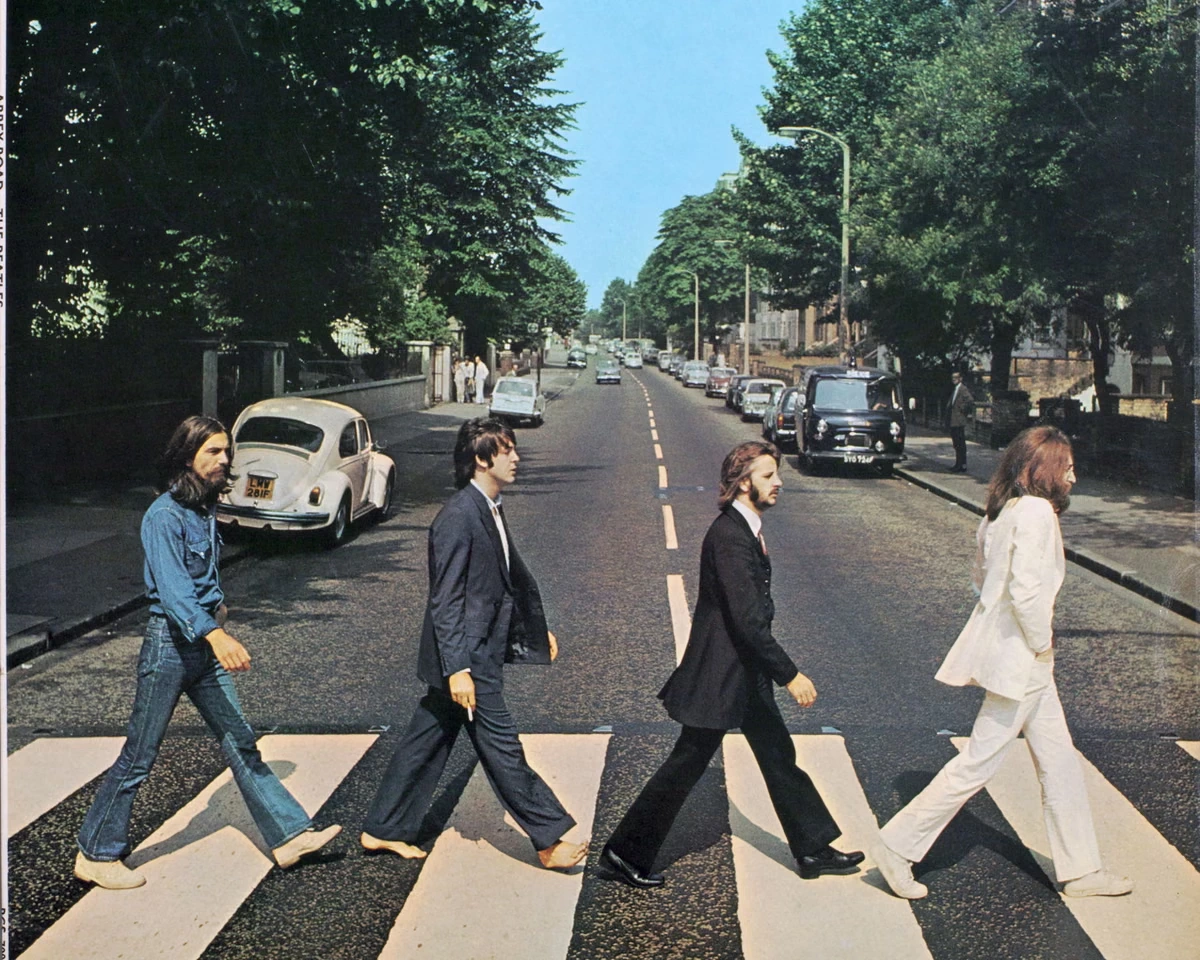
It’s not really the four blokes on the zebra crossing who make the cover of the Beatles’ Abbey Road memorable, but the street behind them. Vanishing towards a perfect blue sky, with summer trees veiling in bright green what might otherwise be dour brick houses, it could be a hyperreal vista painted by David Hockney. The black and white stripes of the crossing and the white line down the middle of the receding north London road are fresh and crisp, enhancing the clarity of this psychedelic daydream.
Of course the four blokes do play a part. The Beatles were so transcendently famous by the time Iain Macmillan took this picture on 8 August 1969 that seeing them do something as ordinary as cross the road becomes a magical mystery.
All the tourists who continue to recreate this photograph, the acts – from the Red Hot Chili Peppers and Kanye West to Franciscan friars and Booker T and the MGs – who have parodied it, as well as Sam Mendes, who this week recreated it for his four Beatles biopics, are hypnotised by its enigmatic marriage of banality and charisma. Just four people on a zebra crossing, but they’re gods!
The Beatles played on the same impossible everydayness months before this picture was taken when they performed live on the roof of Apple Corps in London’s Savile Row in January 1969. These were not just among the group’s last appearances together; they were manifestations against London backdrops of four individuals who had become archetypes.
What Abbey Road freeze-frames with eerie perfection is the dynamic between four individuals and one unit that made the Beatles so appealing: the character of each Beatle coming together, or so fans still wanted to believe, in perfect step, as this photograph catches them.
John Lennon leads, yet seems absent and absorbed: he is the only one whose face you can’t fully see and if he is the pacesetter, he might also be trying to get away. There I go. There’s a self-consciously symbolic quality to this picture that invites you to insert whatever allegory you please. I can picture Lennon walking away because that’s what he told the group he was going to do that September.
But at the time, notoriously, it was Paul McCartney’s bare feet that fed bizarre speculations he was dead. According to this conspiracy theory, the black-clad Ringo Starr is the undertaker and George Harrison the gravedigger.
It’s not such a bad interpretation and answers the picture’s demand to be decoded: surely it must be saying something! But the “Paul is dead” theory was doubly daft since McCartney was the picture’s creative author along with Macmillan.
This was not a photograph taken by chance. It is a piece of conceptual art – something the Beatles were very familiar with, what with Lennon marrying one of the world’s most radical artists, Yoko Ono, that year. After an idea of being photographed in Nepal was rejected, it was McCartney who suggested they just do it in Abbey Road, outside the music studios in north London’s St John’s Wood. His sketches planned out the picture, with the four of them as stick figures on the zebra crossing and a view from above of the tree-lined street. On the day, they got a police officer to stop traffic, and Macmillan stood on a stepladder to get this perspective.
It’s not an accident; it’s art. McCartney started collecting paintings by René Magritte in 1966 and this picture’s combination of a haunting, almost too real perspective and a confounding yet deadpan foreground scene is highly evocative of the Belgian surrealist. These are not the Beatles. This is not Abbey Road.
It is definitely London, though. In these days of national self-loathing the wonder of the Abbey Road cover has to be its celebration of a very British moment. Zebra crossings are British: you know this is London, not New York.
The Beatles are walking into their separate futures, but here McCartney, the most passionate believer in the band, freezes them for ever outside the studios where they’ve worked. He doesn’t want to go anywhere – he’s taken off his shoes.