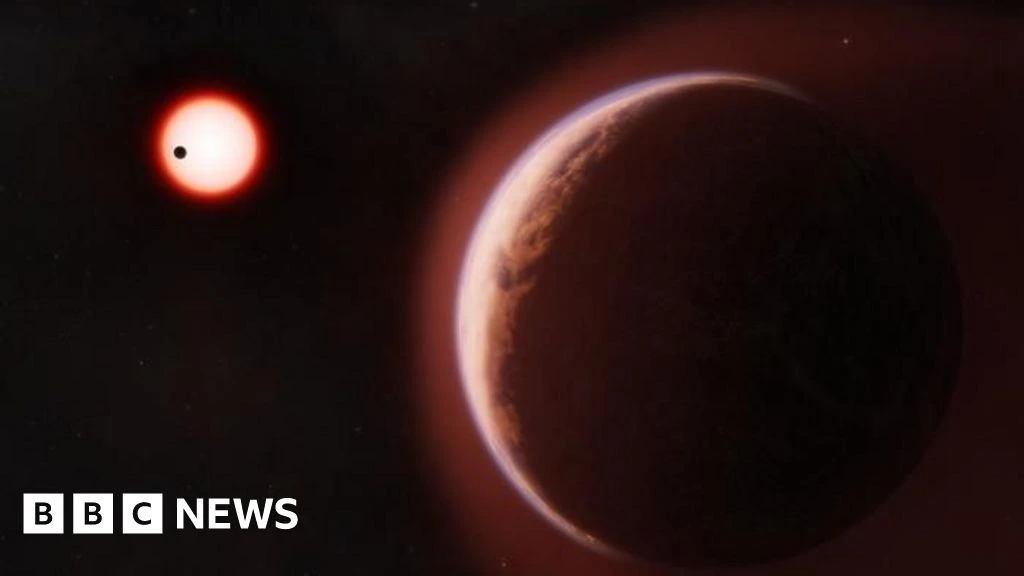
Researchers have found the first atmosphere surrounding an Earth-like, rocky planet orbiting within the habitable zone of a distant star.
Researchers have found the first atmosphere surrounding an Earth-like, rocky planet orbiting within the habitable zone of a distant star.
The researchers say that their discovery provides the strongest evidence yet that worlds with conditions similar to Earth could exist beyond our solar system.
The researchers say that their discovery provides the strongest evidence yet that worlds with conditions similar to Earth could exist beyond our solar system.
The gas detected in the atmosphere is helium, which would not be able to support life, but other gasses may also be present.
The gas detected in the atmosphere is helium, which would not be able to support life, but other gasses may also be present.
The lead author, Dr Collin Cherubim of Harvard University, described the discovery as "a big deal".
The lead author, Dr Collin Cherubim of Harvard University, described the discovery as "a big deal".
"This is the first time anyone has found an atmosphere on a rocky planet in the habitable zone of another star."
"This is the first time anyone has found an atmosphere on a rocky planet in the habitable zone of another star."
The planet, called LHS 1140 b, is 48 light-years from Earth orbiting a red star much smaller and cooler than our Sun.
The planet, called LHS 1140 b, is 48 light-years from Earth orbiting a red star much smaller and cooler than our Sun.
More than 6,000 worlds have been discovered orbiting distant stars. But the new discovery is significant because it brings us a step closer to one of the biggest prizes in science: the discovery of life on another world.
More than 6,000 worlds have been discovered orbiting distant stars. But the new discovery is significant because it brings us a step closer to one of the biggest prizes in science: the discovery of life on another world.
The researchers, writing in the journal Science, are clear – they have not done that, at least not yet. But for a planet to support life it has to have water and for that it has to be the right distance from its star: not too close because it will be too hot and not too far, because it will be too cold – but somewhere in between where it will be "just right".
The researchers, writing in the journal Science, are clear – they have not done that, at least not yet. But for a planet to support life it has to have water and for that it has to be the right distance from its star: not too close because it will be too hot and not too far, because it will be too cold – but somewhere in between where it will be "just right".
journal SciencePlanetary scientists call this the "Goldilocks zone", after the fairy tale girl who was fussy about the temperature of her porridge.
Planetary scientists call this the "Goldilocks zone", after the fairy tale girl who was fussy about the temperature of her porridge.
Hundreds of planets have been found in the Goldilocks zones of their respective stars – but only a few dozen are small and rocky – like our own Earth – which is another tick for a planet's ability to support life.
Hundreds of planets have been found in the Goldilocks zones of their respective stars – but only a few dozen are small and rocky – like our own Earth – which is another tick for a planet's ability to support life.
But none of those have been found to have an atmosphere.
But none of those have been found to have an atmosphere.
Until now.
Until now.
But the only gas discovered in the atmosphere so far is helium, probably in the upper atmosphere, which on its own would not support life.
But the only gas discovered in the atmosphere so far is helium, probably in the upper atmosphere, which on its own would not support life.
But there may be other, more life-sustaining gases, lower down. Dr David Charbonneau, also from Harvard, said that the important thing was the discovery of an Earth-like planet outside of our solar system with an atmosphere.
But there may be other, more life-sustaining gases, lower down. Dr David Charbonneau, also from Harvard, said that the important thing was the discovery of an Earth-like planet outside of our solar system with an atmosphere.
"People are generally interested in the big questions: Are we alone? Is there life beyond the Earth or beyond our solar system? To that end, this study reveals the first atmosphere discovered on a rocky planet in the habitable zone of a star outside of our solar system," he said.
"People are generally interested in the big questions: Are we alone? Is there life beyond the Earth or beyond our solar system? To that end, this study reveals the first atmosphere discovered on a rocky planet in the habitable zone of a star outside of our solar system," he said.
LHS 1140b isn't the only world under scrutiny in the search for life. K2-18b, a sub-Neptune with a possible water-rich interior, made headlines when scientists spotted signs of dimethyl sulphide — a gas linked to marine life on Earth.
LHS 1140b isn't the only world under scrutiny in the search for life. K2-18b, a sub-Neptune with a possible water-rich interior, made headlines when scientists spotted signs of dimethyl sulphide — a gas linked to marine life on Earth.
made headlinesBut a Nasa-led reanalysis in 2025 found the signal too weak to confirm, and showed the gas can form without biology.
But a Nasa-led reanalysis in 2025 found the signal too weak to confirm, and showed the gas can form without biology.
The seven rocky worlds of TRAPPIST-1 remain tantalising, too: Nasa's James Webb Space Telescope ruled out an Earth-like atmosphere on TRAPPIST-1d, while TRAPPIST-1e's data stay frustratingly inconclusive.
The seven rocky worlds of TRAPPIST-1 remain tantalising, too: Nasa's James Webb Space Telescope ruled out an Earth-like atmosphere on TRAPPIST-1d, while TRAPPIST-1e's data stay frustratingly inconclusive.