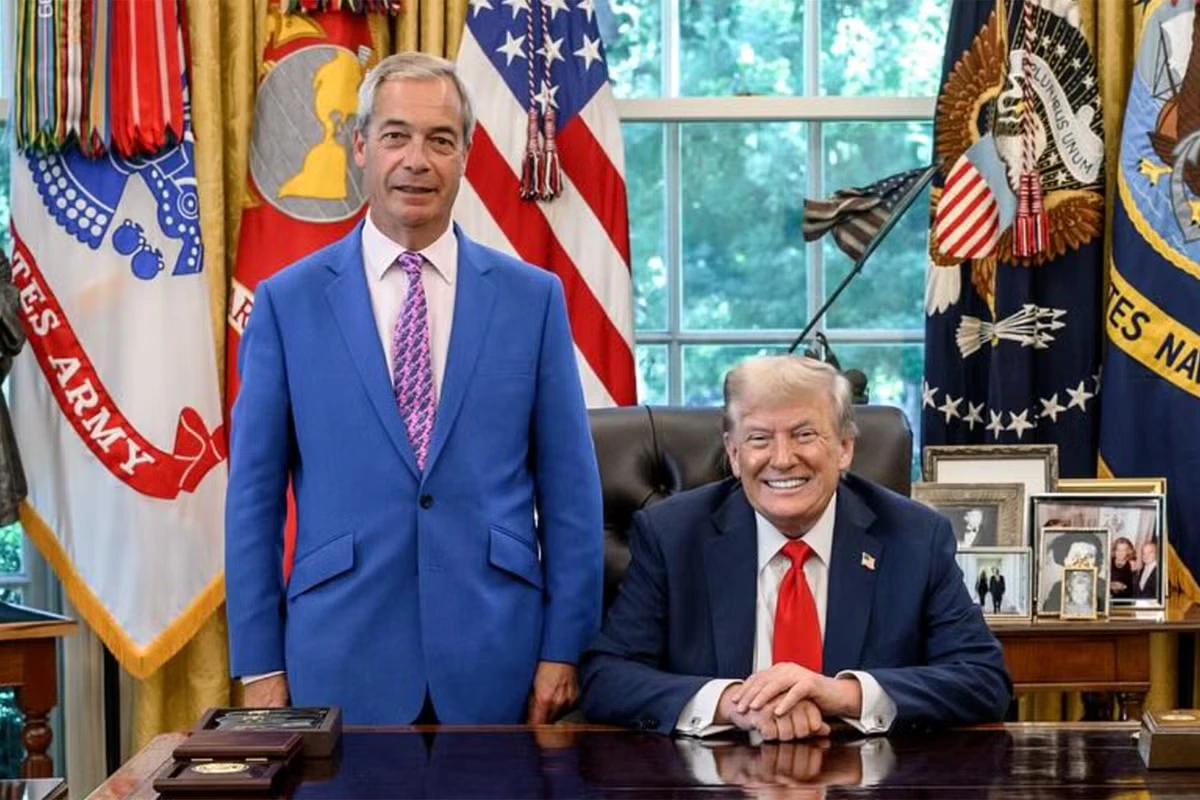
What unfolded on 7 July was unexpected, even by Nigel Farage’s standards. After trailing a statement on his future in public life, he avoided saying anything meaningful. Instead, in a 15-minute speech straight out of the Trump playbook, he baselessly accused the media of harassment, dodged scrutiny around his donations, and avoided addressing any central questions about his political funding.
Something is clearly happening, and it was visible throughout the broadcast. Farage looked rattled, furious even, while his resignation suggests a panic he is desperately trying to gulp down. But having run out of convincing answers, he has fallen back on the oldest trick in the book: flood the zone with chaos, turn your plight into a martyrdom circus by forcing a by-election.
But if this looked like smart play at the beginning – it’s backfiring spectacularly a few days on. And that is because this isn’t our first rodeo when it comes to the politics of victimhood and chaotic game-playing. We are weary enough to know that this particular rabbit gets pulled out of the hat, usually when there is no credible way to escape damaging allegations or even the threat of criminal investigation.
We know from Trump's many tantrums how accountability is turned into persecution; legitimate questions become part of the conspiracy. Far-right actors across the West have learnt from the president, the defining modern practitioner of dummy-spitting politics.
Over the past decade, Trump’s habit of flooding the zone with every toy tossed from his pram has inspired many others to follow his lead. From his attacks on the media during the 2016 presidential campaign to his assaults on investigations into his political and financial conduct, and eventually all the way to the 2021 Capitol riots, Trump has repeatedly shielded himself from accountability with his PR tactics, which amount to PR theatrics.
The historical links between fascist politics and this kind of political martyrdom are not accidental. Figures such as the Italian dictator Benito Mussolini also exploited public anger and political victimhood to justify a politics of revenge.
The message was always simple. The leader, like the nation itself, had been betrayed by a rotten system and had to fight back. Contemporary political martyrdom works in much the same way. It is a form of propaganda that too many politicians and journalists still soften by calling it “populism” or dismiss it as Trump/Farage simply being Trump/Farage. This normalises the performance, making it easier for others to imitate, borrow and recycle the same style.
The pattern has become visible across European politics. Marine Le Pen, parliamentary leader of France’s National Rally, reached for it after her 2025 conviction over European Parliament funds, presenting a legal defeat as an attempt to stop her from reaching the presidency.
Matteo Salvini, Italy’s deputy prime minister and leader of Lega, used the same script during the Open Arms trial, turning the prosecution over a blocked migrant rescue ship into proof that he was being punished for defending Italy’s borders.
Similarly, Geert Wilders, leader of the Dutch Party for Freedom, has taken a leaf out of the very same playbook, labelling hate speech proceedings against him as an attack on free speech and political dissent. In each case, the substance of the allegations is pushed aside and replaced by a misleading story. The leader is not accountable but is under attack. By changing the political weather, they change the story.
And martyrdom works. Even when far-right actors claim to be under attack, they are rarely pushed out of politics altogether. Many remain in power, close to power, or even better positioned to take it. Marine Le Pen is the clearest example. Despite her conviction, this week’s ruling means she can still run for the French presidency, while she has also announced an appeal. During the uncertainty over her future, her protégé Jordan Bardella is keeping the National Rally electorally powerful, framing her conviction as politically motivated. Here, martyrdom shows how easily powerful movements can dodge accountability and turn it into mobilisation, especially when they already have money and a disciplined political machine behind them.
But it is also a playbook that only so many politicians can rely on for so long, and its Clacton version already looks badly botched. This was the moment for discipline and clarity. Instead, the whole thing looks like amateur hour, which is fast descending into a Boaty McBoatface farce.
There is, first, the procedural problem. A by-election will not be enough to make Farage’s troubles disappear. The investigation will continue one way or another. He may have bought himself some time by no longer being a sitting MP, which means the investigation is paused, but that does not change the fact that new details continue to emerge and suggest the situation may be more serious than first understood.
Then there is the political problem. Farage’s decision to trigger a by-election carries an obvious element of political trolling. Quickly, the other parties understood the assignment and refused to walk into the trap. By declining to field candidates in the constituency, Farage is left to compete in a contest that looks like a political stunt, with Count Binface as his most visible opponent. That shows that the party system is currently united against Farage and he is more isolated than ever at a time when Reform has already been falling in the polls. Ultimately, the electorate are sick and tired of political egos wasting their money and time when they watch the cost of living soar and schools and hospitals crumble.
Years of attacks on journalistic ethics have served a clear purpose: to make it much harder for people to be held accountable. But no party can rely indefinitely on legal threats and accusations of harassment as a substitute for accountability. With Prince Harry losing in court, there is a vibe shift. Suddenly, people are waking up to the fact that the journalists may not always be the bad guys. More importantly, it is journalism that exposed the multi-million-pound donations now at the centre of this storm and similarly it was journalism that exposed Angela Rayner’s unpaid property tax. You can’t decide scrutiny is only fair when it’s being applied to one side of the political spectrum. This combative approach always had an expiry date. Based on the latest developments, that date may now be approaching – the public can smell a rat.
Regardless, Farage’s ability to create so much noise, albeit from a one-man band, has meant that, in less than two years, he has pulled his agenda back onto centre stage. However, aggressively playing the victim may also have placed him in a potentially career-ending situation. There is no easy way out of the current crisis. Others have used this tactic more effectively, but it should not be surprising that a political vehicle with a hollow manifesto and little purpose beyond damaging the Conservatives might find itself exposed at the height of its popularity.
Farage helped open this space, but he no longer controls it – Rupert Lowe’s rapid rise, fuelled by Elon Musk’s X, is testimony to that. The result is a toxic algorithmic mix that has handed Restore Britain visibility and a ready-made audience. There is already a more extreme rival waiting to exploit the path he paved. In politics, even martyrs like ‘saint’ Nigel can get replaced.
Dr Georgios Samaras is an expert on the rise of populism in Europe and Assistant Professor of Public Policy at the School for Government, King’s College London