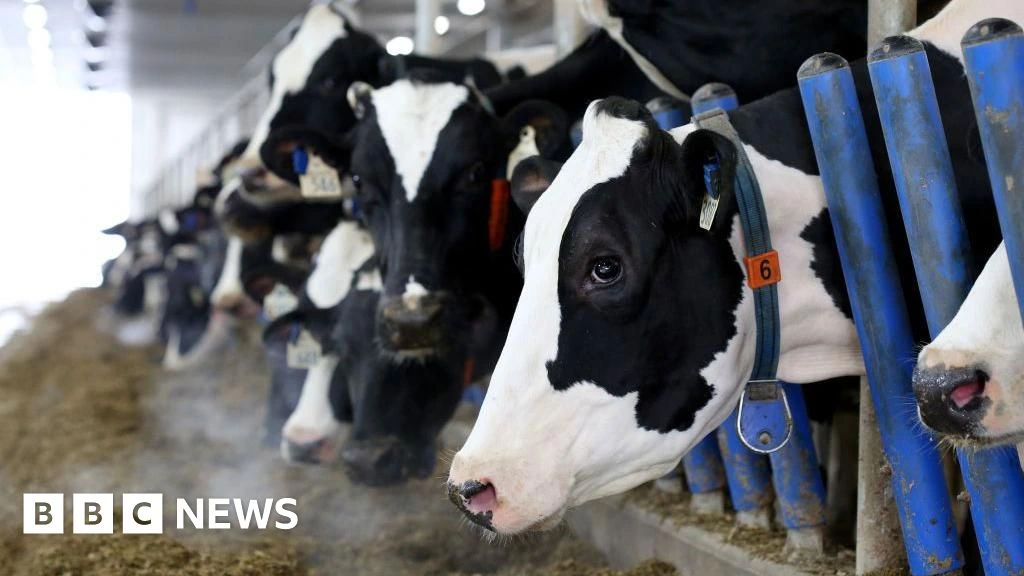
Canada's dairy industry policy is among the most politically sacrosanct in the country. It has also long been a thorn in the side of Donald Trump.
Canada's dairy industry policy is among the most politically sacrosanct in the country. It has also long been a thorn in the side of Donald Trump.
Now, Canada's dairy supply management system is back in the spotlight after the US president singled it out as one of three main irritants used to justify a 50% tariff on $20bn worth of Canadian goods imported to the US, which is set to come into effect in August.
Now, Canada's dairy supply management system is back in the spotlight after the US president singled it out as one of three main irritants used to justify a 50% tariff on $20bn worth of Canadian goods imported to the US, which is set to come into effect in August.
Trump argues the system, which sees production quotas, set pricing, and import quotas on dairy, eggs, and poultry, is "unreasonable" to American farmers who want to sell their product north of the border.
Trump argues the system, which sees production quotas, set pricing, and import quotas on dairy, eggs, and poultry, is "unreasonable" to American farmers who want to sell their product north of the border.
Canadian politicians will now have to decide whether to stand firm on its popular supply management system or risk the ire of the public and a politically "powerful" dairy industry by attempting to fix this issue with Trump.
Canadian politicians will now have to decide whether to stand firm on its popular supply management system or risk the ire of the public and a politically "powerful" dairy industry by attempting to fix this issue with Trump.
So far, they have indicated that dairy is a non-starter.
So far, they have indicated that dairy is a non-starter.
Quebec Premier Christine Fréchette, whose province is home to Canada's largest dairy industry, said on Tuesday that supply management was non-negotiable.
Quebec Premier Christine Fréchette, whose province is home to Canada's largest dairy industry, said on Tuesday that supply management was non-negotiable.
And last week, US-Canada Trade Minister Dominic LeBlanc told the BBC that the system "is a cornerstone of Canada's economy and our rural communities" that "ensures that Canadians have access to high-quality dairy products made by Canadian dairy farmers".
And last week, US-Canada Trade Minister Dominic LeBlanc told the BBC that the system "is a cornerstone of Canada's economy and our rural communities" that "ensures that Canadians have access to high-quality dairy products made by Canadian dairy farmers".
They argue that it supports Canadian farmers and guarantees price and supply stability for food staples.
They argue that it supports Canadian farmers and guarantees price and supply stability for food staples.
Dairy farmers have also been known to stage protests - complete with tractors and cattle on Parliament Hill - when faced with possible concessions in trade talks.
Dairy farmers have also been known to stage protests - complete with tractors and cattle on Parliament Hill - when faced with possible concessions in trade talks.
"It is the most powerful political lobby in the country that stretches across all of the major political parties," said David Clement, a Canadian policy director at the international advocacy group Consumer Choice Center.
"It is the most powerful political lobby in the country that stretches across all of the major political parties," said David Clement, a Canadian policy director at the international advocacy group Consumer Choice Center.
Canada's supply management system has been in place since the early 1970s, and has endured despite other Commonwealth nations, like Australia and New Zealand, phasing out similar policies.
Canada's supply management system has been in place since the early 1970s, and has endured despite other Commonwealth nations, like Australia and New Zealand, phasing out similar policies.
Farmers hold production quotas that limit how much dairy they can produce. Prices are then set by marketing boards in each province, giving farmers a predictable income while providing a consistent domestic supply.
Farmers hold production quotas that limit how much dairy they can produce. Prices are then set by marketing boards in each province, giving farmers a predictable income while providing a consistent domestic supply.
A small amount of foreign dairy is able to enter Canada tariff-free or at low tariff rates under set quota limits. Those that exceed the limit, however, face a levy of 200% to nearly 300%, making it prohibitively costly for both foreign producers and consumers to sell in Canada.
A small amount of foreign dairy is able to enter Canada tariff-free or at low tariff rates under set quota limits. Those that exceed the limit, however, face a levy of 200% to nearly 300%, making it prohibitively costly for both foreign producers and consumers to sell in Canada.
Currently, US producers have tariff-free access to only 3.5% of Canada's market, even as the country is among the top importers of US dairy, buying $1.3bn worth of products in 2025, according to data from the US Department of Agriculture (USDA).
Currently, US producers have tariff-free access to only 3.5% of Canada's market, even as the country is among the top importers of US dairy, buying $1.3bn worth of products in 2025, according to data from the US Department of Agriculture (USDA).
American farmers have long called for greater market access, in part due to a record high dairy production in the US - more than domestic consumption supports. Producers are now looking to sell elsewhere and are eyeing the market of 40 million people north of the border.
American farmers have long called for greater market access, in part due to a record high dairy production in the US - more than domestic consumption supports. Producers are now looking to sell elsewhere and are eyeing the market of 40 million people north of the border.
A White House order, released on Monday, argues that Canada's free trade agreement with the EU makes it easier for European producers to sell their cheese in Canada than the US, saying it amounts to "discrimination".
A White House order, released on Monday, argues that Canada's free trade agreement with the EU makes it easier for European producers to sell their cheese in Canada than the US, saying it amounts to "discrimination".
Supply management has not been only Trump's frustration. The previous Biden administration twice challenged Canada's dairy quota practices under the USMCA, the North American free trade pact at the centre of current talks between the US and Canada.
Supply management has not been only Trump's frustration. The previous Biden administration twice challenged Canada's dairy quota practices under the USMCA, the North American free trade pact at the centre of current talks between the US and Canada.
In 2024, the UK walked away from trade talks over disagreement on tariff-free access for British cheese producers. It has also been criticised by the Organization for Economic Co-operation and Development (OECD), which argues it distorts production and trade.
In 2024, the UK walked away from trade talks over disagreement on tariff-free access for British cheese producers. It has also been criticised by the Organization for Economic Co-operation and Development (OECD), which argues it distorts production and trade.
Even some Canadian economists and pundits have called for it to be dismantled or reformed.
Even some Canadian economists and pundits have called for it to be dismantled or reformed.
"Kill supply management," Calgary journalist and writer Jen Gerson argued in a column published this month before Trump's latest tariff threats, calling it "anachronistic" and blaming it for driving up food prices in Canada.
"Kill supply management," Calgary journalist and writer Jen Gerson argued in a column published this month before Trump's latest tariff threats, calling it "anachronistic" and blaming it for driving up food prices in Canada.
Calgary journalist and writer Jen Gerson argued in a columnClement, with the Consumer Choice Center, wrote last year that the Trump administration "has a point" to say that American farmers are treated unfairly by their northern neighbour.
Clement, with the Consumer Choice Center, wrote last year that the Trump administration "has a point" to say that American farmers are treated unfairly by their northern neighbour.
He also argued that Canada's supply management system had artificially inflated the prices of household staples like dairy and eggs – an issue he said Canadians should be taking note of given the country's current cost of living crisis.
He also argued that Canada's supply management system had artificially inflated the prices of household staples like dairy and eggs – an issue he said Canadians should be taking note of given the country's current cost of living crisis.
"We should get rid of supply management for our own good, outside of any negotiations and trade deals," he told the BBC in an interview.
"We should get rid of supply management for our own good, outside of any negotiations and trade deals," he told the BBC in an interview.
Doing away with supply management, he argued, would save Canadians money while also giving them more choice at the grocery store. It would also help Canada diversify its trade by opening up its market to other countries.
Doing away with supply management, he argued, would save Canadians money while also giving them more choice at the grocery store. It would also help Canada diversify its trade by opening up its market to other countries.
The most recent data shows that Canadians paid an average of C$3.19 ($2.26; £1.69) for 1L of milk in May, while Americans paid C$1.95 for the same amount, according to numbers from Statistics Canada and the USDA.
The most recent data shows that Canadians paid an average of C$3.19 ($2.26; £1.69) for 1L of milk in May, while Americans paid C$1.95 for the same amount, according to numbers from Statistics Canada and the USDA.
Those calling for the end of the current system, however, are in the minority. Around 77% of Canadians support keeping it in place, polling suggests, with Canadians saying they want to protect local farmers and access to high-quality dairy products.
Those calling for the end of the current system, however, are in the minority. Around 77% of Canadians support keeping it in place, polling suggests, with Canadians saying they want to protect local farmers and access to high-quality dairy products.
"I don't want cheap American milk products," wrote Gary Johnson from Ontario to the Globe and Mail in June.
"I don't want cheap American milk products," wrote Gary Johnson from Ontario to the Globe and Mail in June.
"Let the United States send dairy products. I don't think any of us will buy it," wrote Mark Knudsen from Mississauga.
"Let the United States send dairy products. I don't think any of us will buy it," wrote Mark Knudsen from Mississauga.
David Wiens, a third-generation dairy farmer from Manitoba and president of the Dairy Farmers of Canada, argues the framework has contributed to steady prices while protecting "food sovereignty".
David Wiens, a third-generation dairy farmer from Manitoba and president of the Dairy Farmers of Canada, argues the framework has contributed to steady prices while protecting "food sovereignty".
"Dairy prices are actually more stable than many other food categories, and more competitive internationally than people often realise," he told the BBC, adding that prices were determined by a number of economic factors.
"Dairy prices are actually more stable than many other food categories, and more competitive internationally than people often realise," he told the BBC, adding that prices were determined by a number of economic factors.
Wiens noted US consumers also saw the cost of eggs skyrocket after a bird flu outbreak disrupted production, and argued that supply management helped shield Canadians from similar price spikes.
Wiens noted US consumers also saw the cost of eggs skyrocket after a bird flu outbreak disrupted production, and argued that supply management helped shield Canadians from similar price spikes.
Those against supply management attribute the public support to a lack of awareness on a complex trade and supply policy, and say it has become politically risky to propose any reforms.
Those against supply management attribute the public support to a lack of awareness on a complex trade and supply policy, and say it has become politically risky to propose any reforms.
Changing it would likely cost the governing Liberals a number of seats in parliament in particular, said Ryan Cardwell, a professor at the University of Manitoba, who has researched the political support for supply management.
Changing it would likely cost the governing Liberals a number of seats in parliament in particular, said Ryan Cardwell, a professor at the University of Manitoba, who has researched the political support for supply management.
It would also be financially costly, as the government would have to pay out dairy farmers through a compensation package that some estimate to be in the billions.
It would also be financially costly, as the government would have to pay out dairy farmers through a compensation package that some estimate to be in the billions.
"It would be an upfront cost, and of course governments hate that," Cardwell said.
"It would be an upfront cost, and of course governments hate that," Cardwell said.
When phasing out its supply management system, Australia used a temporary milk levy on consumers to fund the transition, while the European Union gradually increased their quotas by 1% annually before formally abolishing them in 2015.
When phasing out its supply management system, Australia used a temporary milk levy on consumers to fund the transition, while the European Union gradually increased their quotas by 1% annually before formally abolishing them in 2015.
But in Canada, Cardwell contends that supply management is likely "not going anywhere".
But in Canada, Cardwell contends that supply management is likely "not going anywhere".