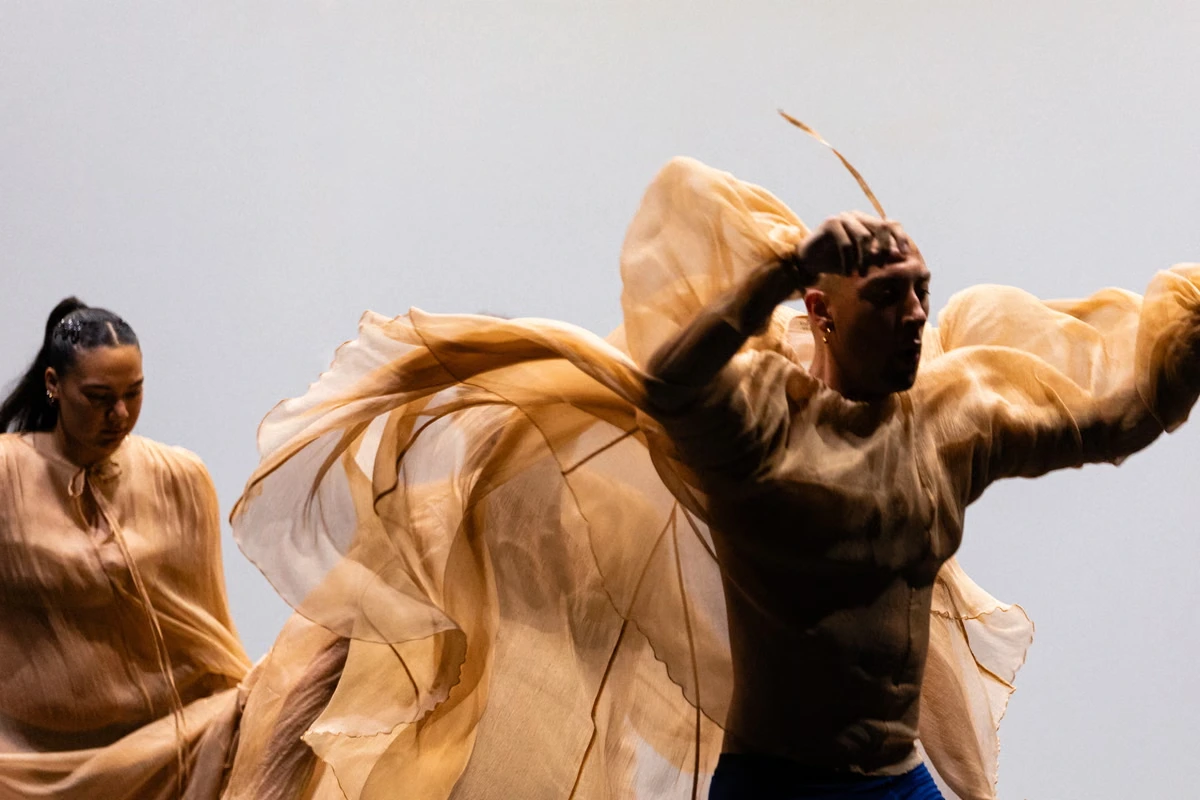
The most memorable performance in the opening days of this year’s Venice Dance Biennale had barely any dance in it at all. Italian choreographer Andrea Salustri’s Invisible is built around movement, but it’s movement of light, air, water and sound waves, with Salustri and co-creator Alice Rende as shadowy figures conducting the elements. They brew up storms like Zeus and Poseidon, with flashing veins of light, sounds of pummelling rain (in fact small drips and bubbles amplified by powerful microphones) and an enormous amount of billowing smoke that ultimately whips itself into a spinning tornado.
Salustri, who won the Italian callout to create a new work for this year’s biennale, is a circus artist and philosophy graduate, and he is also a choreographer – a definition so much wider than one who devises dance. This year marks the 20th dedicated dance festival in Venice (dance was previously seen as part of the theatre or music programmes here until 1999, since when it has been an annual, then biennial, and now annual feature of Venice’s arts bonanza). In a talk to mark this anniversary, current artistic director Wayne McGregor was joined by four former directors to discuss their aims for the event. The question of “what dance is” kept arising as the ongoing line of inquiry, a question “so ordinary that it is still necessary somehow”, said choreographer Marie Chouinard.
A new film, Life Lines, put together by McGregor and filmmaker Ravi Deepres, compiles archive clips from festivals past, showing that the range of dance here has been vast and multifarious, from the fairly conventional to the theatrically wild. There’s clearly no single story of contemporary dance’s development, and McGregor’s theme for this year’s festival is Time Does Not Exist. Influenced by physicist Carlo Rovelli and the theory of quantum gravity, his is not a linear view of time, and without doubt, in dance (and in life), we carry our embodied pasts constantly into the present. That’s no more evident than in Soa Ratsifandrihana’s piece Fampitaha, Fampita, Fampitàna (meaning “comparison, transmission, rivalry” in Malagasy, the language of Madagascar, from where the choreographer is from). It’s a piece about living in the diaspora and concerned with the sometimes joyful, sometimes painful, memories that link back home – especially the memories stored in our bodies, in songs, stories and dance steps. It’s a gentle piece, conversational between the three dancers and fabulous guitarist Joël Rabesolo, in the sense that like many conversations it meanders, then touches on the profound, then gets self-absorbed, connects again, tails off. But it has its moments.
South African Mamela Nyamza is the recipient of this year’s Silver Lion award, for an outstanding emerging artist (the Golden Lion, for lifetime achievement, will be awarded to Aboriginal Australian company Bangarra Dance theatre later in the festival). Nyamza’s work is generally shot through with political activism, although the politics in her piece performed at the biennale, The Herd/Less, is of the quiet kind. A clan of brightly clothed characters arrive on tin-can stilts in rhythmic strides, seemingly a close-knit, cohesive unit. Individuals emerge to fill the role of leader and changes of allegiance seem to happen by stealth rather than force – traditional symbols of status or control including spears and knobkerries are present, but not violently wielded – and the sense of where power lies subtly shifts.
A more straightforward piece of contemporary dance comes from Emanuel Gat, the Israeli choreographer who has been based in France for nearly 20 years. The last of his works seen in the UK was set to the music of Tears for Fears, this one, called Five Days in the Sun, is danced to Mahler’s Fifth Symphony – now that’s range. But if you’re choosing a piece of music as epic as Mahler’s Fifth (a recording sadly; who can afford a live orchestra?), then the question is: what are you going to do with it? In parts, the dance feeds off the music, elsewhere it’s insensitive to it, or entirely uninterested, casually brushing past some of the most exquisite moments in late Romanticism. It’s all deliberate – Gat’s a trained musician, and has spoken before about not choreographing to the obvious beat – but to what end?