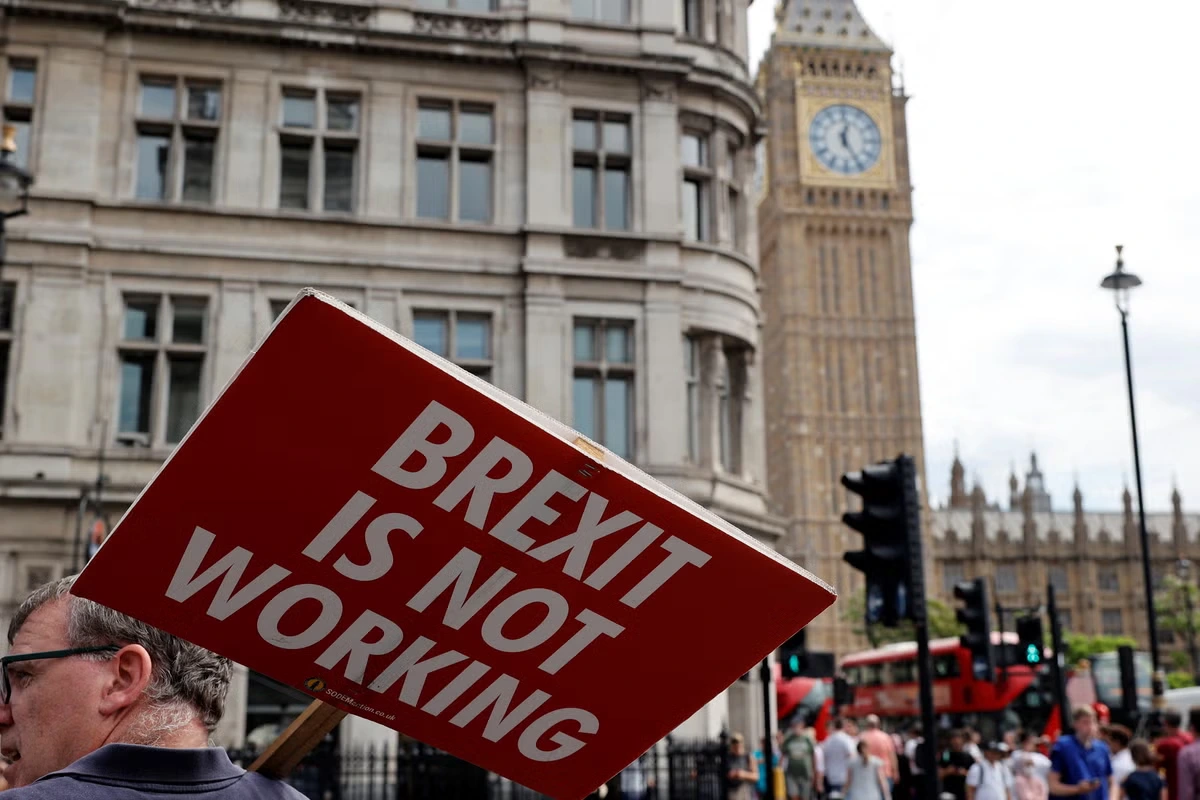
Almost two-thirds of people believe that immigration has got worse since Brexit, a new poll conducted on the ten-year anniversary of Britain’s vote to leave the EU has shown.
The promise to regain control of Britain’s immigration system was central to the Brexit vote, and has continued to dominate political discourse ever since.
Meanwhile, as Sir Keir Starmer – who resigned on Monday – attempted to “reset” relations with the European Union, questions over freedom of movement have been a key part of negotiations with the bloc as Britain attempted to secure a “limited” youth mobility scheme, which would let young people live and work abroad.
The new polling, conducted by Merlin Strategy for The Independent, also found that 55 per cent of people want a return to freedom of movement, while just 16 per cent said they oppose it. It came as former Labour leader Neil Kinnock said, ten years on from the vote, that people are increasingly “feeling the Brexit effects on pockets, purses, jobs and opportunities”.
The poll showed that 62 per cent of people believe immigration levels have worsened since Brexit, while just 8 per cent think they have improved.
Some 4.8 million legal migrants arrived in the UK between 2021 and 2024, a significant rise on previous years, which was influenced by schemes including refugee programmes for Hongkongers and Ukrainians fleeing strife in their homelands, as well as a demand for workers to fill shortage occupations.
The resulting net migration over the period was more than 2.5 million people when emigration out of the UK was accounted for, according to official figures.
The polling, conducted between 18 and 21 June, also saw 40 per cent of people say they would be more likely to vote for a party that promises to rejoin the EU at the next election and 24 per cent say they would be less likely.
This position was even more stark among Labour voters, with 58 per cent saying a pledge to rejoin the bloc would make them more likely to vote for a party, while just 8 per cent said it would make them less likely.
And among Tory voters, 42 per cent said such a pledge would make them more likely to vote for a party, while 32 per cent said the opposite.
Among Reform voters, however, just 27 per cent said a pledge to rejoin the EU would make them more likely to vote for a party, while 47 per cent said it would make them less likely.
Despite the enthusiasm among the general public for a pledge to rejoin the EU, many voters believed that renegotiating Brexit is not a priority for Britain, the poll showed.
While 38 per cent said the government should prioritise a closer relationship with the EU, 50 per cent said there are other more pressing issues the government should focus on right now.
Lord Kinnock said: “10 years after the Referendum and five years since leaving the EU completely, people are increasingly realising that they are feeling the Brexit effects on pockets, purses, jobs and opportunities”.
“They are also recognising that the glib promises made by Farage and other Brexiters were garbage”, he told The Independent.
"Negotiated return to the EU and the Single Market will be arduous and it will take time. But the realities of proximity to the markets, of the condition of the UK economy, and the plain fact that we cannot allow ourselves to be stuck forever as a singular 'middle country’ will bring us nearer to joining again.”
We are campaigning to rebuild Britain's relationship with Europe. Join us here,
Meanwhile, Dr Mike Galsworthy, chair of pro-EU campaign group the European Movement said: “Brits are finally beginning to understand the unique benefits of Free Movement. Ten years on, they recognise that it is a mutual arrangement, giving valuable rights and opportunity to all who sign up.
He added: “There is also an awareness that with Brexit, the short-term talent circulation with Europe stopped and declined, so the government had to hunt further afield to fill gaps, inviting non-EU immigration that is more likely to settle down and bring family members.
“That is, structurally, not what Brexit voters wanted. The offer to re-open immigration that is closer to home, more temporary in flavour and more mutual in benefits, for youth in particular, now suddenly looks more attractive.”
Sir Keir Starmer, who resigned on Monday, had put a “reset” of relations with the European Union at the heart of his premiership.
He promised to undo some of what he described as “deep damage to our economy” inflicted by Brexit, but also set red lines: the UK would not rejoin the EU, the customs union, or the single market, and there will be no return to freedom of movement.
Following his resignation, with Andy Burnham widely expected to take his place, there are now question marks over what Britain’s future relationship with the EU will like look, and whether those red lines would still stand.
Merlin Strategy spoke to 2001 adults in Great Britain between 18 and 21 June.
Sign up to our free Europe: The Way Back newsletter here
What you will get by joining:
There are even more benefits if you subscribe for just £1 for seven months: