Kim Jong-il loved pepperoni pizza. Saddam Hussein couldn’t resist a fish barbecue. Idi Amin reportedly had the capacity for an entire roasted goat. The menus may have differed, but the appetite was the same. For history’s most notorious strongmen, the dining table doubled as a stage for power. For the cooks who served them, every meal came with extraordinary stakes. “It goes back to Hannah Arendt’s banality of evil a bit,” says director Andrew Neel. “These everyday things that are beloved to us, like food, can take on an entirely different dimension within the context of a dictatorship.”
In his latest film, How to Feed a Dictator, which premieres at the Tribeca film festival this week, five private chefs recount their intimate experiences serving some of the world’s most feared dictators and the ever-present dangers that came with the job. Based on the 2020 book by the Polish journalist Witold Szabłowski, the 95-minute documentary probes the fraught terrain between morality and survival, asking viewers to consider the choices these chefs made – and the choices they never really had. Structurally, the film is something of a tasting menu, serving up sobering morsels of human atrocity within the trappings of a decadent cooking show. It makes for especially uneasy viewing on an empty stomach.
Much like the menu on offer, the perspectives vary wildly. We meet Keo Samoun at the unkempt gravesite of her former boss, the Cambodian dictator Pol Pot, laying out a spread of fish, fruit and rice for a man she still regards almost as a god. Famed pizzaiolo Ermanno Furlanis, by contrast, recalls the terror of making pies for Kim Jong-il – his life under surveillance, his passport under guard, the state apparatchik who barged into his kitchen to ensure the olives on one pizza were spaced just so.
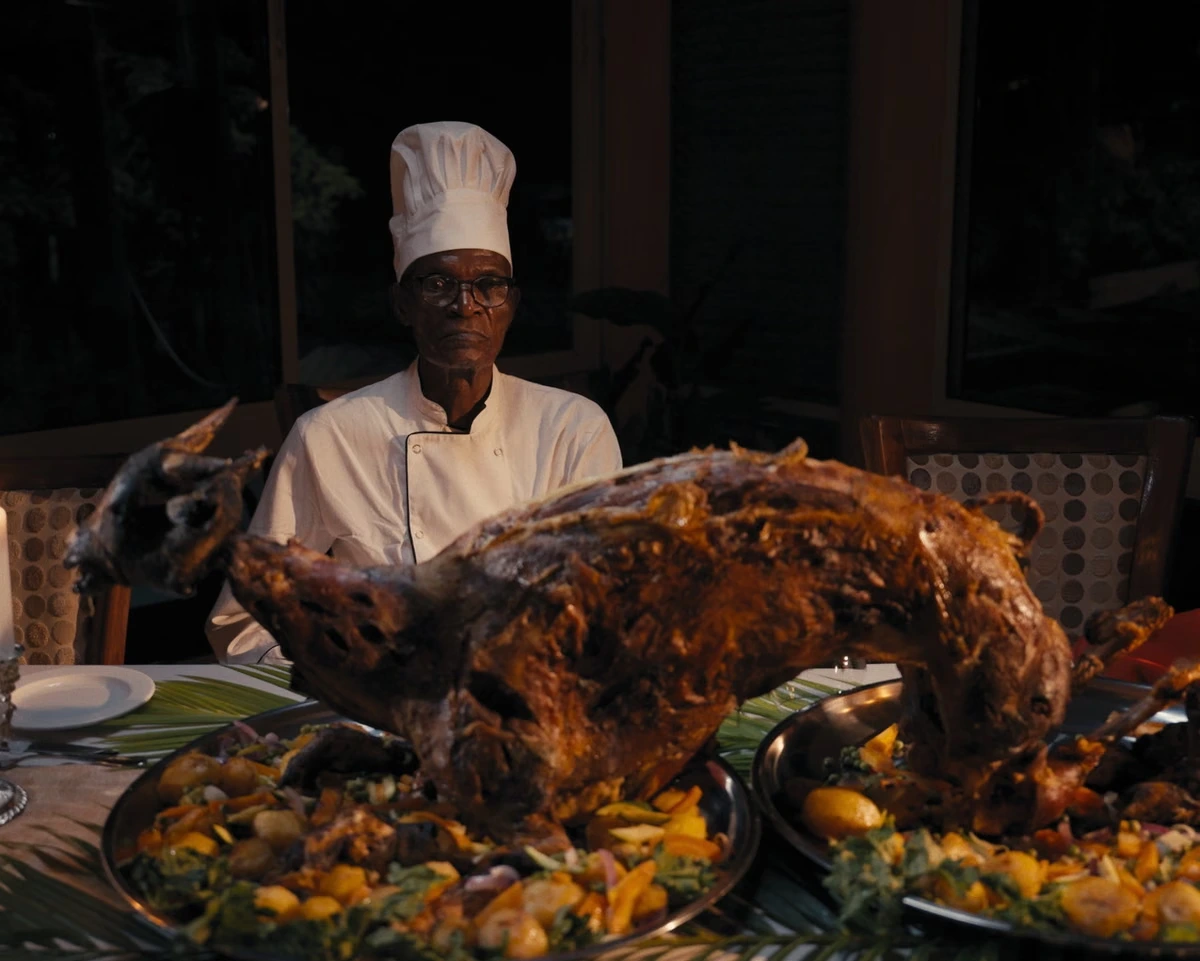
No chef is as tormented by their service as Ugandan Charles Otonde Odera. He describes his early days working for Ugandan despot Idi Amin as life-changing – a poor villager scraping by one day, and the next driving a Mercedes, supporting eight wives, and living in extraordinary comfort as Amin terrorized and brutalized the local masses. For all the chefs, comfort was the trade. By most measures, theirs was a great gig – logic that can excuse almost anything. “Saddam’s chef got a car every year,” Neel says. “That phrase, ‘it was a great gig,’ I think, actually runs the world. Like, ‘It was just business.’”
It wasn’t until Amin’s second wife, Kay, was found dead in the trunk of a car, amid rumors he had her killed for taking a lover, that Odera began to reconsider the bargain. “I missed my low wages from before,” he says in the doc. “At least my heart was at peace.”
Odera characterizes Amin as “a man of great appetites” who appeared to delight in how speculation of his supposed cannibalism upset Uganda’s British interlopers, reinforcing the image of a ruler beyond both convention or restraint. (Amin famously denied the hearsay, insisting human flesh was “too salty”.) Odera remembers being ordered to cook a human heart, with Amin telling him that eating someone’s heart prevents their spirit from haunting you. His career took another dark turn when one of Amin’s children suffered a stomach ache after a meal, an innocuous incident that nonetheless earned the chef a death sentence.
As Odera shares these harrowing memories, he prepares a roasted goat with a team of cooks. In How to Feed a Dictator, images of animal butchery and state-sanctioned violence are deliberately paired. One can only imagine the discomfort of the crew filming all this sumptuous food, caught between the sensory pull of what was in front of them and the carnage it was set against.
“The food does get cold when you’re designing for shots, and we didn’t get to try everything,” Neel says. But he does offer praise for Samoun’s fish dip, a Pot favorite, and for masgouf – the grilled carp dish that Hussein reportedly could not live without, and which ultimately helped lead US forces to him after his regime was toppled in 2003, when he was found in a spider hole in the desert.
For those who may wonder what stops a chef from playing the hero and poisoning a dictator, the film implicitly makes clear: the thought never occurs. Entry into a dictator’s inner circle requires a level of deep trust that also ensures distance from those on the outside. “There was plenty of food where I was,” says Furlanis, recalling how his Italian grocery orders would arrive in the Hermit Kingdom within days. When he suggested sharing some of his food surplus with starving North Koreans – many of whom were reportedly subsisting on grass and tree bark – his offer was swiftly rebuffed. “A cook only needs to cook,” says Odera, the Ugandan chef. “There is no other story.”
Samoun, Pol Pot’s former cook, simply cannot reconcile the man who arranged her marriage, paid for her wedding and gave her away with the architect of a genocide that killed an estimated 1.5 to 3 million Cambodians in four years. In the film’s most charged moment, one of Neel’s translators challenges her account, recalling his own experience of being beaten and tortured by the Khmer Rouge.
“She wasn’t really answering the question,” Neel recalls. “And I said to [the translator], because I knew his history, ‘You need to tell her what happened to you.’ Everyone wants to be respectful. Everyone wants to forget things, even the people who went through it. This is the awful lineage that dictatorship leaves: people who were brutalized by the regime living their lives next to people who benefited from it.”
The dissonance appears to bring Samoun to a breaking point. “Even though he made mistakes, it couldn’t all be bad,” she says, weeping.
All the while, Coco Pacheco – Chile’s Emeril Lagasse – remains unwavering in his devotion to Augusto Pinochet. He keeps one of Pinochet’s star-studded peaked caps under glass, treasures photographs of their days together and memorializes his military coup in Chile as a brave stand against the spread of communism. He prepares a table of his late boss’s favorite foods, lays out an empty setting and toasts him. “We never talked politics,” Pacheco says. “It was all family. I laughed with him a lot.”
As for the tens of thousands Pinochet killed, tortured and forced into exile, Pacheco treats the subject with all the gravity of an omelet ticket. “He had to give the orders he didn’t want to give,” he says. “That’s life.”
Hussein’s ex-chef is similarly loyal, calling the president who used chemical weapons against his own people “the father of Iraq,” and likening his execution after trial – carried out on Eid, of all days – to a death in the family. The chef speaks under a pseudonym and appears on screen as a black silhouette, his anonymity preserved more out of fear of Hussein’s enemies than of any relatives or former allies. “His body was changed, his voice was changed – we wanted to make sure that some of it couldn’t be reverse engineered with AI,” Neel says. “One thing I really liked was the idea that he was just a hole. We went for this full black shadow because he can’t say any of that stuff in public. In a way, for me, Saddam cut him out of the world.”
How to Feed a Dictator rests on a central idea: that people help make dictators as much as they help unmake them, and that the chefs who sustain these regimes are just culled from the herd at the end of the day. Watching it, one is reminded of a certain American president drawn to authoritarian figures past and present, and to the performance of strongman politics itself – even if his taste for fast food and Diet Coke sits uneasily alongside the dictator’s more refined palate.
Neel did give some thought to including Donald Trump in his film – even though, “to be clear, he is not a dictator,” he says. “He wants to be one, but he’s not. I did find a chef who cooked for him before he got elected. But after Trump got elected, the chef disappeared. He wouldn’t talk to me anymore. Why? He was probably scared of hurting his job. He probably had a great gig.”
-
How to Feed a Dictator is premiering at the Tribeca film festival and is seeking distribution