The tawdry routine of everyday misery of cold, darkness, and fear that grinds at the human soul that is Vladimir Putin’s strategy of attacking civilians across Ukraine could break the country’s will to fight on. But it’s unlikely.
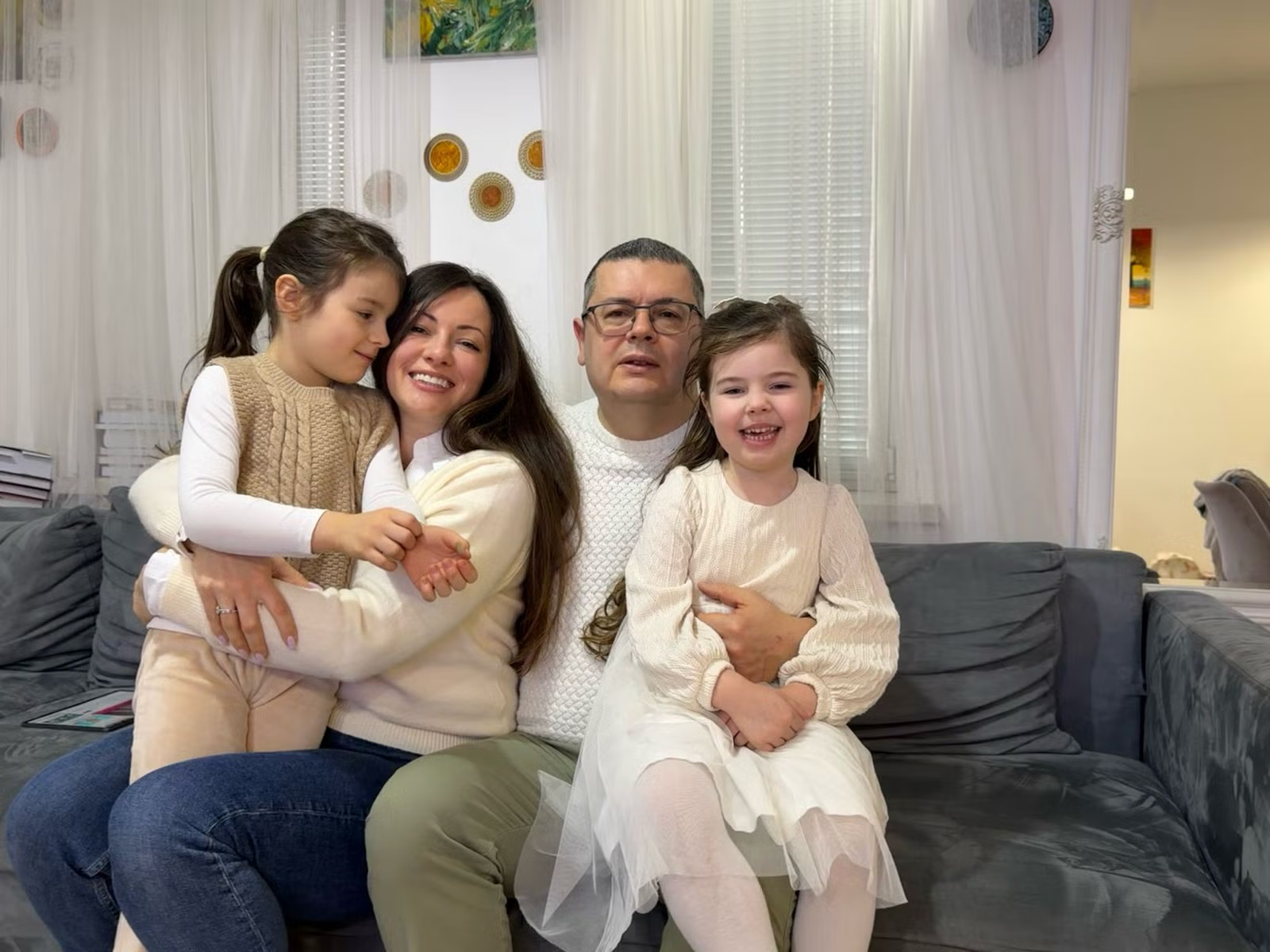
Showers in darkness, a shave in cold water every morning, two small children who know the Russian president is trying to kill them, and dawn coffee and cocoa runs to a streetside stall the only morale booster for a new day. These are the routines of Kyiv residents like Oleksandr Morezhko. He knows he is lucky.
His four-year-old daughter Sophia is the same age as the full scale invasion of Ukraine. The elder, Lilian, is seven so neither have known a world in which Russian troops are not fighting inside their country.
Sophia can tell an outgoing missile blast from an incoming Shahed drone attack. She attends kindergarten. Her older sister has learning difficulties, so Sophia grabs her hand when the sirens scream and the air buzzes with what the family calls “bees” – incoming drones.
She then leads her sister to safety in the Soviet-era bunkers outside their old but untargeted ground floor apartment where school carries on.
“For them it’s normal. They cannot imagine their life without it,” Oleksandr explains. “They know that when they go to the kindergarten we still don’t have power in the flat. When they come back there is no power. They have learned how to play using little lights and how to play in darkness.
“Better than adults I think, children are more adaptable. And they never complain.”
A couple of weeks ago what he thinks was a Shahed drone smashed into the top floors of the building next door, setting fire to two flats and injuring three people in the Kremlin’s ongoing campaign. Fragments, bits of plastic and yellow foam of the Iranian-designed autonomous plane loaded with 40kg of explosive, still pepper the snow outside the building – where this member of Ukraine’s parliament has lived with his family for four years.
“We almost bought a flat in the new high rise but we could not afford it so bought on the ground floor next door – luckily for us – just before the full scale invasion of February 2022,” says Oleksandr, who is chairman of the parliament’s foreign affairs committee.
A former human rights lawyer married to an academic, he can bring warm food to his small children from the parliamentary canteen. His cooker at home is electric and they’re unlikely to get power for more than a couple of hours in 24 – and usually after midnight.
Roughly half of Ukraine’s power generating capacity has been destroyed by Russia. Most of these attacks have come since Donald Trump ended military aid to Ukraine last year – in the 36th month of the full scale invasion by Russia. Two thirds of its nuclear capacity has fallen and GDP is expected to take a three per cent hit.
“I started to plunge into kind of depression and apathy because when it’s cold, when for the whole day you cannot even warm up food, and it’s dark, and it’s cold – it is difficult psychologically and for me, for many people.
“It looked endless, you know, just endless. And everything came at once, this cold weather which we haven’t had for years since the full scale invasion, this darkness,” says Oleksandr, warming his hands on a mug of green tea.
When power does come, usually between one and two in the morning, he likes to stay up with all the lights on just to recharge his psychological batteries. Millions of other Ukrainians go through the same experiences every night. They have done so for months.
They are all fed up with lofty “pompous” phrases about plucky Ukrainian “resilience”, which he calls the “adaptation that has been forced upon us”. It is clear why he thinks Putin has focussed so heavily on civilian targets and energy systems.
“He realised that he cannot win on the battlefield. And he decided to focus on our critical infrastructure and to create conditions which are uninhabitable in which you cannot live.
“That’s his goal. To break to our defiance – to make them more submissive to his peace plan,” says the MP, a member of Volodymyr Zelensky’s ruling Servant of the People Party.
He goes on to explain that Putin’s scheme will not work because “historically it never worked. If you take the example of the Blitz, for example, it didn’t work. If you take Sarajevo as an example, you cannot do it by bombing and killing the civilian population. You cannot make people more receptive to the capitulation, to surrender this way”.
The US under Trump has been pushing Ukraine to accept the loss of all of the territory now held by Russia in Ukraine, roughly 20 per cent.
Moscow insists it will not consider a deal that does not give it further control over all of Donetsk province and the “fortress belt” which has held back Russian assaults for more than a year and where Nato estimates over 400,000 Russians have been killed or injured.
Both Russia and the US have claimed, wrongly, that Zelensky lacks a democratic mandate, they demand that he seek re-election.
Putin’s focus on civilian attacks is an obvious attempt to drive Ukraine into a deal that Europe, the UK, Canada and many other allies see as a capitulation.
Oleksandr sees the Russian/US demand that Ukraine give up on territory as an obvious ploy to cause internal divisions – many Ukrainians are bitterly opposed to any concessions and all are opposed to giving up their defensive line.
“Doing so could split us apart,” says the MP – and anyway territorial concessions are not in the gift of the government, or parliament; they would require a national referendum under Ukrainian law.
Nato intelligence officers have repeatedly said that Ukraine’s immediate challenge is to get through the winter.
European aid to Ukraine, including the UK, is estimated by the Kiel Institute to be worth €380 billion, including all pledges compared to the US contribution of a little over €115 billion – far short of the mendacious €350 billion claim made by the Trump administration.
Nato intelligence estimates suggest that it would take Russia many years to capture the extra territory that it demands as part of the latest “peace process” with US mediating.
“Putin’s logic is ‘first peace treaty and then ceasefire’. So while we’re negotiating he can ruin the country he can continue to destroy critical infrastructure,” says Oleksandr.
“And Trump has has agreed to this logic and that’s why it’s not going to work. It’s not going to work. For us, the biggest issue, and it’s our absolute red line, is withdrawal of our troops from Donetsk.
“We will never agree to that. We just can’t. It’s absolutely out of the question.”