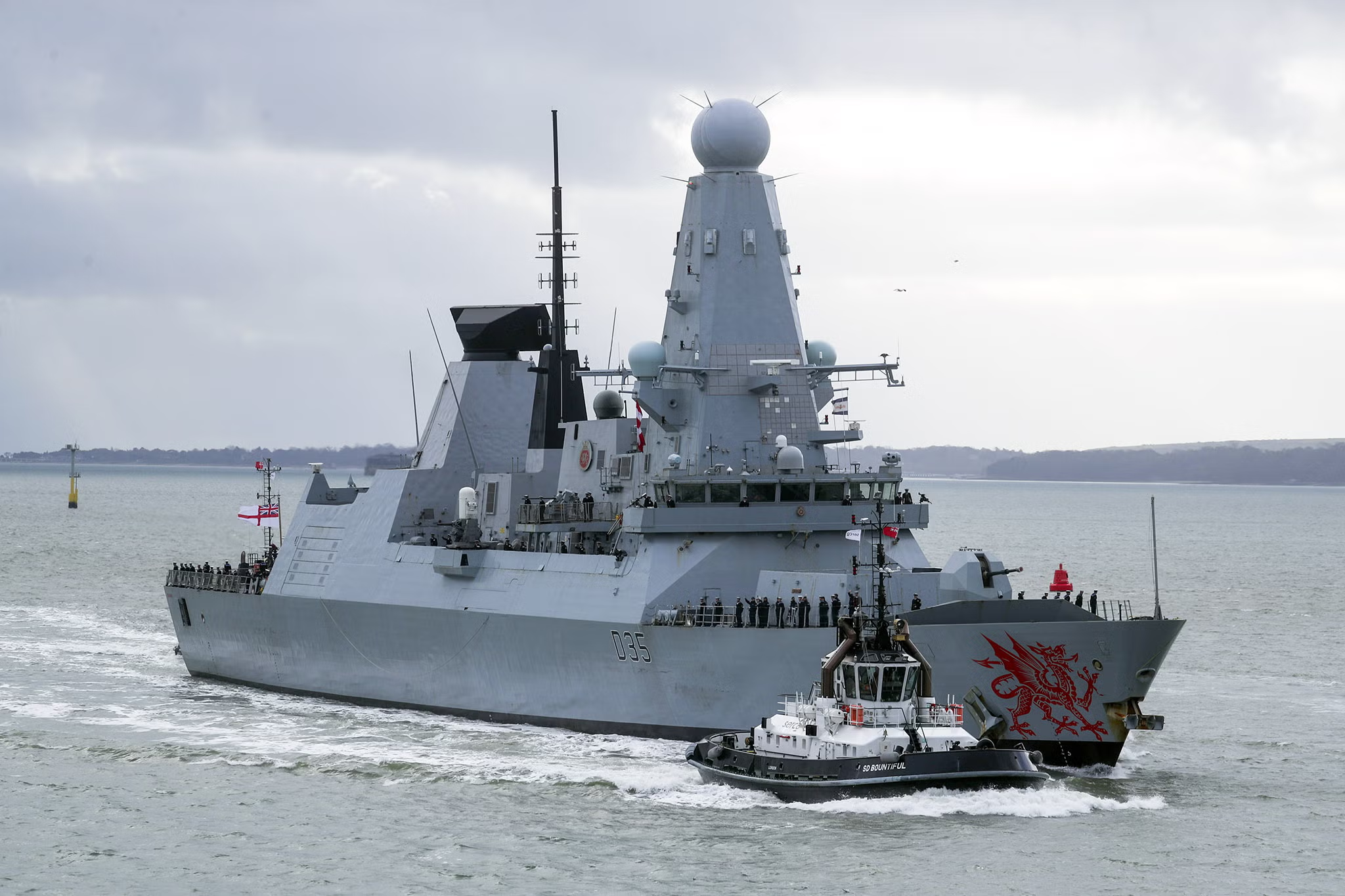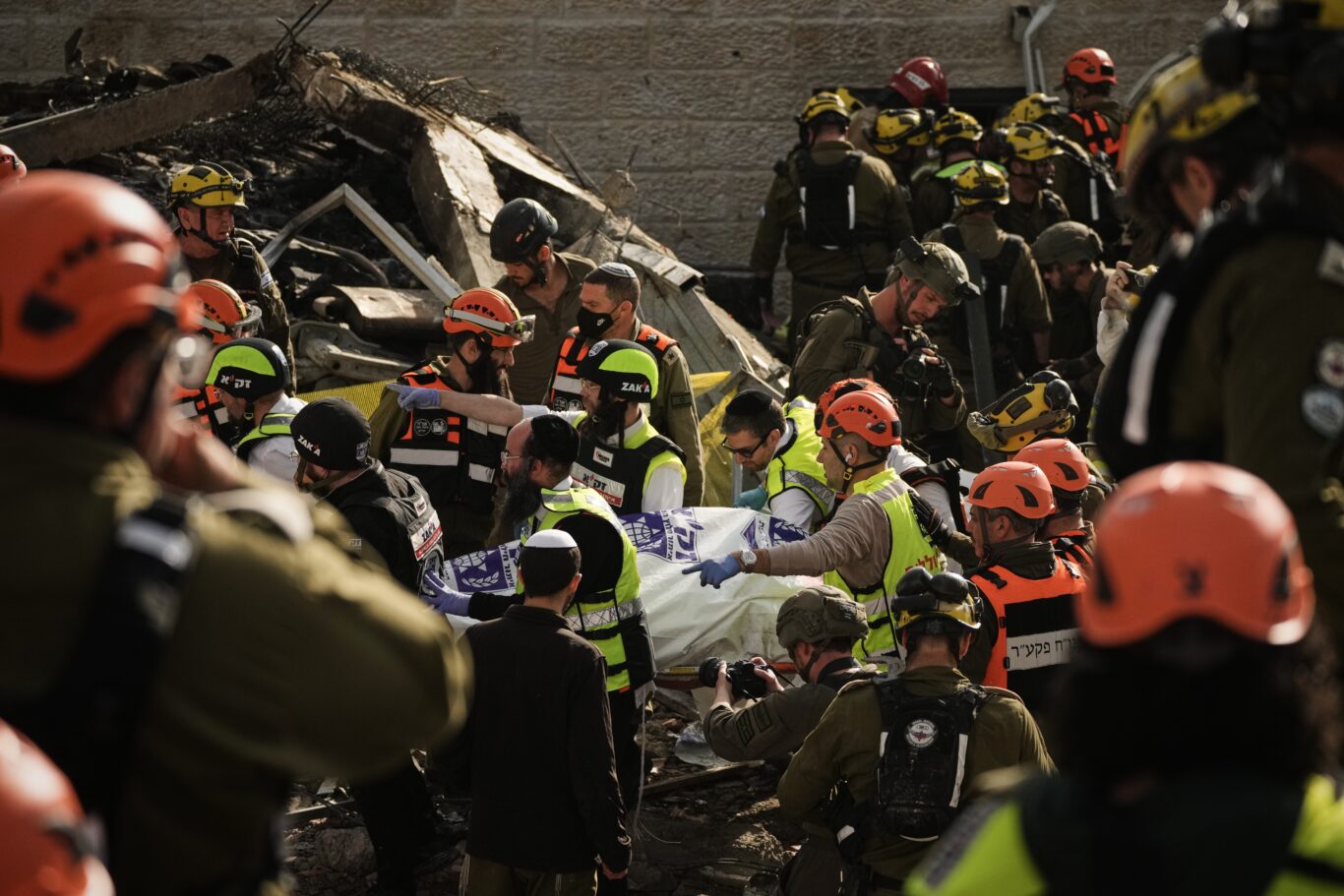
The sirens were blaring in the morning as we approached the site of Iran’s deadliest attack on Israel so far. They must have done the same less than 24 hours earlier, minutes before the ballistic missile razed a synagogue and the neighbouring housing, killing 11 and wounding dozens of others. This time, the residents were able to emerge from the shelters soon afterwards, three audible but relatively distant booms indicating that the incoming fire had been blocked by missile defences.
Yesterday had been a very different story. Looking across the tottering slabs of dislocated concrete and mangled masonry that had once been the heart of this close community in the central Israel city of Beit Shemesh, you could see the large, shallow depression in the ground that marked what had been the public shelter under the synagogue.
The missile somehow evaded Israel’s formidable air defences. For all their precision, they cannot stop everything.
Among the dead – including three teenage siblings as well as a mother and son – there were several who had sought safety there. The sheer force of Iran’s half-ton ballistic missile meant that they did so in vain.
As civil servant Mordechai Shadi, 42, who lives directly opposite one of the destroyed houses, put it: “The shelter can protect you if the missile lands nearby, even next door. But not if it’s a direct hit on the building you are in.”
It’s representative of majority opinion in Israel that the devastation did not shake Shadi’s faith in the war on Iran started by Donald Trump and Prime Minister Benjamin Netanyahu, even while mourning for his close friends and neighbours. The shockwaves from the blast had not just smashed windows up and down the street but made gaping holes in his own roof by dislodging many of its red tiles. It did the same for houses as far as 200 metres away.
But Shadi, whose kippa showed him to be one of the 80 per cent of Beit Shemesh’s population who are religious Jews, said of the onslaught: “It’s right that Iran was attacked. There was no other option. If we’re not going to do it, what’s going to be tomorrow?”
He was hardly alone; a few doors down a secular neighbour, electrician Dror Azulai, 50, who also had friends among the dead, agreed: “It should have been done a long time ago. [Iran] is a country that threatens the world.”
What remains less clear is how near the neutralisation of that perceived threat is to being achieved – or at what cost. This applies whether the aim is to topple the regime in Tehran or end its nuclear programme, once and for all.
As usual, the signals as to which course is actually being pursued have been mixed; Trump, without using the actual term, seems to think it’s the first; his defence secretary Pete Hegseth said on Monday that it was confined to the second.
Either way, the opening days of the war were a major success from the US-Israel alliance’s point of view. The intelligence which identified the whereabouts of the octogenarian Ayatollah Khomeini and some of his most senior officials – and which brought forward the timing of the war from its originally planned nighttime schedule – led inexorably to the “decapitation”, to use the term beloved by strategic analysts, of not just the Supreme Leader but several of his most senior military and governing officials, albeit very much not all.
For their part, the Iranians’ retaliation against Israel, backed as it was not last year by attacks on US bases and a surprising number of other targets in Arab Gulf states, has been more random and apparently less strategic than it was during the 12-day war.
But it has certainly succeeded in confining millions of Israelis in safe rooms and bomb shelters for much of the last three days, as well as shutting schools.
It’s already clear that the Iranian regime had been as prepared for war as it could be after the depletion of its military resources last year. Khamenei had already set in motion a potential succession process, leaving as interim leader the National Security Council head Ali Larijani, who says he will not negotiate with the US. Certainly there is as yet no bankable evidence that it is moving towards surrender.
The question, then, is not only of outcome but duration. Trump, who can rarely resist the temptation to punt a figure whether or not it has any basis in fact, has now said it will take “four weeks or less” for the alliance to reach its goals.
But Amos Harel, Haaretz’s astute military analyst, wrote of one potential difference between president and prime minster. Netanyahu would like to “go all the way” by toppling the regime and changing the regional balance of power. Trump normally “doesn’t like long wars” – with good reason given the doubts about their wisdom even in Maga circles.
For Netanyahu it’s easy to see that the end of the Iranian regime, however desirable in itself, would help to shore him up against the prospects of a defeat in this election year. Voters still blame him for allowing the October 7 murders of 1,200 Israelis by Hamas to happen three years ago. But for the war to last long enough to meet his ends he needs the continued material support of the US. Which is why Trump’s choice will be the deciding factor.
Back in Beit Shemesh yesterday Gili Perez, 50, landlady to the tenants living in the house next door to Shadi’s, took a slightly more nuanced view. Yes, she was sure that it was right to start the war and that the problem was that “you can’t talk to them [the Iranian leadership] – they’re so crazy”.
But she would still probably prefer a negotiated end if the alternative was a forever war. “People can’t go out of their houses half the time. The schools are shut,” she said, adding that her own 16-year-old son had been reduced to sleeping in their shelter. “We’re used to everything in Israel, but three years of war is enough.”
The war is indeed popular among the Israeli public at present. Whether that public is ready to pay the price that it might exact, especially if Netanyahu actually takes the time needed to bring his own moment of triumph, is another question.